
At The New Atlas of Digital Art – Immersive Frontiers in Milan last June, hosted by MEET, the term “immersive” is not treated as a trend but as a production reality: works are judged by their ability to hold attention, translate across venues, and remain legible under shifting technical constraints and visitor flows. In that landscape, Sebastiano Vitale stands out as a profile shaped less by a single medium than by a consistent obsession with scale. Artist and producer, he operates through FLOW Productions, presented as an international network dedicated to large-scale entertainment and immersive exhibition projects.
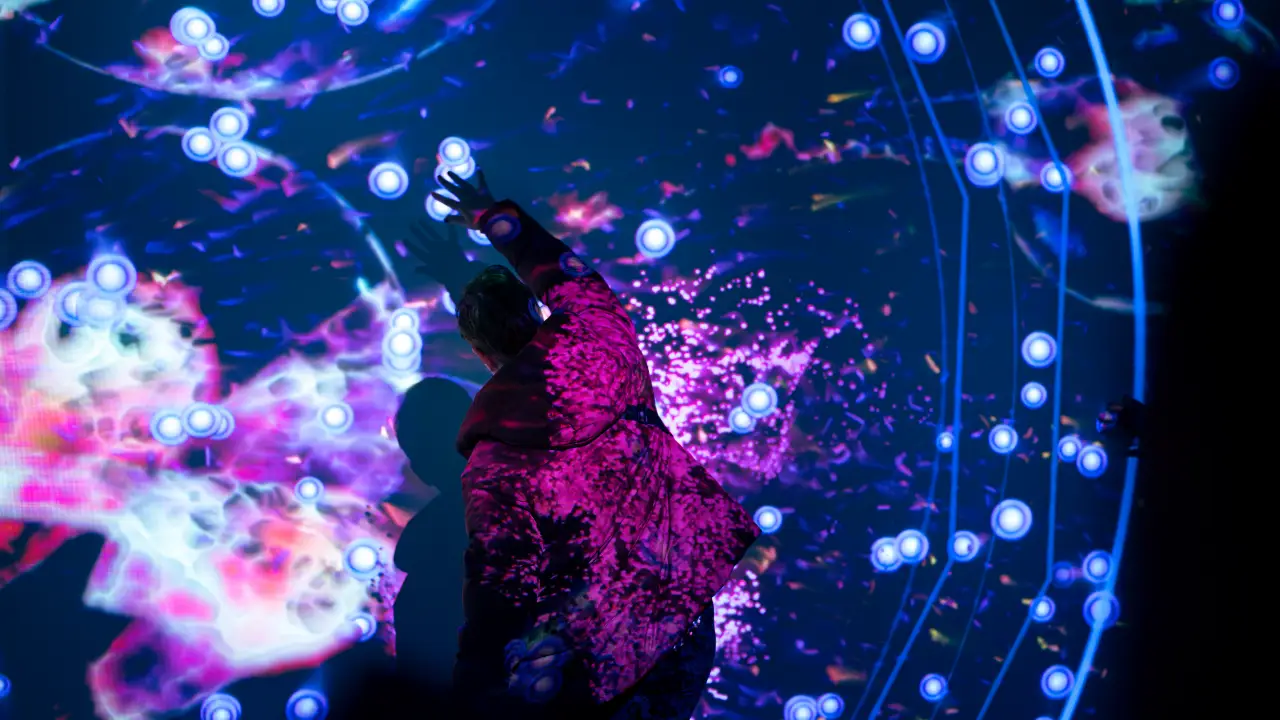
With INTO THE MIND OF AI (a co-production with High Files, a collective of media artists based in Torino), Vitale approaches artificial intelligence as a cultural object rather than a tool to demonstrate. The project is framed as an immersive journey narrated in the first person by a fictionalized AI entity, and designed for touring contexts rather than a one-off installation. What makes the work relevant right now is not the theme alone – AI is everywhere – but the production choice behind it: turning an abstract subject into a narrative presence capable of surviving exhibition realities, from indoor rooms to urban-scale LED façades.
Cover: INTO THE MIND OF AI @ Next Museum Bilbao
A large-format trajectory built on international production and calculated risk
Vitale’s relationship to digital art began before XR stabilized into an industry. In discussion, he states his early practice in the late 1990s “new media” era, when net art and web art were still unstable categories and artists often had to invent both language and logistics. He describes that period as one of “gigantic installations” produced around the world by small teams operating with a mix of audacity and improvisation.
The defining element here is not a nostalgic origin story, but a production DNA: large-scale work as a method. Vitale also acknowledges the cost of that method—moments when scale outpaced readiness, and the weight of massive projects could become destructive. He evokes the pressure of oversized productions connected to Olympic ceremony environments, suggesting that early exposure to such machinery can push artists either into retreat or into a deeper understanding of what scale demands.
A long detour follows—photography and documentary formats that can be carried more lightly—before a return, roughly a decade ago, to “massive productions.” In his account, the return is enabled by a structural change in the field: immersive and large-format digital work now has venues, partners, and production expertise that make touring and repetition more feasible.
FLOW Productions is positioned publicly as the operational extension of that trajectory. The company presents Vitale as a creative with more than twenty years of experience, with projects across Europe, the United States, China, the Middle East, South America and Africa, spanning museums, institutions, brands and major public platforms. This combination—international circulation, large-scale delivery, and artistic authorship—places him in a category closer to artist-producers than to artists who “enter immersive” occasionally.
INTO THE MIND OF AI: a narrative strategy against the “technical lecture”
The project’s starting point is described as immediate: Vitale links the impulse to experiment with generative image tools—specifically the first contact with Midjourney—and to a familiar feeling of cultural rupture, comparable (for him) to the early internet. Rather than building a work that showcases AI-generated aesthetics, the choice is to build a work that uses AI as a narrative problem: what happens when an intelligence becomes an entity in the collective imagination?
A decisive constraint shapes the writing: the refusal of the technical lecture. Vitale states that a strictly technical explanation reduces the audience and is not the type of discourse he wants the artwork to carry. The solution is dramaturgical: AI becomes a character. He describes the figure as a “goddess,” an entity treated as feminine—reinforced by the fact that the word “intelligence” is grammatically feminine in Italian—allowing the work to operate through presence and voice rather than explanation.
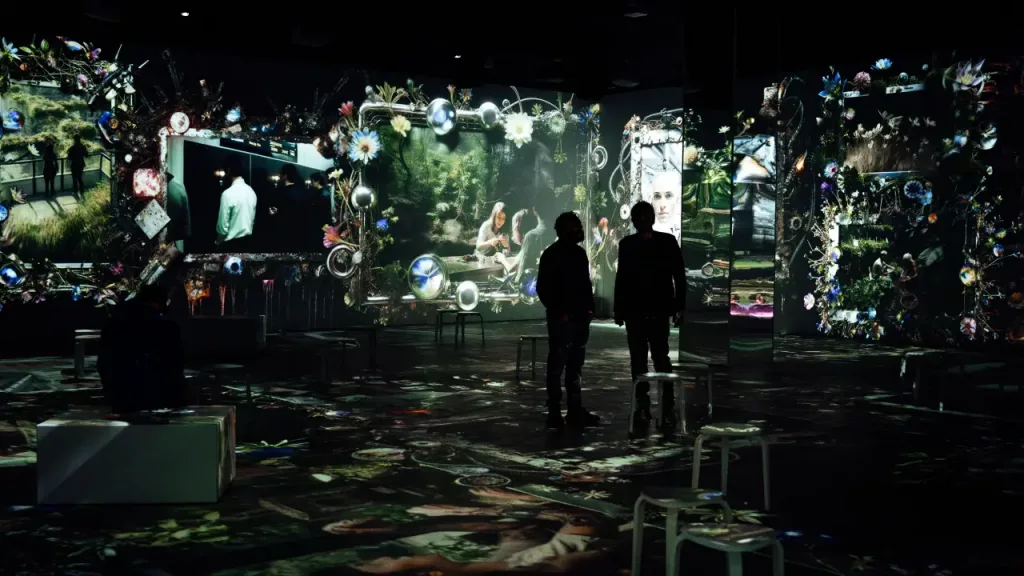
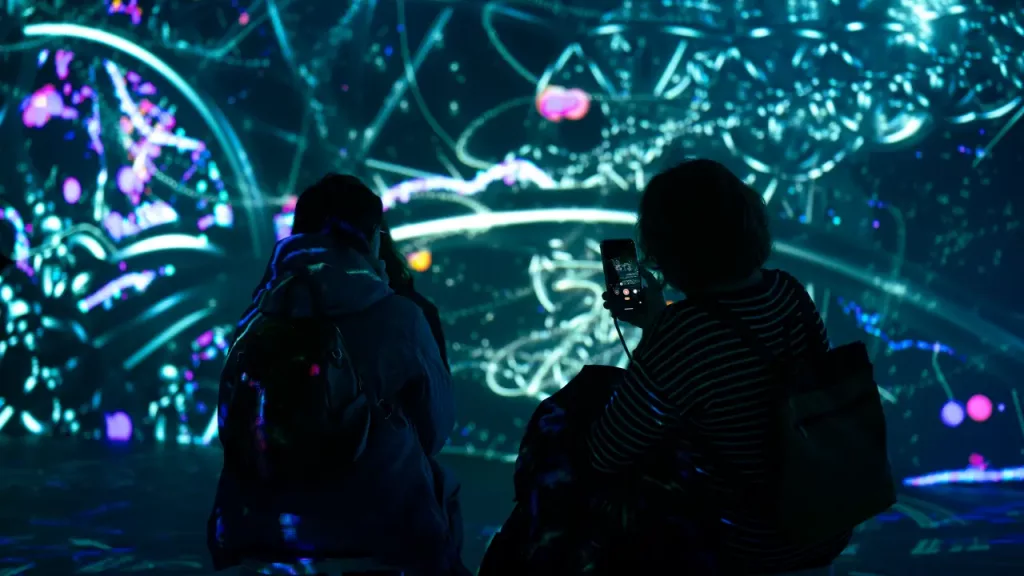
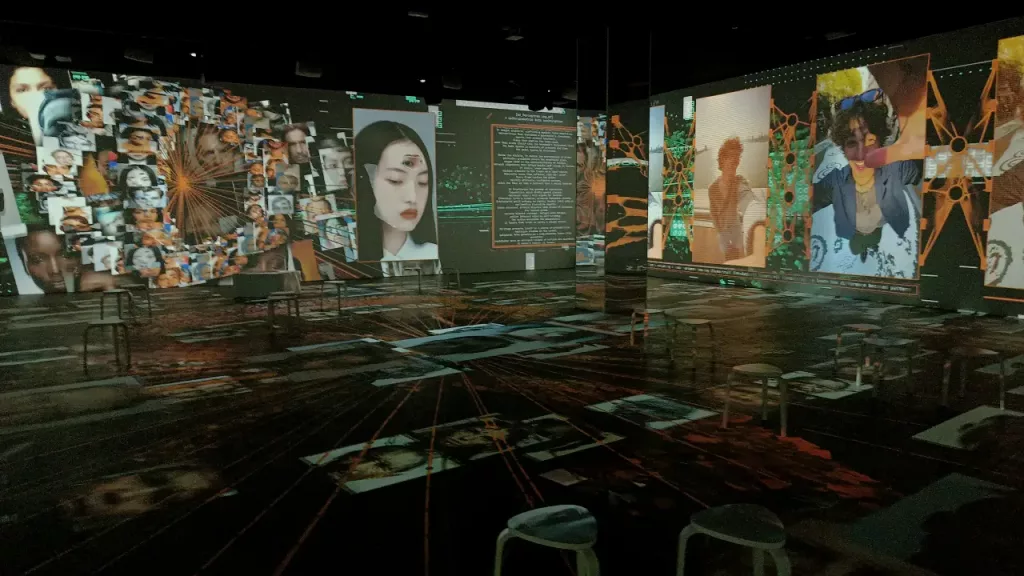
The narrative arc is structured as progression: a beginning anchored in real facts and shared knowledge, then a gradual move into speculative futures—up to the scale of decades—where ethical questions emerge from the story rather than being appended as a disclaimer. Around the cinematic immersive core, the project adds an explicit contextual layer: panels and informational content that explain what AI is, how it functions, and what it is used for, creating a two-speed experience—sensory immersion first, intellectual anchoring second.
Public descriptions emphasize the touring dimension. The official project site presents INTO THE MIND OF AI as an imaginary journey into AI’s mind, narrated in the first person, and lists presentations including W1curates in London, Bilbao and Salt Lake City. Vitale’s portfolio frames it as produced by FLOW Productions and High Files, partnered with The Leonardo in Salt Lake City, with a premiere date of January 26, 2024. The work, in other words, is not positioned as a lab prototype but as a scalable exhibition asset—one that can hold narrative coherence while adapting to different infrastructures.
Touring as re-authoring: adaptation, infrastructure, and the move beyond screens
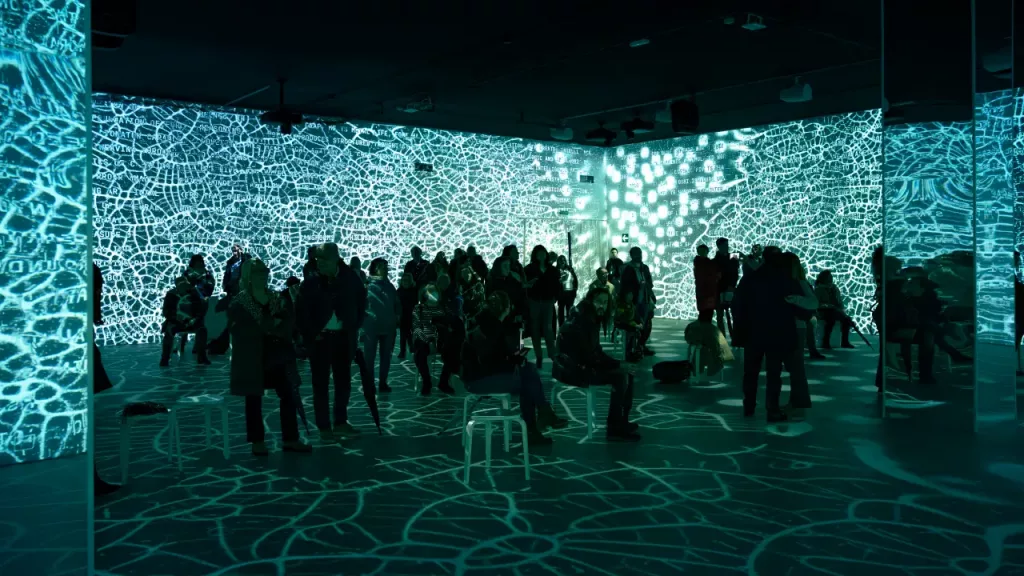
Large-format touring forces a hard principle: every venue changes the work. Vitale describes adaptation as the most creatively active phase—difficult parts are framed as the moment when the team “plays,” and each new installation becomes close to “a new project,” even when the core content remains stable. In practice, this means rethinking pacing, spatial storytelling, and the relationship between the viewer’s body and the architecture hosting the piece.
London serves as a case study. There, the project operated as a hybrid between outdoor and indoor presentation: a large urban façade on Oxford Street used as a multi-floor display surface, paired with a more conventional immersive room inside. This configuration forces the narrative to behave like a system rather than a single-format film: one version catches a passerby in the city, the other sustains an audience inside. The artistic problem becomes continuity across contexts rather than spectacle alone.
The technical layer is treated with the same pragmatism. London used LED; most other venues rely on projection for cost reasons. The consequences are aesthetic: LED stabilizes blacks and contrast; projection—especially with very powerful projectors—can wash out black levels and reshape the image. In this sense, “format” is not neutral: it is part of the authorship, and infrastructure can either protect or undermine an intention.
Vitale’s current development interests also point to a broader definition of immersion. He references ongoing work that shifts away from screen-first experiences: consulting on a permanent museum project in Italy (under NDA), pitching a large permanent production in Saudi Arabia described as a “digital aquarium with no water,” and a project centered on smell and physical props—scents, headphones, and environmental elements—explicitly “without a projector.” The direction suggests a practice increasingly focused on the body and on low-tech sensoriality as much as on high-tech display systems.
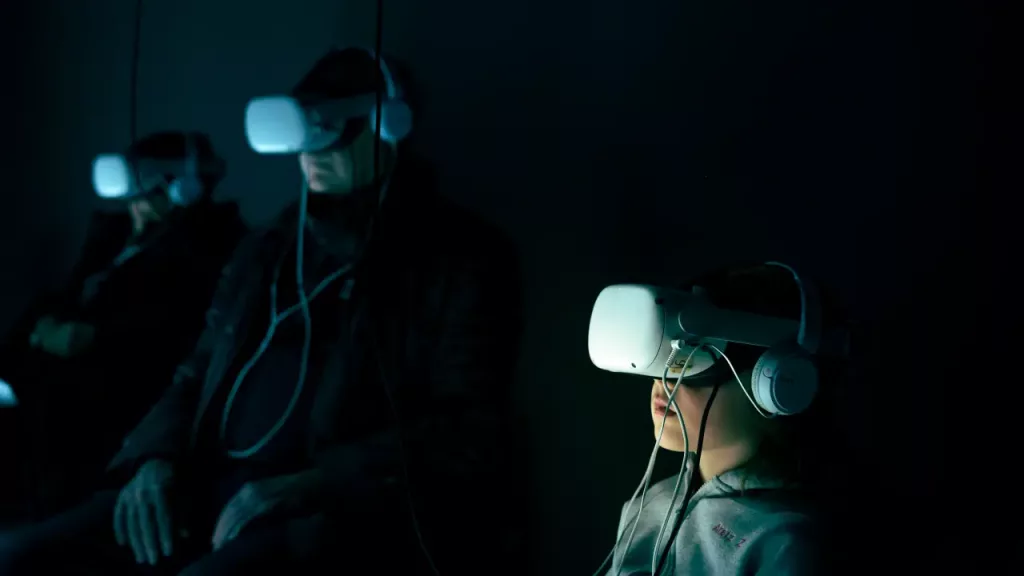
At the same time, the appetite for free roaming VR remains present, but framed as an operational issue: interactive VR creates flow bottlenecks in exhibition contexts, so VR rooms often become short, non-interactive add-ons unless the entire experience is designed around throughput. This diagnosis is consistent with a producer’s approach: the next leap for immersive formats will be as much about visitor management and venue design as about hardware.
INTO THE MIND OF AI ultimately reads as a statement about how to make “AI art” durable in the public sphere. Rather than treating AI as surface texture or a fashionable toolset, the work treats it as a narrative entity and tests that entity against real-world exhibition conditions. That insistence on scale—on touring, adaptation, and infrastructure—helps explain why Vitale’s profile registers as international: the work is not merely shown abroad, it is designed to survive abroad.
Leave a Reply
You must be logged in to post a comment.