
Eight years after its creation, Atlas V has formalized a major development that has just been announced by Variety: a $6 Million fundraising campaign—led “primarily” by HTC—and a deliberate diversification strategy, designed as a direct response to the maturation(and limitations) of the online narrative VR market. The stated objective is to consolidate a studio internationally recognized for its immersive works, while redirecting a significant portion of its activity toward segments considered more economically structured—casual/arcade VR gaming and location-based entertainment (LBE), with or without headsets.
This announcement comes in the wake of a blunt assessment by CEOs Antoine Cayrol and Arnaud Colinart: online narrative VR “doesn’t have the audience we hoped for,” and the lack of operating revenue automatically hinders the ability to build sustainable growth. For Atlas V, this is not a matter of abandoning immersive storytelling, but rather of rebalancing: continuing to produce editorial works, while financing risk and growth through markets where usage, volumes, and distribution seem more predictable today.
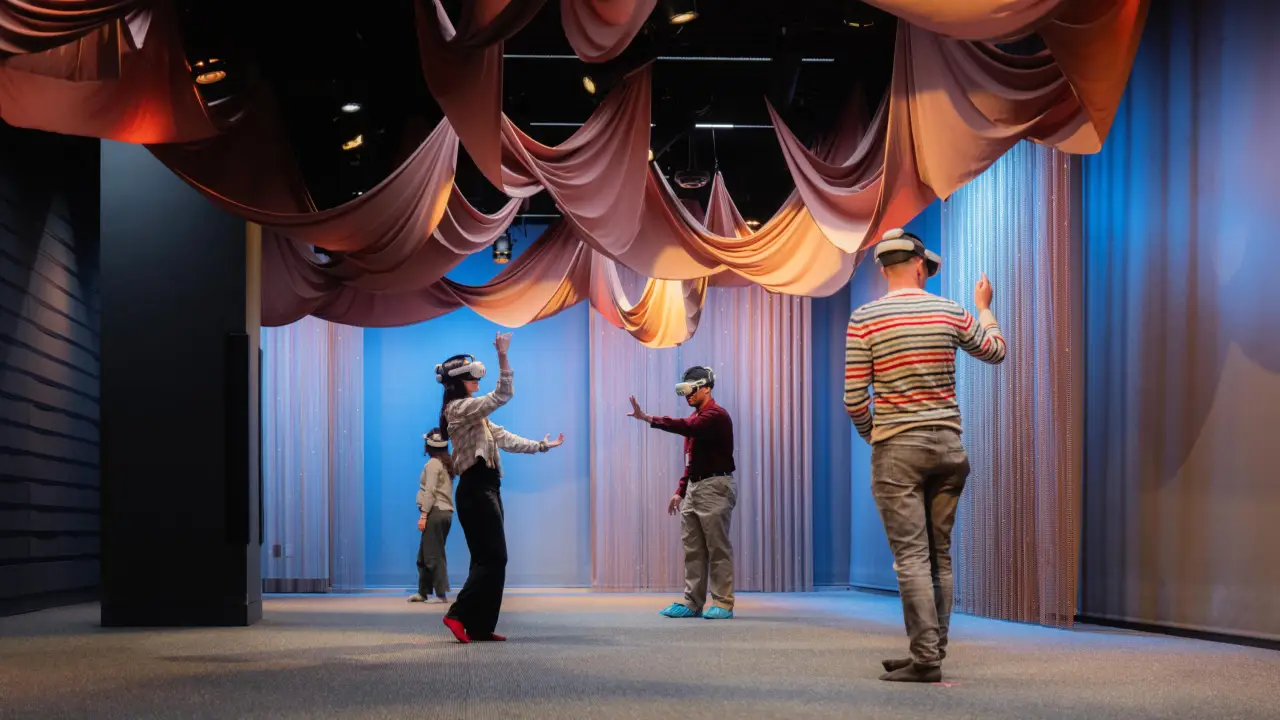
Cover: COLLECTIVE BODY by Sarah Silverblatt-Buser @ Lincoln Center for the Performing Arts 📸 Lawrence Sumulong
A blunt diagnosis: online narrative VR does not generate operating revenue.
At the heart of the two funders’ thinking, one idea keeps coming up: a work can be properly pre-financed and recognized without necessarily becoming an economic driver. “The fact is that the audience is not there (…) and so we have no operating income,” summarizes Antoine Cayrol (also CEO), who explains that, after taking over as president and CEO, he undertook a more direct analysis of the model.
Arnaud Colinart adds a double whammy: even though the audience remains limited, “pre-financing still tends to decline.” In their view, narrative VR, strongly supported by broadcasters and public funding, has seen its budgets erode over several years, to the point of calling into question its production value. “Since the company was founded (…) budgets (…) have only gone down. They have almost halved, or even reduced by two-thirds,“ with an ”average budget“ of around €300,000 for a non-co-production and €700-800,000 for a co-production—with, according to them, the associated complexity and ”zero income.”
From this perspective, Apple Vision Pro appears to be a strong signal, at least symbolically, in the recent sequence of events. Arnaud Colinart refers to it as a “small nail in the coffin”: there was a window of interest, during the porting and ordering phase, but it quickly closed due to a lack of sufficient traction.
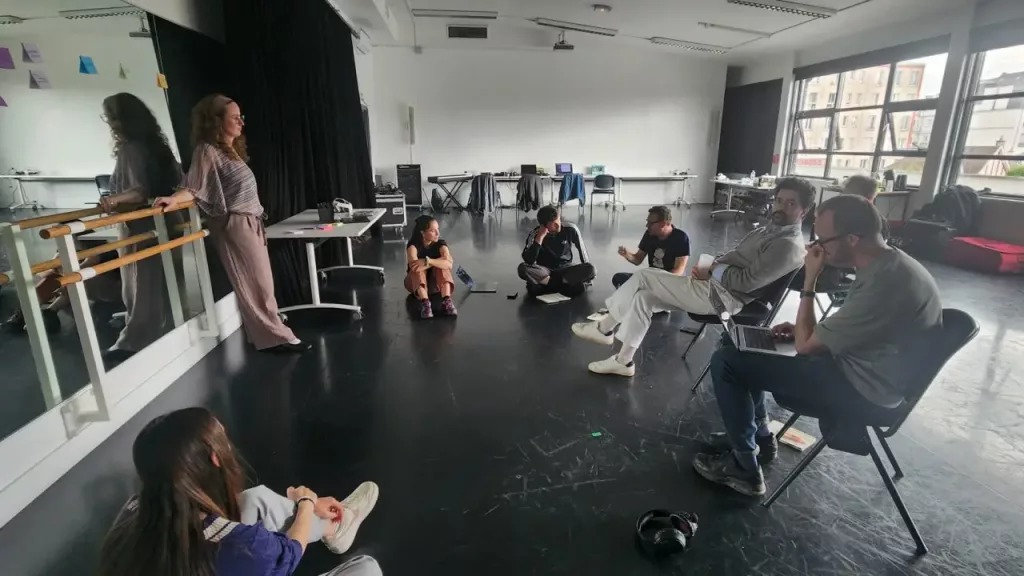
Two markets identified: on the one hand, online VR gaming, and on the other, LBE for a wider audience.
Atlas V claims that its analysis is now structured around “two markets.” The first is an online market, estimated at around “15 million active users,” with a predominantly young population (12–25 years old) and usage focused on gaming. The second is location-based VR, historically driven—they say—by players such as Félix & Paul Studios and Excurio (formerly Emissive), targeting an older, family audience (aged 35–70) seeking “artistic, narrative, heritage” experiences. This process was already set in motion by the studio last year with the release of COLLECTIVE BODY by Sarah Silverblatt-Buser and PLAYING WITH FIRE by Pierre-Alain Giraud.
This breakdown serves as the basis for the strategy: to continue to exist in the immersive narrative (particularly for creative and positioning reasons), while investing more in formats and channels that correspond to dominant uses. Antoine Cayrol puts it this way: “Today, online narrative VR is not a market. It will become one (…) but it isn’t yet.”
From storytelling DNA to entertainment focus
Atlas V is undergoing a semantic shift: rather than “storytelling,” the keyword is now “entertainment.” “We’re really going to move into casual gaming (…) very arcade-style,” they explain, emphasizing short cycles: produce faster, release more often, test, capitalize if it works—and start again.
Antoine Cayrol illustrates this relationship to volume with a recent sales metric: “We’ve been selling 400 copies a day of Scan or Scam – Cashier Job Simulator for two months now,” which he implicitly contrasts with narrative VR works, most of whose visibility is concentrated on festival phases with no subsequent outlets.
However, caution is clearly advised: there will be no immediate “AAA” strategy. Arnaud Colinart mentions a focus on casual/arcade games over the next 12 to 24 months, citing market signals (including the discontinuation of certain VR developments by studios) as justification for “operational rationalization.”
The producer highlights a cultural shift: moving from a B2B approach geared towards broadcasters (Arte, France Télévisions, etc.) to a B2C approach, with marketing skills drawn from the video game industry, “using data and everything involved in asset creation.”
One Atlas V company, two poles, and refocused distribution
The planned diversification requires a break with the historical logic of pre-financing: video games and LBE involve more prototyping, internal investment, and risk-taking—hence the opening up of capital and fundraising.
A significant portion of these funds will be used to rebuild the team: Antoine Cayrol mentions 25 new hires, “half” of which have already been made, as well as the arrival of senior profiles (marketing, data, management). One example is the arrival of Mathieu Barbier as head of the studio, co-founder of the Vertical studio, which was subsequently acquired by Celsius Online, who has solid experience in distribution and production models for casual and mobile games. He emphasizes the alignment with current economic conditions: the slowdown in the video game industry paradoxically makes hiring more accessible and attracts talent curious about VR as an area of diversification.
Beyond its portfolio of formats, Atlas V has announced a restructuring. Antoine Cayrol describes a desire for clarity: refocusing on a single Atlas V entity, structured around a studio division and a production division. In line with this approach, certain brands/subsidiaries will disappear (he cites Astrea and Albyon in particular), and the distribution of third-party projects will be abandoned: the teams concerned will remain integrated, but will focus on Atlas V projects.
Location-based, immersive exhibitions, and licensing: seeking scale without limiting oneself to heritage
When it comes to LBE, Atlas V does not want to limit itself to heritage museum uses. Arnaud Colinart notes that the “cultural LBE” already seems “relatively saturated” to him and that the ambition is to move towards original creation and/or entertainment, including through licensing—with relationships already established, according to them, with Japanese rights holders and international studios.
The most concrete example cited: a GLOOMY EYES project in location-based VR, announced as funded, with a target throughput of “100 people per hour” and delivery scheduled for around March 2027. Antoine Cayrol sees this as the first tangible building block of the LBE entertainment strategy.
The studio has also observed the stabilization of a network of venues for immersive “headset-free” exhibitions, following a period of consolidation. Antoine Cayrol cites sites capable of attracting large numbers of visitors, mentioning, for example, venues with “one million visitors per year.” He sees it as a medium whose narrative possibilities are still “overlooked,” and an area where formats can become more reproducible. This is already the case with THE LITTLE MOUSE… by Nicolas Bourniquel and Floriane Cortes, a virtual reality project presented at Venice Immersive 2025 and since adapted for mapping rooms with the help of Kunstkraftwerk Leipzig.
On the issue of licensing, the discourse remains pragmatic: the bigger the IP, the more complex the decision in a market that is still limited. Antoine Cayrol sums it up: even with “established” business plans, location-based VR remains difficult to sell to major players if the projected revenues remain low on their scale. However, he points out that with the fundraising, Atlas V can now “pay for options” and send a signal of credibility in negotiations.
The evolution of Atlas V can be seen as an attempt to reconcile two often conflicting requirements in immersive media: preserving editorial ambition (and an established position in XR storytelling) while accepting the current reality of usage, volumes, and revenues. “We’re not stopping (…) we’re diversifying,” insists Antoine Cayrol, rejecting the idea of an opportunistic pivot: the studio wants to remain identifiable, but in areas where there is already an audience—and where distribution, whether digital or physical, allows for more regular exploitation.
Leave a Reply
You must be logged in to post a comment.