
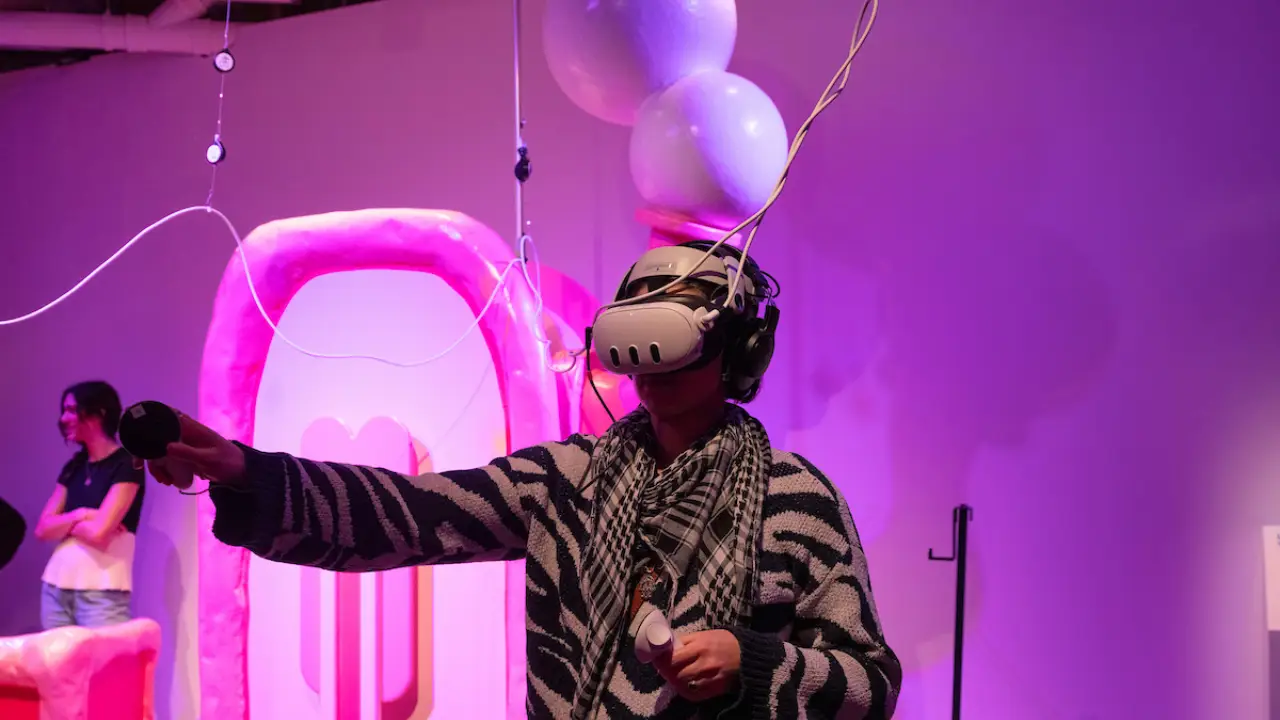
At IDFA Doclab, you can be sure of two things: 1) the ever evolving and creative programming means you never can be sure what you will experience, and 2) whatever it is, you will be surrounded by thought-provoking work, people and conversations. DocLab is always a great way to close out the year – with a playful and hospitable spirit grounded in an investment in building the immersive ecosystem.
It’s not just the carefully curated (thanks to Caspar Sonnen and Nina van Doren) slate of interesting art works, which take many forms. Attendees here are along for the whole ride – from the exhibition to the R&D Summit, from the DocLab forum to the experimental playrooms. The team has built an event that feels like a gathering of community (one of smart, creative and open people).
Cover: LESBIAN SIMULATOR, OF(F) the Internet exhibition 📸 Roger Cremers, IDFA DocLab
This year’s theme was OF(F) the Internet, a reflection of where the industry has come from and a challenge to ground ourselves in the present and the collective experience. “The artists we showcase, their work couldn’t have existed without interactive media and technology,” notes Sonnen, Head of New Media. “So it’s very much a celebration of the most beautiful things that arise out of the internet and new technology. At the same time, it also invites us to reflect – what if we leave the internet sometimes, instead of being perpetually connected to it.” And what does it mean to be involved in an artistic field that often isolates us from the world around us? How can we bridge it with collective, and connective, experiences?
Despite being grounded in a documentary festival (IDFA), the boundary of what is perceived as non-fiction is very fluid here. But this is not out of place for two reasons – IDFA has long featured its Paradocs section of films which “push the limits of the documentary form”, and the long-debated question of “what is reality” in documentary is at the core of much immersive art. To an extent, all documentaries are a reflection of how what we see as truth is often mediated by our context and affected by what’s around us. As Sonnen says, “we have a soft spot for artists who are comfortable to not be obsessed with whether what they’re making is fiction or documentary, but who love to explore new types of technology to create a thing we like to call ‘perception art’: art that forces us to rethink and reflect what human perception is, what human behavior is.”
An exhibition of perception art
The highlight for many was NOTHING TO SEE HERE, a new piece from Celine Daemen which plays with that perception of reality. In this hybrid of personal and public experience, a metal column stands in the middle of the exhibition space, with a headset nested within. [Spoiler alert to follow.] Looking inside, you see yourself from a mixed reality, bird’s eye view, with the public walking around you, but also animated birds and detritus passing on the ground. A person walks towards you and engages. It takes a moment to realize he’s not real. The piece is a meditation on what is real, what is lived experience. What do we think of this guy? Are we annoyed by him? Threatened? How we experience and react to what transpires is unique to each viewer and really depends on our own lived experience.

IN 36,000 WAYS also dwells in that liminal space of real and imagination. It approaches war in an abstract way, inviting you to hold a piece of shrapnel found in Ukraine, with maker Karim Ben Khelifa gently relating the context in your ears before he drifts away to leave you with silence and a beating heart, prompting you to imagine being in a war-time moment. The piece is just the tip of what will be a larger, more comprehensive installation.
UNDER THE SKY, which received a Special Mention Award in the competition, is the ultimate in VR citizen journalism: Palestinian journalists have been responsible for showing the outside world what is happening on the ground in Gaza (at great expense of their lives), and this takes you even more viscerally into that reality. If you have been following any news from Gaza the last 2 years, you will see familiar journalist faces in front of you, staring at you, talking to you. Produced last year, by Khalil Ashawi and Hadeel Arja, it hauntingly leaves you to wonder how many of these people are still alive.
For many years now, IDFA DocLab has partnered with Artis Planetarium and WeMakeVR for a full-dome planetarium programme. While some featured works were made specifically for dome presentation, other IDFA-selected pieces worked with WeMakeVR (supported by the Netherlands Film Fund) to create full-dome versions, a process that isn’t a one-to-one conversion but a collective reformatting of the piece.
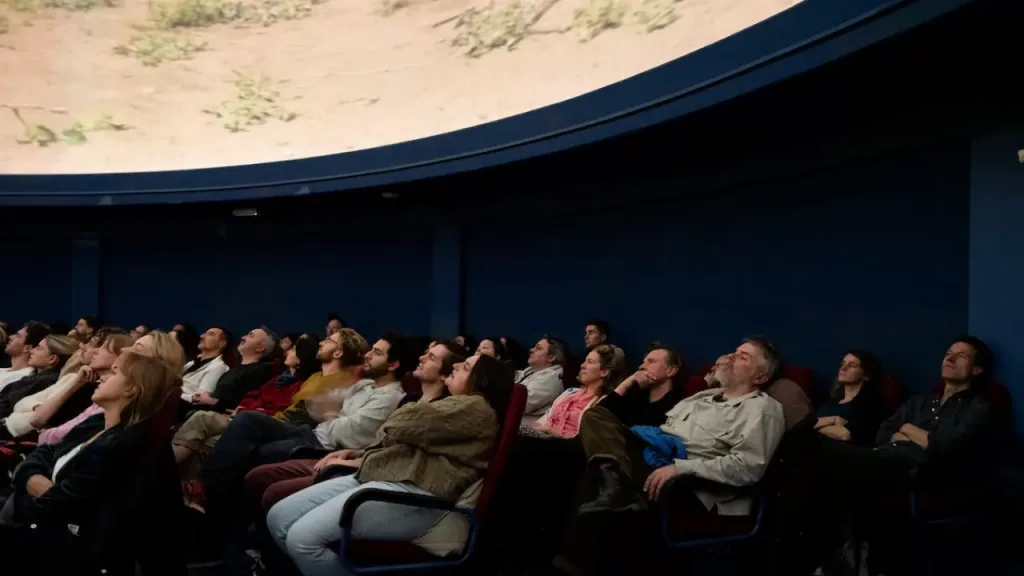
FEEDBACK VR, UN MUSICAL ANTIFUTURISTA by Claudix Vanesix for Collective AmiXR (which won the Immersive Non-Fiction Award) was one of these works. The piece is a musical immersive trip blending real-life videos with virtual avatars on a journey through rituals and future imaginings. While the full-dome version fits well with the Andean futurism tone of the piece, the headset version feels more intimate, as though you are participating in the rituals, not just watching the spectacle. (Note: I cannot get the main song out of my head.)
REALITY LOOKS BACK by Anne Jeppesen offers beautiful animation on quantum physics, a hamster and a blue coffee cup. Those who missed the planetarium programme could watch it lying down under a mini-dome in the exhibition, along with THE RIFT(Janire Najera, Matthew Wright). It’s always interesting to see how dome pieces are experienced differently in the large full dome setting versus a more intimate mini-dome or VR headset.
LESBIAN SIMULATOR by Iris van der Meule and WE ARE DEAD ANIMALS by Tote Tiere Maarten are Netherland-based interactive VR experiences that gamify social realities. The colorful and playful LESBIAN SIMULATOR invites you to recognize what it is to be queer – through both the joy and pride moments, and those of disapproval and harassment. We are Dead Animals is a bizarre, semi-dystopic game where you walk through barren land encountering dead animals; touching them displays their classifications and allows you to bring them back to life. A meditation on bio-diversity protection and extinction, there is something quite moving about turning around and seeing all of these moving animals left in your wake, as though you are re-populating the world for survival. (Extra points for the timber nest playing space installation)

Did you ever watch someone play a video game, maybe your partner at home or a stranger on Twitch? That’s the concept behind the Interactive Cinema (new this year), where players at a podium can choose from several different games in the Digital Storytelling competition to play live on the room’s screen as a collective experience. For the times I passed through the room, most people were playing INDIVIDUALISM IN THE DEAD-INTERNET AGE: AN ANTI-BIG TECH ASSET FLIP SHOVELWARE R̶A̶N̶T̶ MANIFESTO by Nathalie Lawhead, probably because it so appeals to this crowd who remembers when online creation was still raw and independent and underground, a stark contrast to the mediated, prescribed landscape controlled by big tech gatekeepers today. The set up did make it harder to play all the games (hence the brilliant playroom – more below).
Let the “industry track” begin
This year, the events running parallel to the exhibition were bundled into the new “industry track”, covering angles from distribution to sustainability, financing to experimentation.
The sustainability of the immersive sector relies on stable distribution options, innovative exhibition ideas and the grappling with how to preserve work produced with tools and formats that quickly evolve to leave artworks unplayable. The R&D Summit highlighted several significant partner initiatives designed to tackle these issues.
MIT’s OpenDocLab shared the latest research updates from the Independent XR Distribution Coalition, showing their mapping of the distribution and exhibition landscape. Not surprisingly, the big gaps in the map were in parts of the world with a leaner (or absent) production ecosystem, and perhaps also a lack of presence in the industry networks. Summit-goers were excited to user-test resources and tools the coalition is building to help navigate the emergent space of XR distribution for projects, venues and platforms.
Adding to the landscape of research and collective XR industry-building is the new Shared realities initiative, a consortium to develop XR for collective experiences in public spaces, a more innovative XR exhibition culture and a living lab for experimentation and arts-based research. “It really is an exploration to how we can bridge the gap between what artists are making (and really celebrate the fact that artists should make whatever they want to make) and actually getting audiences to see it, to actually being able to fund it,” explains Sonnen. What are those hurdles and how do we open the ecosystem up?
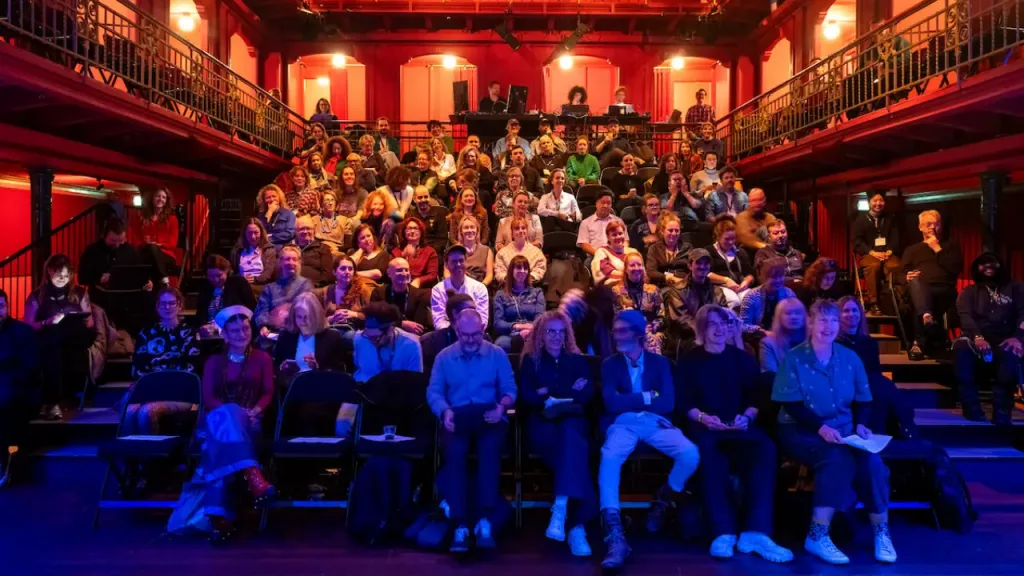
That goal of “de-isolation” was the concept of the post-conference afternoon, with discussions from different entry points on those challenges facing the immersive ecosystem. A session led by creative technologist Abdelrahman Hassan on XR and civil society opened an excellent conversation on taking XR out of our industry bubble and into the rest of the world, tapping an underrealized opportunity to find new audiences and use physical and collective immersive experiences towards our shared humanity.
In an effort to de-isolate work from obscurity, WeMakeVR’s Avinash Changa presented software/hardware they are developing that would adapt current systems to be able to play XR pieces built with now out-of-date technologies. This would vastly open the possibilities of a living, playable archive, allowing for research about and exhibition of older immersive work.
A space for development
Introduced last year, DocLab continued its playrooms concept – a place to experiment with new presentations and prototypes, which also mirrored components of the documentary film industry. One session invited makers of the games in the Interactive Cinema room to present their work and play a bit of their games for the audience. Like a festival Q&A, the artists shared the inspirations, origin and technical journey for their pieces. The only regret was not having more time to watch the game play.
In another playroom, artists met the audiences with new pieces in development, giving the makers a chance to test them and the audience a first-look/-try (again, like work-in-progress film screenings). They ranged from Sjef van Beers’ breezy yet informative visual lecture about technology and capitalism, which culminated in a participatory scavenger hunt with self-scanners in the local market, to interviews with Bart van de Woestijne for his early prototype of PARALLEL YOU, an immersive, AI-powered encounter in which we can meet our ‘opposite self.’ (I didn’t have enough guts to face my opposite self.) It was inspiring to see how full the rooms were for these, showing how eager industry folks are to test, discuss and imagine together.
Makers and industry experts gathered in the cozy, red back room of Droog, ready to pitch and provide feedback for new projects in development as part of the DocLab Forum. There was a refreshing range from first-time to experienced makers, but they all delivered quality projects, with LGBT- and music-related narratives the most represented.
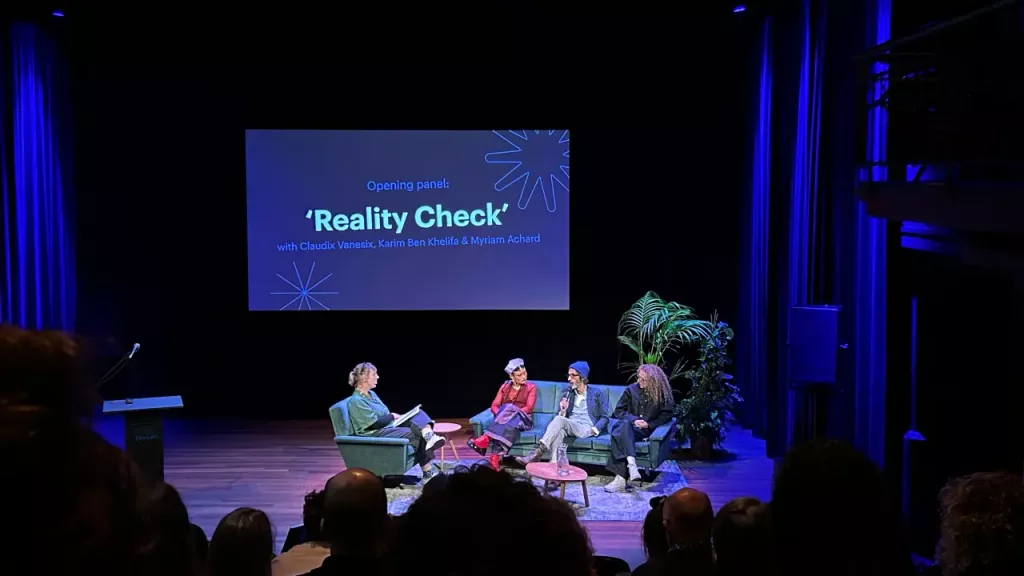
BODY COUNT, a project exploring trauma and connection from newcomer Cris Bringas from the Philippines, a country rarely seen in VR production, won the DocLab Forum award. The viewer experiences an intimate Grindr encounter in a Berlin flat between a Filipino nurse and a soldier, drifting through the visually fragmented rooms while listening to their vulnerable conversation (amazingly recorded at the time, and used with full consent of both parties).
THE EYES OF MILA KAOS (Yimit Ramírez, Tony Alonso) brings you into the mind of a Cuban actor and his dynamic drag queen alter-ego, the viewer entering a colorful animated space with bubbles of memories that explore the difficulties of his encounters and decisions. Amasonic is a co-created work with environmental researcher Dr. Maria Cecilia Oliveira and Marcel van Brakel, where every part of nature has a sound. Users journey through these sounds, recorded by local communities and scientists in the Amazon, and use them in their own composition by the end. These are just a few of the dozen pitches that covered a range of topics, formats and exhibition options, showing how the immersive field is never one thing.
Next year, DocLab will turn 20 years old, which is sure to bring a programme that reflects on the past, celebrates the highlights and favorite works, and brings us forward into the next decade of immersive challenges and possibilities. While we won’t have solved all the challenges, you can be sure the people in these rooms will have been working on them.
Leave a Reply
You must be logged in to post a comment.