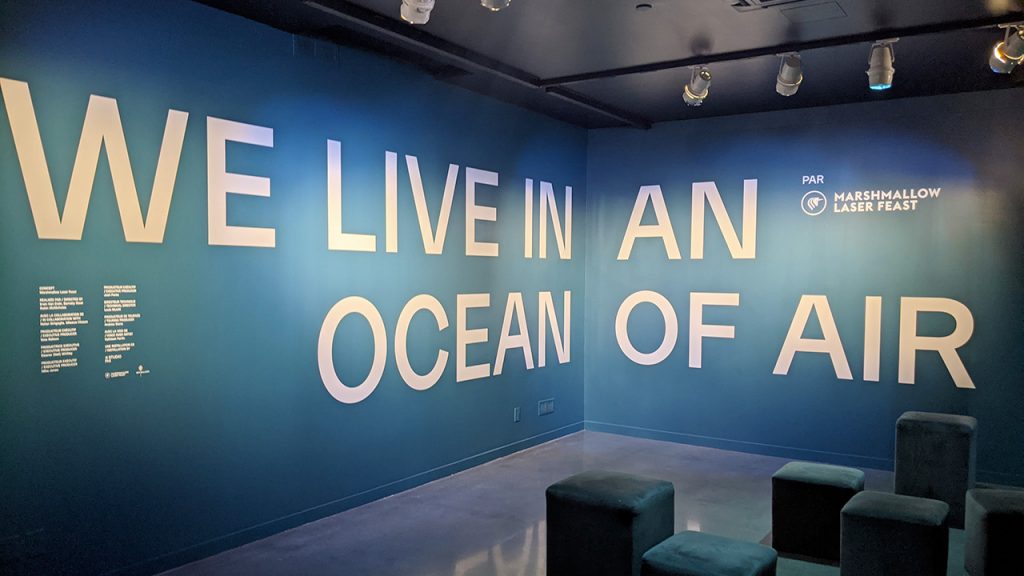
For the first time since its Particles of Existence exhibit in 2018, PHI Centre is hosting a project by Marshmallow Laser Feast (MLF), one of the world’s leading immersive art collectives. We Live in an Ocean of Air—a twenty-minute VR experience for two groups of six people—will have its North American premiere in PHI’s premises in the Old Port of Montreal, from September 29, 2021 until January 16, 2022.
Read through our review to learn all about this enveloping experience.
This review was first published in French on Québec/Canada XR
Worlds beyond our senses
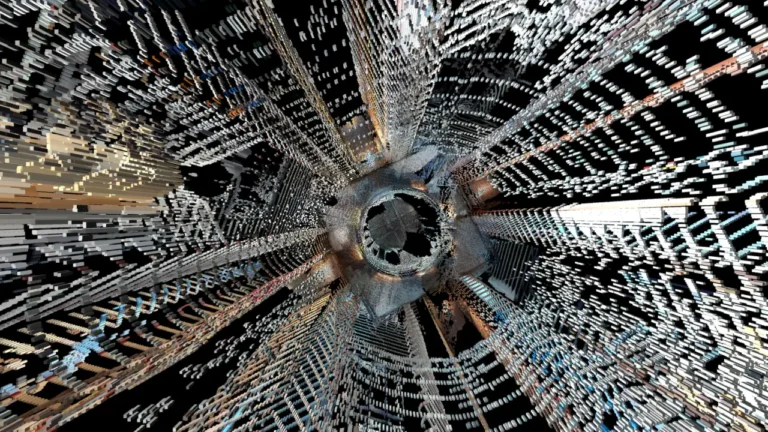
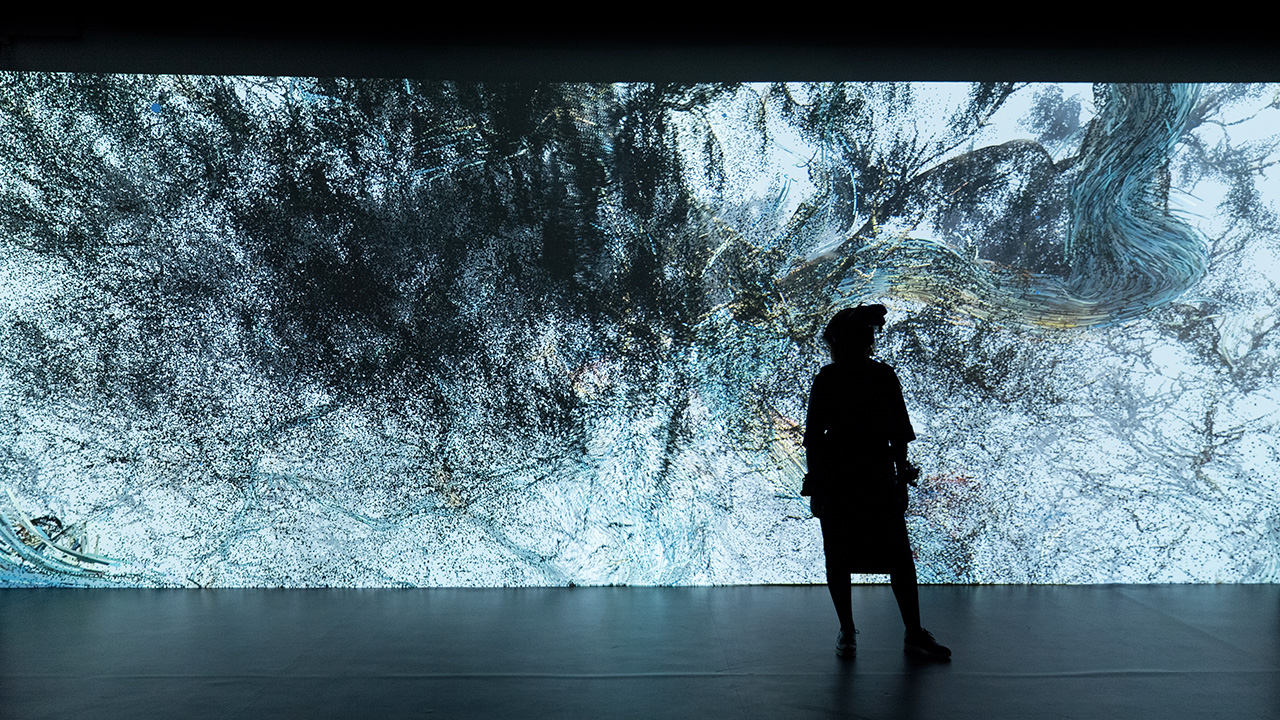
If you’ve seen In the Eyes of the Animal (2015) or Treehugger: Wawona (2016), the last two MLF projects presented by PHI, you’ll recognize the British studio’s unique aesthetic, marked by its use of floating dots and particules. By using “terrestrial laser scanners”—i.e. LiDAR (Light Detection And Ranging) sensors more commonly used in architecture—Marshmallow Laser Feast manages to produce an effect that lies halfway between scientific imagery and pointillism.
In each case, this visual signature allows MLF to represent ways of seeing the world that go far beyond human understanding. In the Eyes of the Animal, for example, puts viewers in the shoes of four different animals and insects (owl, frog, dragonfly and mosquito), each with its own way of perceiving the space of a forest; although they all share the same world, they each have their own unique environment (or Umwelt, to put it in the words of Jakob von Uexküll). Meanwhile, Treehugger offers viewers the chance to explore the universe of a sequoia, the largest living organism to have lived on the planet.
Invisible connections
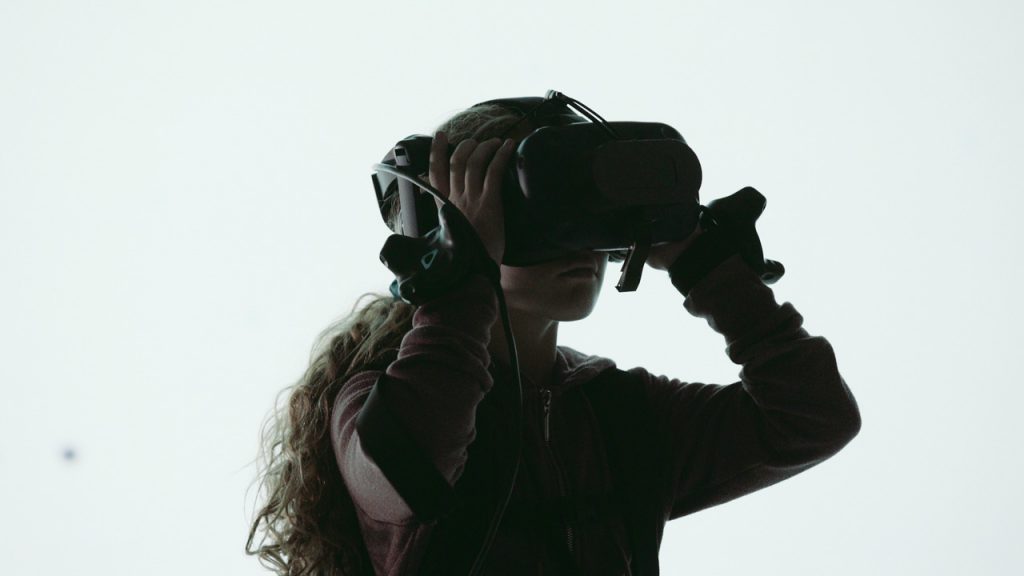
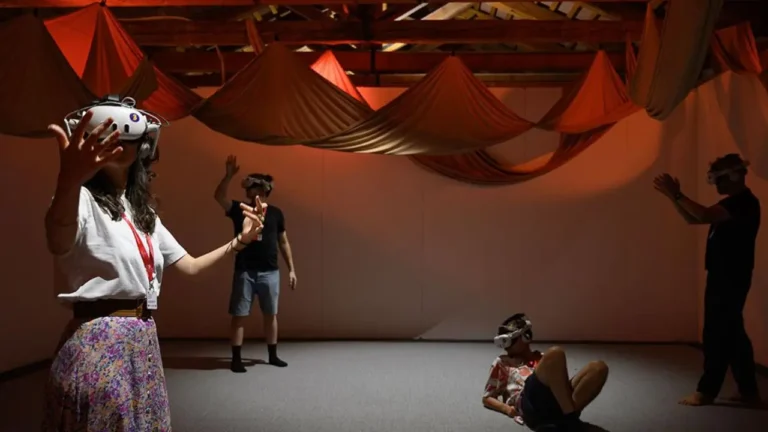
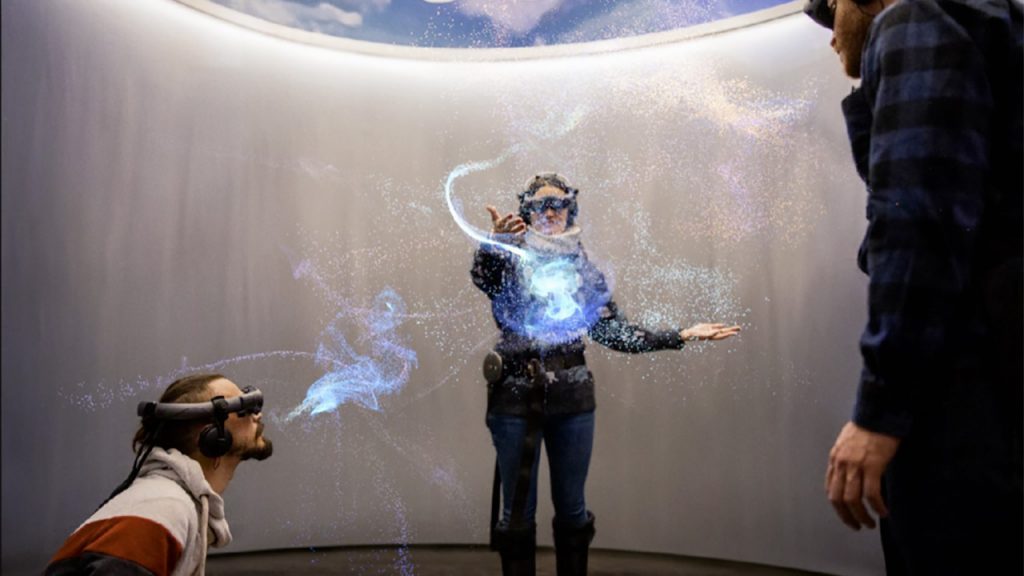
We Live in an Ocean of Air falls in line with these two earlier projects by revealing the invisible links that unite us to the rest of life on earth. More specifically, it is through our breath that this fundamental connection is highlighted. The experience allows visitors to visualize their own breathing (as well as that of the other five participants) thanks to a wireless virtual reality headset modified by the addition of a breath sensor, a pair of wrist-worn trackers and a pulse sensor clipped to the ear. Despite this cumbersome equipment and the elaborate onboarding process, We Live in an Ocean of Air quickly moves beyond these technical concerns and invites viewers to reconnect with nature.
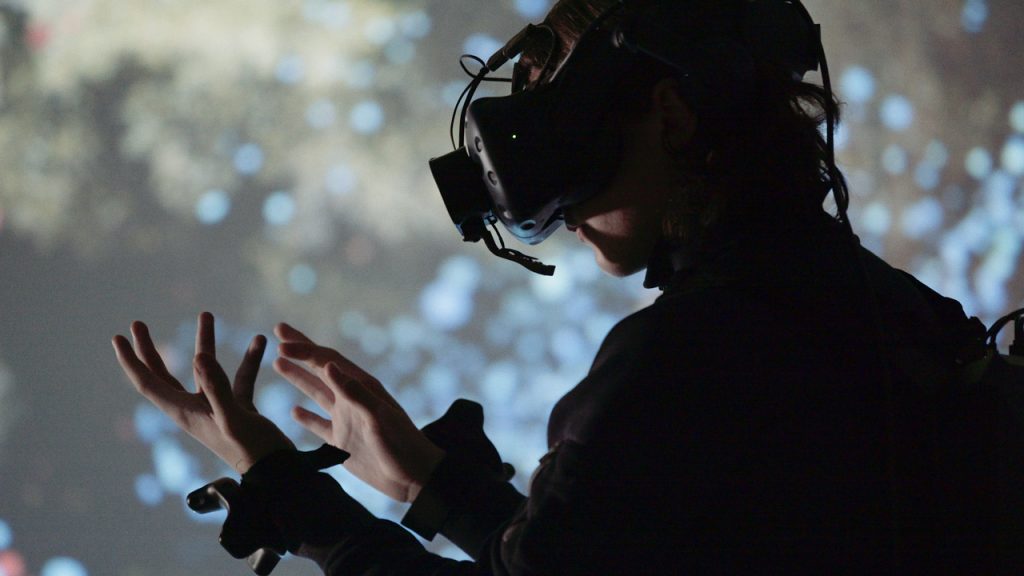
After having looked at, and played with, our own breathing for a moment, the initial awe of discovery gives way to a curiosity piqued by what lies just beyond our reach. Namely, by exploring the four-square-metre play space, we discover other organic phenomena: root systems tangle beneath the earth while the capillary networks of the giant tree in front of us are traced by the cyclical movement of its sap. Walking into the tree’s core, we get another point of view on things, looking at the processes from the inside out. As in Treehugger, the experience even takes us up to the peak of the 30-storey tall sequoia. This offers yet another perspective on these invisible organic phenomena. What’s more, We Live in an Ocean of Air plays around with temporality, such that the rhythm of these phenomena seems synched with that of our breathing; the circuit of the sap that would normally follow the day-night cycle now aligns with that of our own breath. Again, the goal is to highlight the links that unite us to other forms of life, as well as to their own reality.
An experience of duality
As the official page of the exhibit explains, one of the aims of the project is to highlight “humanity’s dependence on the natural world” as well as the fact that the “protection and regeneration of ecosystems are fundamental to our collective future.” That said, it was difficult for me to see anything in this project other than an allegory for the current context of the pandemic.
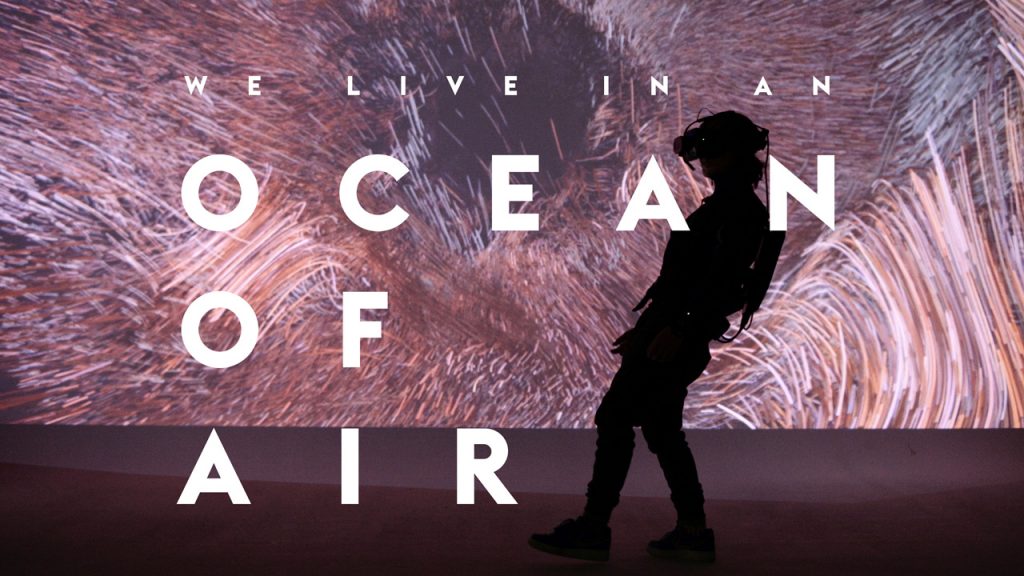
Based on breathing, We Live in an Ocean of Air occupies a very strange position, exhibited as it is at a time when the effects of the COVID-19 pandemic are still being felt. In addition to all the technical accoutrements that PHI’s docents help us put on, the expected sanitary measures mean that it is of course necessary to wear a face covering during the experience. However, I had the impression that my mask sometimes interfered with the operation of the sensor that—placed as it was right in front of my face—I expect was meant to track the flow of air in and out of my nose and mouth as I breathed. At the same time, the fact that the experience allowed me to visualize my own breathing as well as that of the people around me made me appreciate my mask despite everything! This is all the more evident since these air particles remained visible for a long time, to the point of saturating my field of vision. The effect was already impressive with a group of four people, and I dare not imagine the amount of visual “pollution” that there would have been caused by six people breathing in the same space.
Barnaby Steel, co-founder of Marshmallow Laser Feast and co-director of the experiment along with Ersin Han Ersin and Robin McNicholas, was present by videoconference during the press tour to present his project and to answer questions from journalists. When I asked him what influence the pandemic may have had on the development of the experience, he replied that the project had actually been developed before the onset of COVID. In fact, it had to be temporarily shelved because of the pandemic.
Regardless of the links that could be made between We Live in an Ocean of Air and the context of the pandemic, for Steel, the essence of the project remains breathing. For Steel, breath is an umbilical cord that unites us to the life around us. When I asked him to compare his project to other immersive experiences based on breathing—including Breathe (Diego Galafassi, 2020), which had been produced in residence at PHI, and Osmose (Char Davies, 1995), an oft-forgotten landmark in the development of immersive media—the director explained to me that he hoped this mode of interaction could serve as a springboard to more diverse forms of immersion. Seeing what kinds of exhibits PHI has presented in recent years, as well as the multisensory approaches they propose (tactile, olfactory, even gustatory), I am inclined to believe that the field of XR is indeed continuing to find ever more original modes of immersion.
Conclusion
Like BREATHE — which was presented at Sundance New Frontier 2020 on the eve of the global lockdown — WE LIVE IN AN OCEAN OF AIR is a product of its time. Although it deals first and foremost with our connection to nature, the experience is particularly timely, seeing that air is no longer simply synonymous with life. At the same time, just like many of Marshmallow Laser Feast’s other productions, this project also proposes to make us see the world from another point of view.
This approach is all the more interesting as one of the collective’s upcoming project, EVOLVER, promises to be an exploration of the human body.