
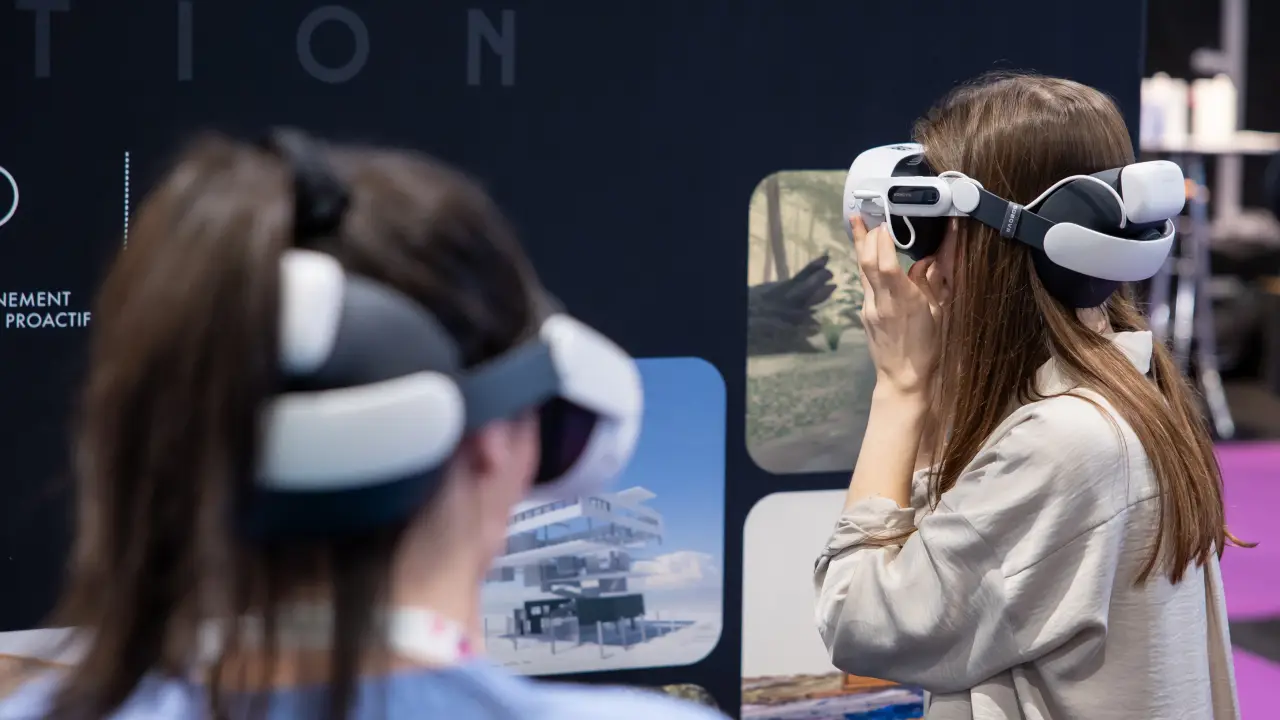
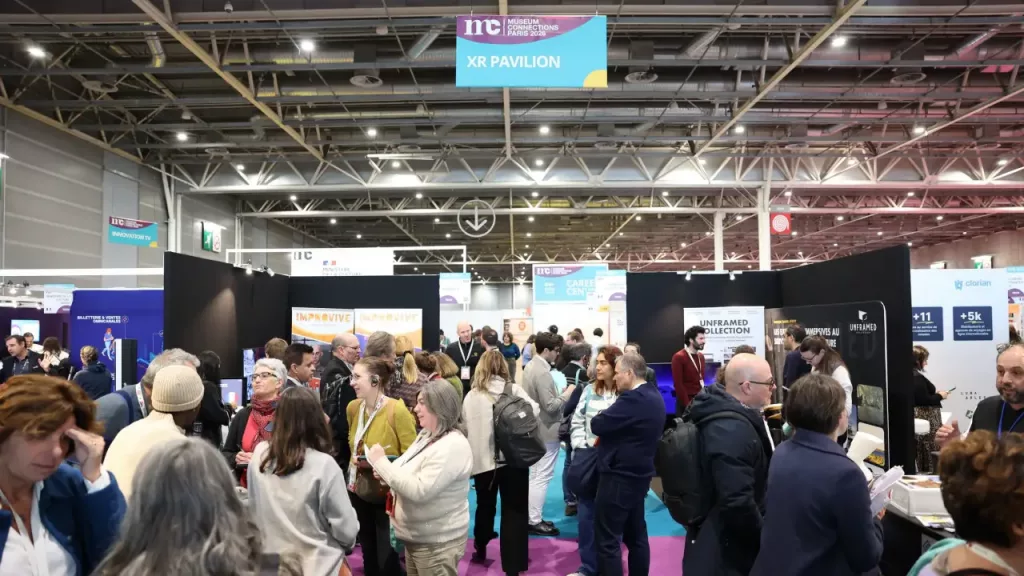
At the latest Museum Connections event (January 13–14, 2026, Paris Expo Porte de Versailles), the stands are no longer solely dedicated to museum catalogs, best practice exchanges, or shop services; innovation is well represented among the exhibitors, particularly immersive creation with a beautiful XR space showcasing several start-ups and distributors of experiences of all kinds. It was also an opportunity to talk to Romane Sarfati, former director of the Cité de la céramique – Sèvres & Limoges, who previously worked at Manifesto, and who does not talk about immersive technology as a gadget or a simple technological layer applied to museums.
For Romane Sarfati, in an obviously complex context, immersive technology is a field undergoing rapid maturation, subject to very concrete constraints—economic, logistical, narrative—but also driven by a collective energy that is rare in France. Romane Sarfati now works in consulting and project management, between cultural institutions and private actors, within ARSTORIA, the company she has just founded. Her diagnosis is clear: to scale up, we need to focus less on “proving that it works” and more on clarifying formats, opening up writing styles, and thinking of the experience as a collective moment.
Cover: Unframed Collection @ Museums Connections 2026
Bringing digital creation to audiences
Romane Sarfati’s career path is unique in that it does not pit the world of institutions against that of innovation. She boasts a trajectory marked by successive twists and turns: contemporary art, video games (linked to her experience at Cryo Interactive more than 20 years ago), museums, public policy, institutional management, and then a return to immersive digital technology. In the discussion, she emphasizes that this return is “new and not so new,” because she has already worked for nearly a decade in digital technology and video games, and today she is encountering issues that she has seen emerge before.
What is changing is not the existence of digital technology, but the intensity of the questions it now poses for cultural venues: how to produce, distribute, finance, secure, and above all, give meaning to experiences that are taking place in already constrained spaces. Romane Sarfati places immersive technology in a longer historical context: for her, the real revolution was the Internet in the 1990s, followed by a series of developments that transformed how people use technology. Immersive technology, in this respect, is just one more step—but a step that requires everyone, from creators to audiences, to learn new ways of doing things.
In her case, a trigger crystallized her desire to “reinvest” in this field: ETERNELLE NOTRE-DAME by Excurio and LE BAL DE PARIS DE BLANCA LI and Backlight. She explains that these experiences were the tipping point, transforming curiosity into a decision to commit, and leading her to meet some of what she calls a “network of French talent.”
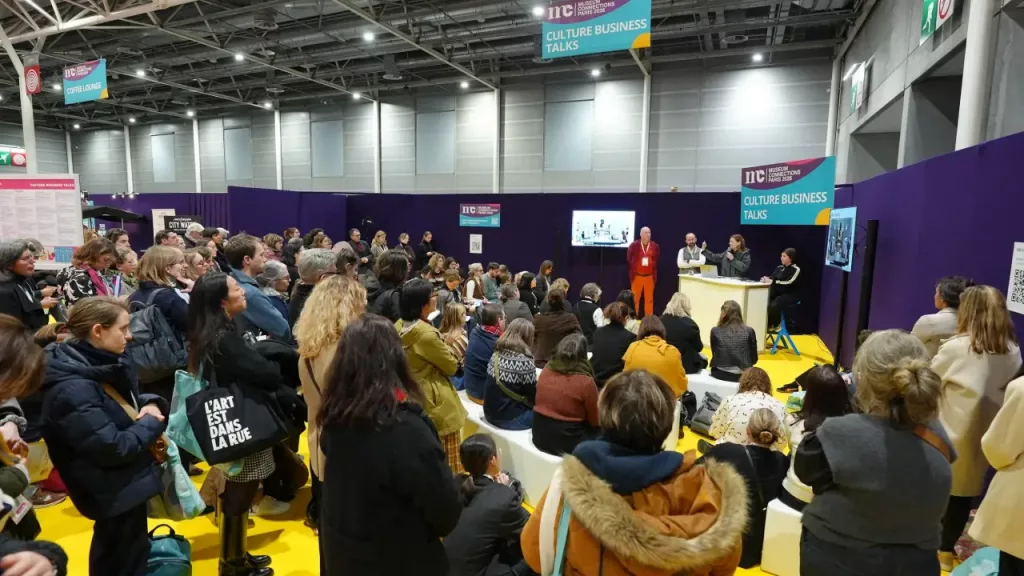
In his view, the challenge is not to “create immersive experiences” just for the sake of it. It is to take a cross-disciplinary approach: connecting disciplines, teams, and methods, and sharing skills between all visual and narrative arts—craftsmanship, design, contemporary art, audiovisual, animation, comics—and technologies. These intersections of creativity, know-how, and innovation are one of France’s great strengths. That’s what makes the French Touch so unique.
A creative industry with multiple formats
The core of her analysis lies here: “immersive creation” may not be a homogeneous sector, but rather a constellation of markets. She evokes the diversity observable in festivals and professional markets, and the way in which some works are closer to cinema, others to a contemporary art biennial, and still others to a heritage mediation project.
This diversity has one virtue: it proves that immersive technology is not a single niche, but a set of formats capable of infiltrating already structured sectors, with economic models that can be relied upon.
But this diversity also has a cost: it increases friction. In the exchange, the question comes up directly: does this “scare” museums? His answer is clear: it’s not so much a question of fear as it is a question of ecosystem. Museums have significant constraints (security, budgets, organization), and in the current budgetary context, everything becomes more difficult.
Above all, she highlights an issue on the production side: each player developing “their own platform” contributes to making distribution more complex. She does not criticize the studios—on the contrary, she emphasizes their excellence—but she puts her finger on the crux of the matter: formats and standards. Until the sector converges on “two or three standards,” the circulation of works will remain costly, fragile, and difficult to industrialize.
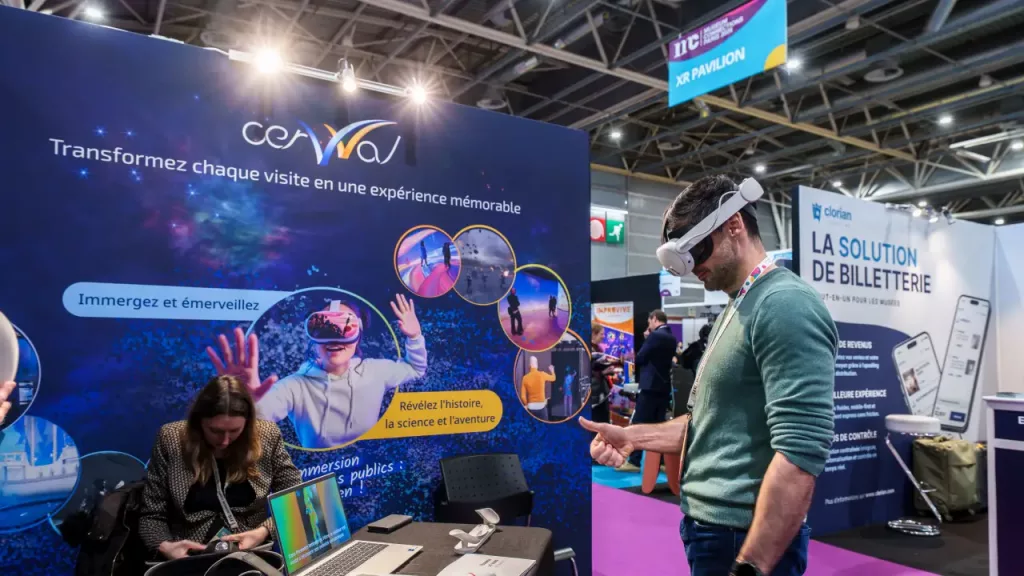
Finally, she issues a fundamental warning about content: if immersion boils down to a series of augmented guided tours, enthusiasm will wane. In the discussion, the example is clear: a guided tour of a museum may be appealing, but endlessly repeating this model is not enough to create lasting desire or justify systematic visits by the public.
What she hopes for is a broadening of the scope of writing: mobilizing artists, art and design schools, and allowing the emergence of works whose intention is not solely “mediation,” but creation in its own right. She compares this moment to the arrival of video in art: at first unthinkable, then gradually adopted, until it became a natural medium.
Scaling up: the “collective” as an ambition
When the conversation turns to venues, Romane Sarfati refuses to give magical answers. Yes, dedicated spaces are emerging, yes, museums are considering immersive rooms, and yes, “anything is possible.” But she immediately brings the discussion back to reality: it is necessary to identify the right formats and content, and remain attentive to the financial balances and support structures that shape certain venues.
In other words: providing venues will not solve everything if the sector does not simultaneously resolve the issue of the circulation of works, standards, and operating models.
Her strongest criterion, the one that guides her monitoring, is almost simple: the ability to share an experience. She is interested in devices that allow people to stay connected, to exchange ideas in groups, to experience something together—family, friends, visitors, school audiences—because in cultural venues, the value of the collective is central. “Moi Fauve” by Studio Small is an interesting proposal in this regard, as the narrator manages to get a group immersed in a poetic universe to sing while raising their awareness of ecological and cultural issues.
With this in mind, she is particularly interested in connected glasses, not as an alternative to VR, but because they potentially open up less isolating uses that are more compatible with an experience that is both immersive and social. She also cites non-isolating audio, and more broadly, all forms of immersion that do not prevent conversation. Le Confident at the Hôtel de la Marine is a good example of this. Another example is the Kandinsky exhibition, Music of Colors.
This is a decisive factor for adoption: if immersive experiences are to become a permanent fixture in venues, they must become experiences that people talk about, share, and compare, just as they do after seeing a movie or a show. She also believes that this poses a design challenge: inventing truly intergenerational experiences that can work for very different audiences, such as Novaya’s NOIRE (COLORED), which makes brilliant use of mixed reality.
Finally, she opens up a path that goes beyond technology: immersion can also come from practice, workshops, gestures, and participation. She evokes formats where visitors are valued for what they produce, and cites TeamLab as a reference for experiences that make participation visible and rewarding. We can go further and truly encourage visitors’ creativity. In this context, AI can be interesting if it serves constructive participation rather than simply being a fad. On a completely different note, a creative workshop that confronts visitors with materials such as ceramics, textiles, or paper can also be particularly rewarding as an immersive experience over a long period of time. We need to be able to invent hybrid proposals that engage all the senses.
Ultimately, his message is demanding and rather stimulating: immersive technology does not need to be “the latest fad.” It needs to be mature. And maturity, in this case, is not measured in terms of technology, but in the sector’s ability to agree on a few standards, to expand writing beyond mediation, and to design truly collective experiences, designed for real places and real audiences.
Leave a Reply
You must be logged in to post a comment.