
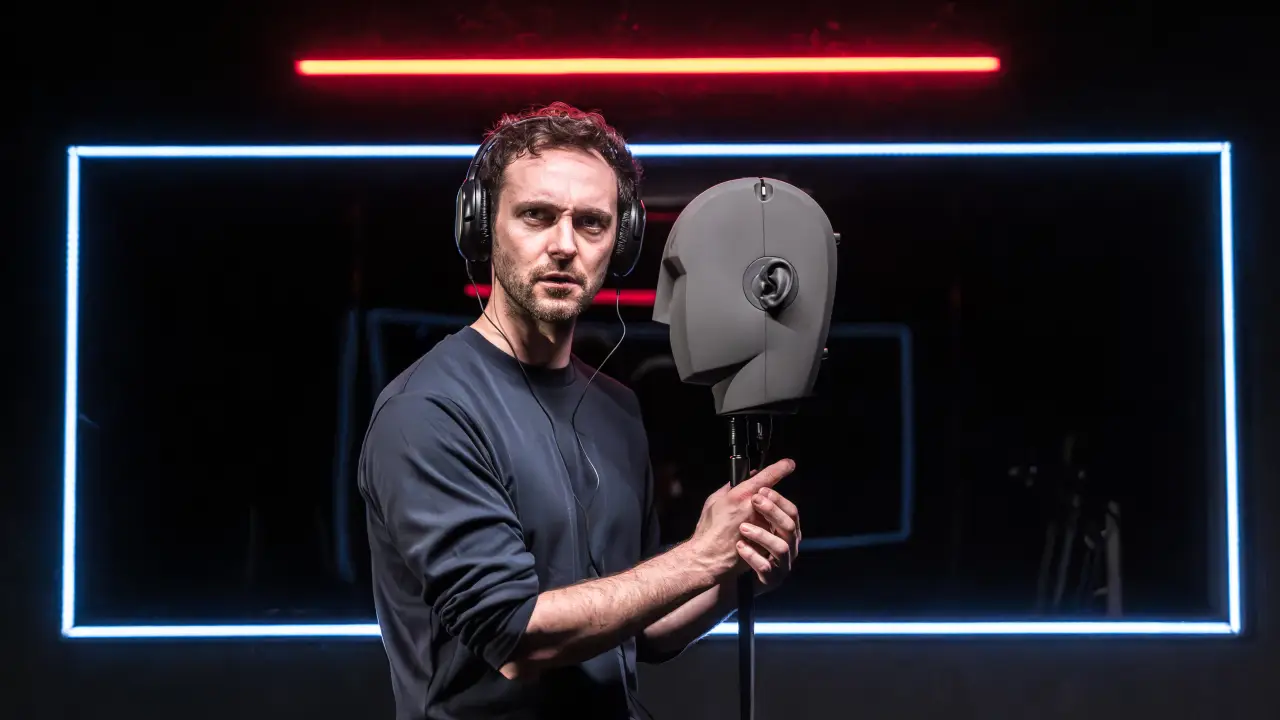
An in-depth look at Jamie Armitage’s new stage production, A GHOST IN YOUR EAR, currently running at London’s Hampstead Downstairs (Hampstead Theatre) until 14 February. A horror story that uses binaural sound and the emotional exchange between actor and audience to deepen the live experience of theatre.
Cover: A GHOST IN YOUR EAR – George Blagden 📸 Marc Brenner
An actor arrives late at a sound studio for a last-minute job that he is yet to see the script for: an audiobook recording of a particularly chilling ghost story. But as the evening progresses, the horrors start to escape the pages of the story, and haunt the studio itself…
— Spoiler alert: this article contains plot and scene details —
There are events that, even on paper, already have everything it takes to grab your attention. Sometimes there’s just something behind an idea that makes you instantly think: someone had a Vision, with a capital V, here. And you simply can’t wait to find yourself right in the middle of it.
That’s exactly how it was for me the first time I heard about A GHOST IN YOUR EAR, the latest production by theatre director and writer Jamie Armitage, co-director of the musical SIX with Lucy Moss, and the author of An Interrogation.
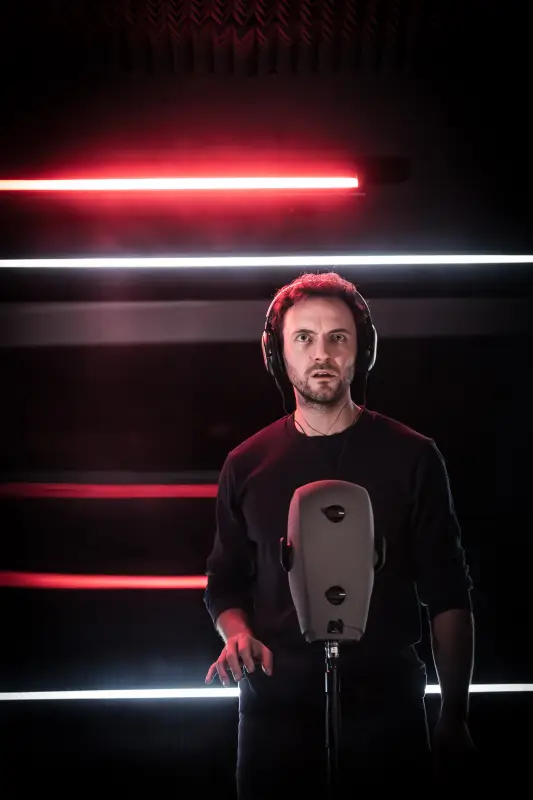
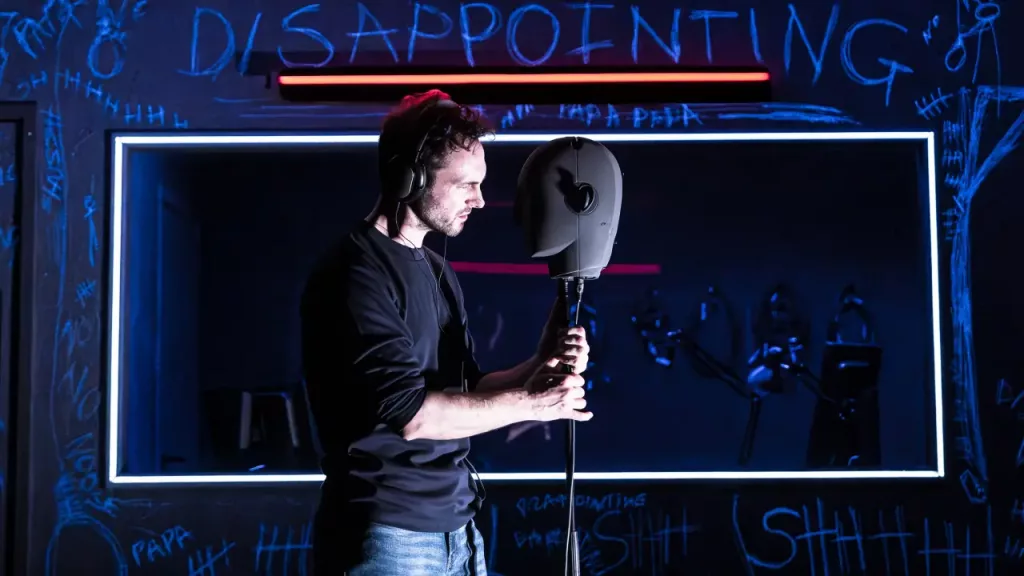
A GHOST IN YOUR EAR is a horror theatre show that uses binaural audio. Put simply: the actor speaks and moves around a mask/microphone, and the audience — wearing headphones from the very start — hears everything in a three-dimensional soundscape.
We all know horror relies heavily on sound. Take the audio out of The Ring and you’re left with a girl who urgently needs a physiotherapist, and horses awkwardly somersaulting off a moving ship. Sight isn’t always the point (and sometimes it can even get in the way): turn off the lights while you’re exploring a cave and even the perfectly normal drip of water from stalactites starts to feel like an omen of imminent doom.
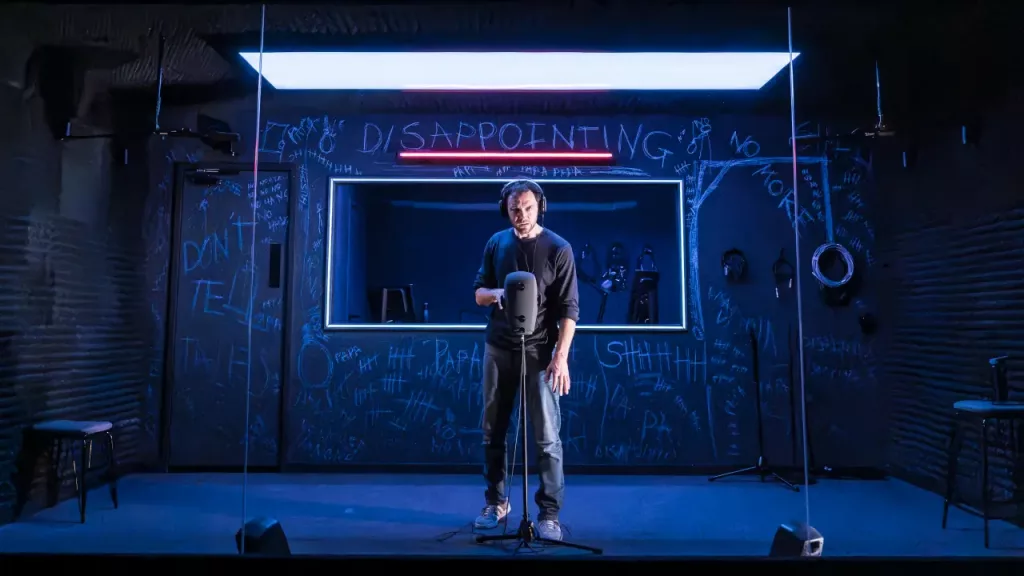
So, A GHOST IN YOUR EAR starts from solid ground, playing with some of horror’s most familiar tricks. Yet from minute one, it feels new. Not simply because it uses technology, but because that technology is woven into the story: an actor in a studio recording a horror audiobook that, over 90 minutes, spills beyond the fiction… and beyond the stage itself.
Even in the onboarding, there’s a nice sense of care and thoughtful choices behind it: a corridor lit by a mysterious red glow leads us into a room where the stage is obscured by a sheet of glass reflecting our own faces back at us. It’s a moment that, beneath the obvious excitement of entering the theatre, carries that note of psychological unease and that suspension of reality that feels very Edgar Allan Poe. I sat down with my heart already in my throat and a grin on my lips, spiritually ready to hug the stranger to my right at the first jump scare.
What followed was a ninety-minute performance carried by George Blagden — with Jonathan Livingstone in a key supporting role — to whose talent I can only bow. He leads you through a gradual slide from irony into deep terror, with a physicality that’s almost sensual in the elegance of his movement around the binaural mask, and yet profoundly emotional. You don’t just witness the fear building; you feel every other emotion too, carried straight into your ears by his voice, his breath, the small sounds of his gestures.
The connection you build with his character becomes one of the most interesting elements of A GHOST IN YOUR EAR, and it’s something I had almost overlooked at first, back when I was only fangirling over the idea of the binaural side of the experience.
After seeing the show, I felt a very strong urge to go back and watch it again. But location and time zones were in the way, so I found another solution: I asked the director, Jamie Armitage, to tell me about this Vision. And I’m happy to share our conversation with you today, in the hope of meeting A GHOST IN YOUR EAR again at one of our future immersive events.
Turning tech into a story
AGNESE – I know you mentioned that this project comes from your interest in technology, but why now? And what’s the origin story of A GHOST IN YOUR EAR?
JAMIE ARMITAGE – I first experienced binaural sound and binaural headphones about ten years ago. I watched a show called The Encounter by Simon McBurney via a YouTube livestream while I was in my uni bedroom, and I was completely blown away. Even with terrible headphones, the power of binaural sound was incredible.
Since then, I’ve long been drawn to the idea of making a show that could use it. But I also wanted to make sure the technology was genuinely justified within the storytelling, because if it isn’t, it risks feeling like a gimmick. And it’s not that compelling if you haven’t managed to integrate it into the story.
So after years of wanting to do a show with binaural sound, and specifically a horror show, I eventually settled on the idea of the recording studio setting. That immediately clarified why the audience would be wearing headphones, and why the actor would be speaking into a binaural head. That was the turning point, the moment it clicked: I’d gone from a vague desire to use the technology to a specific idea for how it could work in a show.
The third character
A. – Technology works best in immersive experiences when it disappears behind the story. But in A GHOST IN YOUR EAR, it both recedes into the background and functions as a character. How do you balance those two roles without breaking the audience’s immersion?
J. A. – There’s always a risk of tech getting in the way of an experience, but the biggest danger is when it’s just an add-on, rather than something integrated into the story and justified by it. That’s exactly why we started thinking of the technology as a character, as you said: it gave it a clear narrative function, not just a technical one. From that point of view, it was probably the most useful framing, because that’s how we see it: the binaural head, whose nickname is Bin, is the third character in the show. That was our way in.
The other way we thought about it came from what our sound designers, Ben and Max Ringham, talked about, which is to think about it as “point of hearing.” So often we talk about what our point of view is, but their argument was that your point of view remains that of a normal audience member, while your point of hearing can shift. That became a key idea for me, because it unlocked the possibility of playing around with where you’re hearing the show from.
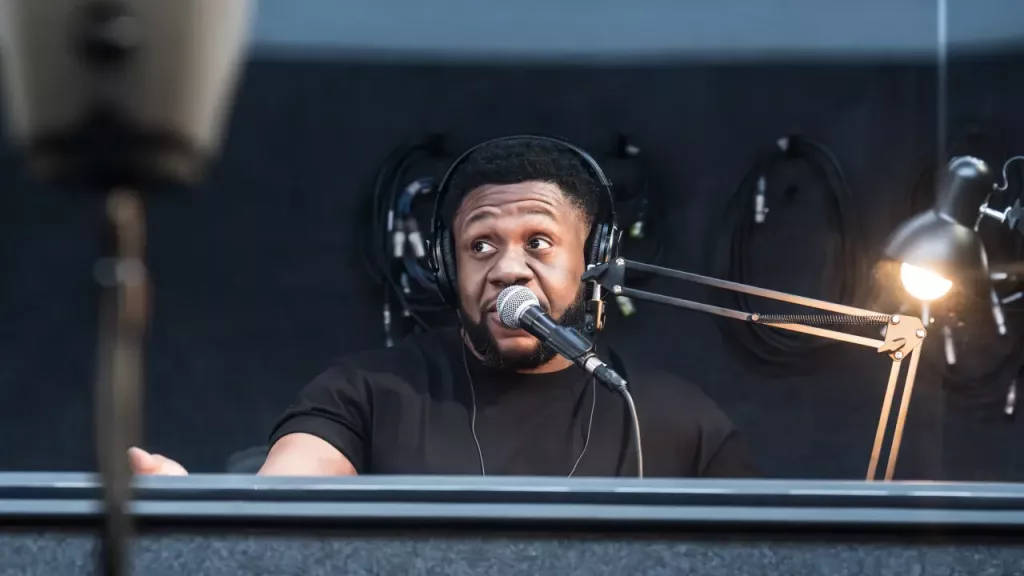
A. – Was the ghost’s design intentionally meant to echo the binaural head? There was an obvious strong visual similarity there.
J. A. – That’s very much part of our approach with the show: adding lots of playful layers. A lot of audience members might never notice them, or might not pick them up the first few times, but they’re all there. And I think even if you don’t consciously spot them, you can still feel them.
If the ghost simply looked like a scary monster, it would read as fun and frightening, but you wouldn’t necessarily know why it feels right. Whereas when you see him, there’s an immediate sense that he belongs to this world, even if you don’t consciously realise he matches the head.
A new language on stage
A. – How does working with this kind of technical toolkit change the way you write and tell the story?
J. A. – On the writing side, it felt different because I had to write a story in prose, rather than in the form of a conventional play. But even within that, I knew sound would be central. So throughout the story there’s an almost absurd number of references to what you can hear and what sounds are present. Not only in direct terms like “I heard this,” but also details like the mud squelching as I walked up the drive, tapping sounds, that kind of thing. There’s a constant sense of focusing on the aural quality of it.
We were very deliberate about sticking to that. We don’t really talk about smell or taste, for example, because it was a question of choosing your senses and staying with them.
A. – How does working with binaural sound, and this technology-led approach to storytelling, affect the actor’s performance?
J. A. – It changed things a lot. George Blagden, who leads the performance, kept saying it felt like being asked to play the guitar without having had any lessons. He’d ask, can you teach me how to use the head? We had to explain that no one really knows how to use it yet, so we were having to develop the vocabulary as we went. That was challenging for him.
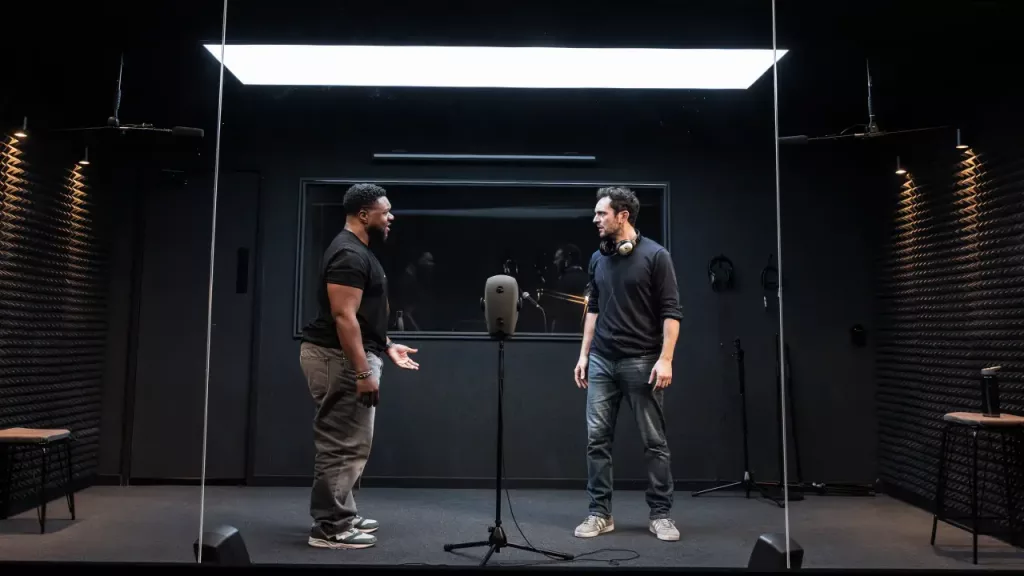
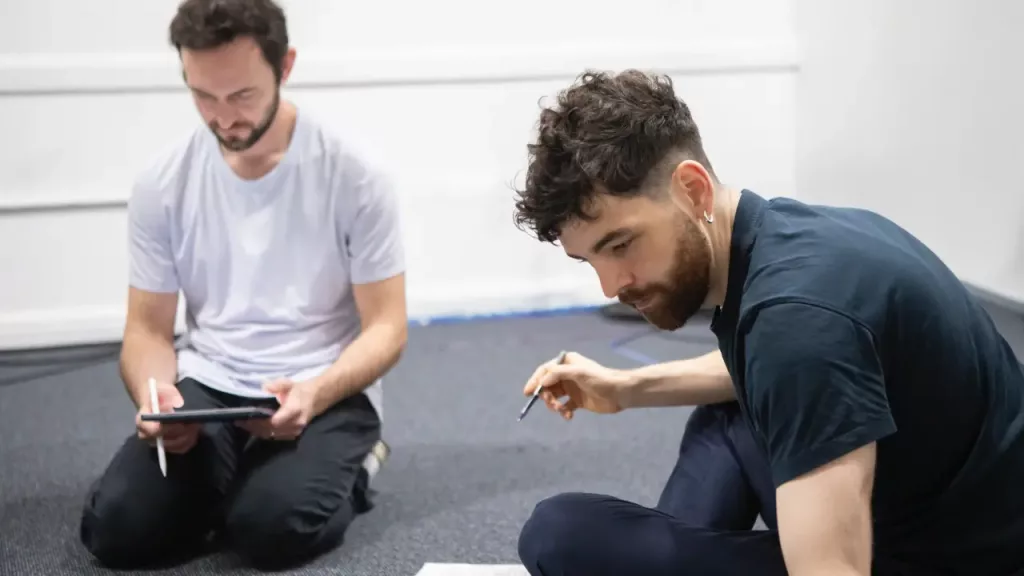
In the end, we did a lot of play sessions where we’d take turns with the microphone and see what we discovered. Many of those discoveries made it into the show; some didn’t. But that willingness to explore, and to acknowledge how new it all was, gave us more freedom to experiment. That process is still ongoing: George makes different discoveries every single night, which keeps the piece feeling fresh, and each performance teaches us something new about the sound, the space, and the story.
The paradox of isolation
A. – You often mention a defining characteristic of horror: its communal aspect. One person jumps, everyone jumps, and then you all giggle about it together. That definitely happened during the performance I was in. Yet immersive tech is often criticised for isolating people, and I’ve heard the same said about binaural headphones. How do you respond to the concern that this kind of setup can make a shared experience feel isolating?
J. A. – It’s an interesting concern. For this story, I actually think isolation helps. The audience reaction is different from what it would be without headphones. People often describe it as solitary, even though you’re still aware of everyone around you.
That’s something I find very curious. Normally, it’s all about the communal aspect. Here, something happens where people are simultaneously very locked into the story, and also highly attuned to the jumps and screams around them. I honestly don’t think I fully understand what that is yet. But we did get a really clear insight into it from one note about the ending. When the curse is passed on and the noose drops down above the audience, we used to have five nooses. People kept saying it felt strange, because they thought they were the one being given the curse, so why were they seeing five? In that moment, you suddenly became very specifically aware of the audience and it feels like an interesting threshold.
Pacing the tech to the audience
A. – Did A GHOST IN YOUR EAR change from its early version to the one you have now?
J. A. – The show is about 15 minutes shorter now. When we started in early December, it ran just under 100 minutes, around 97, but now it’s about 82.
That came out of a few things, but it was mostly on the story side. It felt like audiences wanted to reach the more exciting elements sooner. The biggest change is that there used to be a whole additional section, another night and another day.
Originally, our character would have the first day where he arrived at the house and wandered around. Then, on the first night, instead of him leaving his room and exploring, there was a section where he heard a tapping sound and it was about working out whether it was coming from the left or the right. That was one of those moments with the tech where, when I wrote it, I thought it would be really fun. But by that point in the show, the audience had already adjusted to the headphones, so they weren’t that impressed or that scared by the question of whether it was coming from the left ear or the right ear. They already understood the headphones could do left and right.
That was probably my biggest lesson with the technology: you have a certain amount of time before you need to do something new with it, and then you do need to do something new. That’s why, later in the show, he starts moving the head around the space, and eventually he takes the head off the microphone. It was always important that, in each section, we were doing something we hadn’t done before, so there was a sense of progression with the technology.
Binaural sound as emotional storytelling
A. – For me, binaural sound didn’t just heighten the fear, it also added real emotional weight to certain scenes. Do you see it as a tool for empathy that can be used in other kinds of performances, too? Would you want to use it for different emotional registers?
J. A. – Absolutely. I think we all felt that we’ve only scratched the surface of what’s possible with these headphones and this microphone. And what you’re describing also connects back to your earlier question about technology sometimes being seen as distancing: in this case, I actually think it brings you much closer.
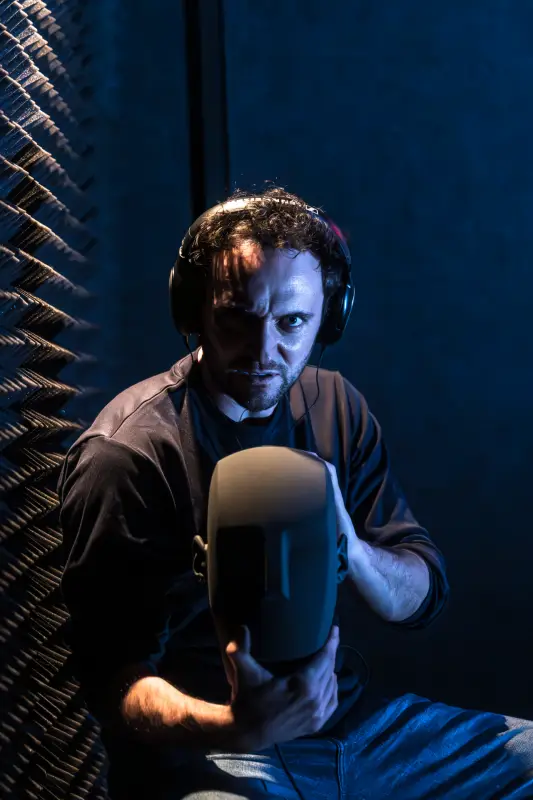
You almost never get to hear someone, let alone an actor, that close up, unless it’s someone you’re genuinely close to, someone you have real intimacy with. We know what it feels like when someone is crying on our shoulder, but that’s usually a close friend or a loved one. So I think that’s a beautiful example of the technology unlocking a kind of intimacy that’s otherwise impossible in theatre or film, and that can really only be achieved in this way.
Expanding theatre
A. – Immersive experiences sit at the crossroads of several forms — theatre, cinema, games, music, art, installation. When you look at A GHOST IN YOUR EAR, do you still see it primarily as theatre, or does it feel like it belongs somewhere else? More broadly: is immersive work expanding existing art forms, or is it becoming something new—its own medium?
J. A. – It’s such an interesting question, because I feel that, at least in British theatre, the word “immersive” is overused. Nobody really knows what it means anymore. Does “immersive” mean you’re in a non-traditional theatre space and the experience surrounds you? That’s what I’d instinctively call immersive. But technically, immersive can mean anything that immerses you: a really good play, just someone on stage, no tech at all, can be immersive.
So I go back and forth, and I’ve become very, very careful about using that word. With this piece, I do still see it primarily as theatre, because it takes place in a theatre. There’s a live storytelling element, and the main focus is the story rather than the technology, or anything else. The technology is a means of telling the story, not the impressive element in itself.
I think that’s where my experience with VR has often been different. I feel that, too often, the focus is on showcasing how impressive the medium is, rather than using it to tell a story. I’d love to do some work in VR, but my interest would be in how you make VR the second most interesting thing, after the story.
A. – After this run at Hampstead Theatre, what happens next? Do you see the piece touring, or reaching audiences in other countries?
J. A. – We hope so. It’s very difficult to tour a show, especially one as intimate as this. But because the response has been as passionate as it has, there are definitely conversations about a future life. We’re still figuring out what the best path might be.
Personally, I’d love to share it with as many audiences, in as many different countries, as possible. This is a show that means a great deal to me, and I particularly love seeing younger audiences, teenage audiences, get so excited by it. They scream, they lean into it, and it does for them what some of my favourite shows did for me when I was a teenager: it shows the power of theatre, and how thrilling it can be to be in a theatre. So hopefully we’ll be able to take it further.
A GHOST IN YOUR EAR runs at Hampstead Downstairs until 14 February. Don’t wait too long for tickets: January is already sold out!
You can follow updates on the piece, and news about its future, on the show’s Instagram page.
Leave a Reply
You must be logged in to post a comment.