
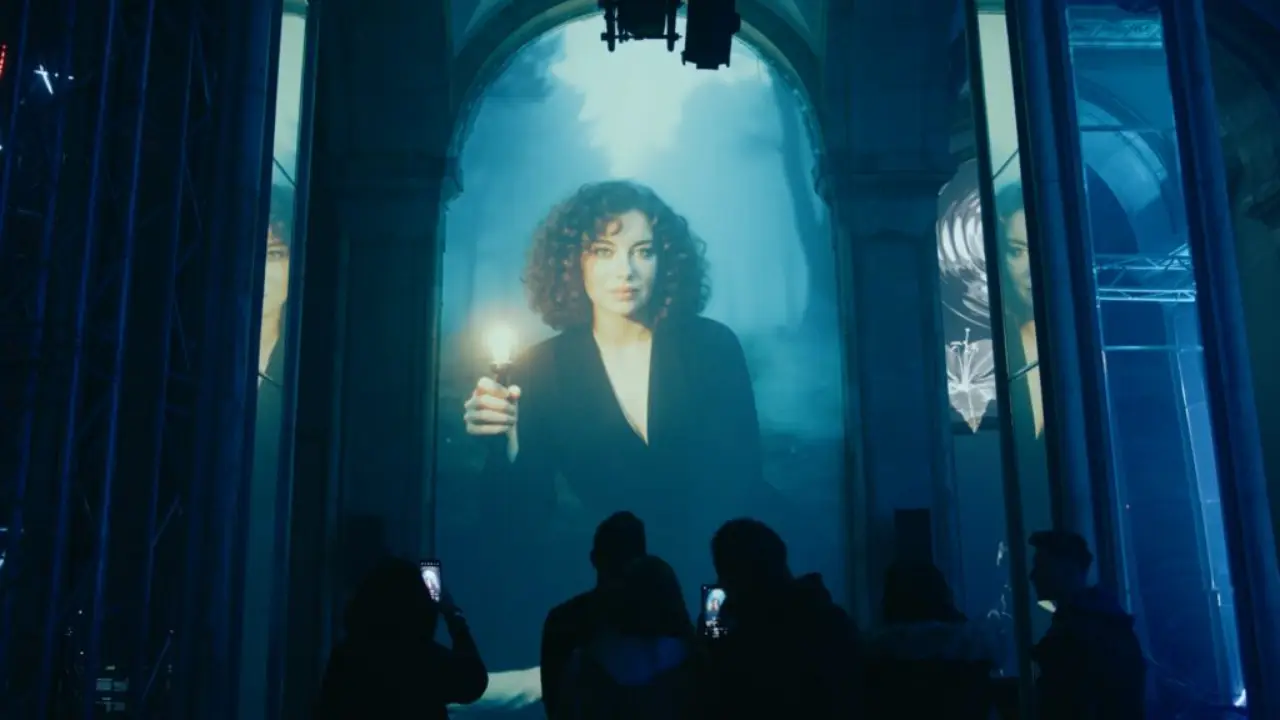
Ahead of the new edition of CPH:DOX Inter:Active, we spoke with curator Mark Atkin about this year’s lineup and the theme Hypervigilance, which frames an exhibition that confronts the collective anxiety of a society on high alert amid digital saturation and pervasive surveillance.
Cover: THE PLEDGE by Daniela Nedovescu and Octavian Mot
Documentaries have a way of slipping off the screen and into your life, sometimes even more so than fictional films. You watch one, and then it keeps working on you afterward: it hasn’t simply told you something, it has found a place inside you, adding a new layer to your mind that will shape the way you perceive things from that moment on.
Immersive documentary amplifies that effect exponentially. Expanding into installations, performances, and spatial storytelling, it is made up of works that ask for your body as much as your attention. These works allow you to step inside a world or a vision, to feel its textures and tensions, to imagine its stakes physically as well as intellectually.
In 2026, CPH:DOX Inter:Active brings all this into an even sharper focus. It is no longer a parallel strand of one of the most celebrated international documentary film festivals; it becomes woven into its soul, right there, impossible to ignore.
This year’s curatorial thread is Hypervigilance, and it’s hard to think of a theme that feels closer to us all. It’s a theme that names something many of us carry daily: that tightening in the chest before switching on the television, that reflex to brace ourselves before scrolling through the news on our phones… the sense that something bad is always about to happen, and that we have to be ready for it.
For Mark Atkin, curator of CPH:DOX Inter:Active, hypervigilance is not just the shared anxiety felt by a society on high alert, but is also a survival strategy historically rooted in queer and trans experiences, in colonised and threatened communities, in those forced to code-switch just to stay safe. But what was once a condition imposed on specific groups now feels diffused across entire societies.
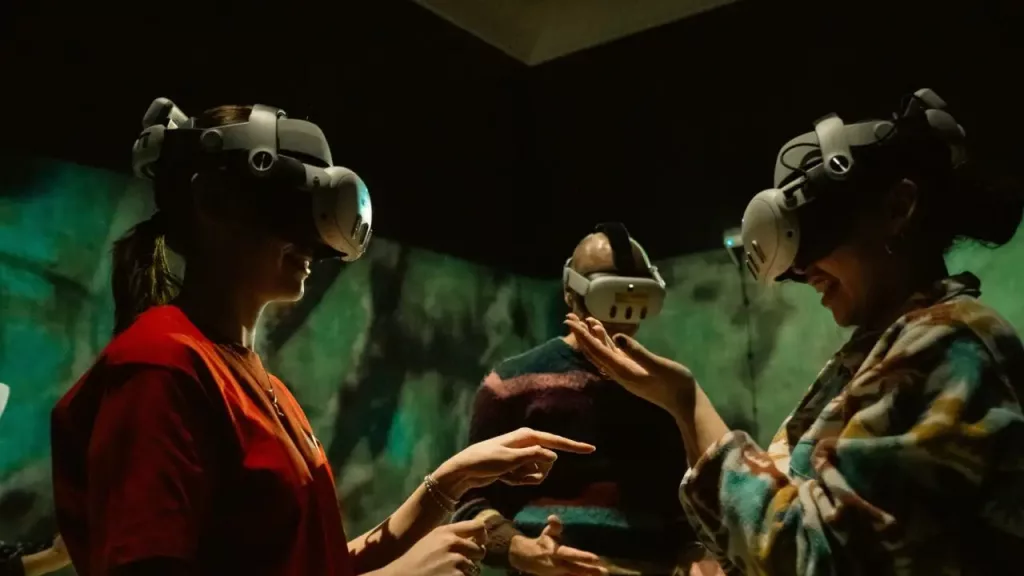
So, in this 2026 exhibition, we are placed directly into this state of alertness, mirroring the way we move through a world where power is increasingly embedded in platforms, policies, corporate infrastructures, and automated systems that shape our decisions while silencing our voices. And in doing so, the lineup poses a fundamental question: how do we live like this, and how do we respond to this constant vigilance and uncertainty that is trying to define us?
Mark Atkin builds a selection in which this question finds its answer in narratives of resistance, in moments of beauty, in artworks designed as shelter. But also in shared, hopeful imaginaries that make us feel it is still possible to turn things around.
A multisensory approach to storytelling
One of the clearest examples of the theme of this edition, as Mark explains, is Palestinian artist Mohamed Jabaly’s My Tent is Not a Shelter, which stems from a sudden rupture: while attending a festival in Tromsø, Norway, years ago, renewed violence in Gaza left the artist unable to go back home. Out of that displacement, this work was created “to turn distance into a personal, embodied space through a tent he built from his own T-shirts”. In this way, My Tent Is Not a Shelter reflects Mohamed’s efforts to stay connected with his family as the city he grew up in, and where they still live, is steadily being reduced to rubble. Rather than showing devastation outright, though, the piece relies on suggestion and tension: “You see images of Gaza before it was destroyed, and the only other sound you hear is the sound of a drone approaching. So, the images you see are not images of destruction… but it’s all implied in the actual piece”.
That logic also runs through a work on trans lives and institutional violence. No Place at Home, made for The New Yorker by Sam Wolson (creator of the intense Reeducated, which we discussed here) and Lilli Carré, follows a mother and her trans teenage child leaving the United States as access to gender-affirming healthcare becomes restricted. “The work lingers on how someone arrives at a life-changing decision, and what it feels like to realize that the place you live in, the place you have always called home, suddenly no longer feels like home at all”. Wolson conveys that shift through images built from family photos, reworked through illustration and layered with firsthand reporting, “so the piece itself is grounded in real reportage, yet shaped by beautiful, personal storytelling”.

Another work that looks at trans experience is IN THE CURRENT OF BEING by Cameron Kostopoulos, which won the Agog Social Impact Award at SXSW. “IN THE CURRENT OF BEING uses haptics and mixed reality to show what it’s like to endure the trauma of conversion therapy as it’s practised on a trans woman. So, again, it’s a form of embodied storytelling, strongly multisensory”.
DARK ROOMS by Mads Damsbo & Laurits Flensted-Jensen was part of the 2021/2022 CPH:LAB, and it is now another key piece of the CPH:DOX Inter:Active lineup. “In each of its stories, the characters are pushed into a state of hypervigilance”, Mark explains. Fear is produced by different forms of coercion: an oppressive religious upbringing that fractures the meaning of home, the social cruelty of school bullying, and the racial abuse endured by the woman at the centre of the third chapter. Yet the piece refuses to end where it begins. As the interview puts it, “all three stories ultimately move toward triumph: toward self-expression through sexual liberation. And that kind of personal liberation can open onto a wider social liberation”.
Mark Atkin also highlights an intimate work by Sacha Wares, who was at the Royal Court in London, and worked alongside Toby Coffey at the National Theatre’s Immersive Storytelling Studio, where she first began developing this piece, titled INSIDE: THE CHILDHOOD OF AN ARTIST. The work tells an extraordinarily beautiful, meticulously constructed story that draws you into what feels like a perfect American childhood shared by two young girls, right before one of them, deaf and with Down syndrome, is taken away without explanation and placed in an institution. This girl is artist Judith Scott: a life that begins in horror, with a violent separation and institutionalization, but moves toward care, reunion, and triumph, ending in the reclamation of agency and the emergence of a celebrated artistic voice. “It’s multisensory in a very direct way”, Mark explains. “You can feel the heat, you can smell the smells. And I think that matters because the whole work is built so you don’t need to hear it in order to appreciate it. In fact, you might not even notice, when you’re watching it, that it’s essentially non-verbal storytelling”.
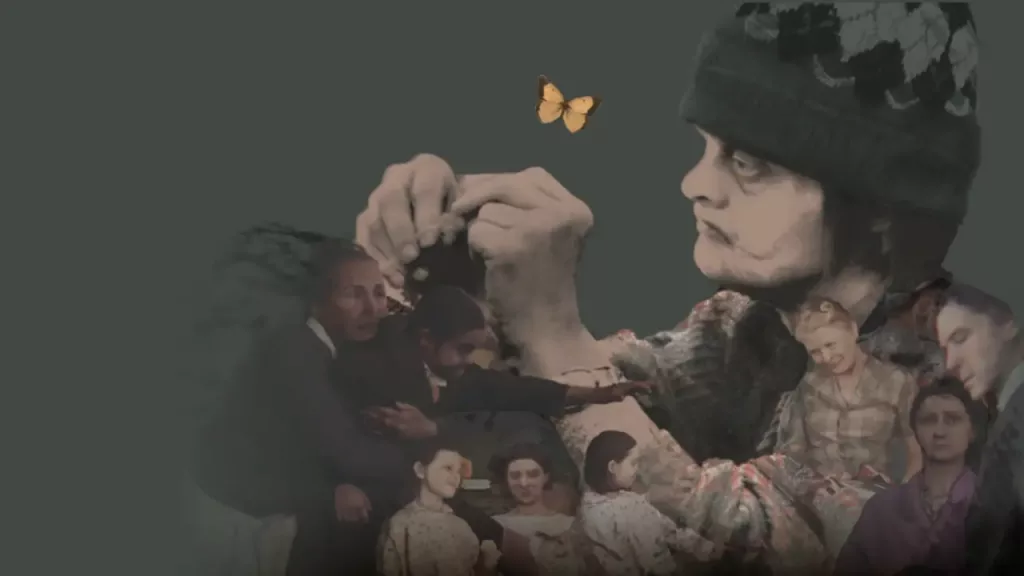
This piece reflects another striking feature of the CPH:DOX Inter:Active 2026 lineup: how immersion is increasingly shaped by artists who develop new languages for storytelling. The Lost Golden Lotus, created by Chisato Minamimura in collaboration with Alice Hu Xiaoshu, is a vivid example: its approach is “unusual and genuinely striking, almost like a multisensory film. The artists have developed a new, highly expressive form of sign language for the piece, which is visually extraordinary. And, again, it’s a work that doesn’t depend on spoken language to be understood”. The Lost Golden Lotus uses scent and taste, tactile soundscapes, and haptic feedback to tell the story of foot binding in China, and how the practice was brought to an end, opening onto a broader reflection on beauty standards across time. “It doesn’t state it outright, but it clearly points toward contemporary pressures too, and what people feel compelled to do to their bodies under today’s exacting norms, including the ones amplified online”.
Horror, AI, and corporate power
If hypervigilance is about threat, it is also about the way societies build “monsters”, and that’s where the lineup’s horror strand becomes relevant.
In the CPH:DOX Inter:Active lineup, horror is not used as a form of entertainment but as a political instrument. That’s what happens in CODED BLACK, a game shaped by the research of Maisha Wester, an academic specialising in Black diasporic Gothic and horror. A key focus of her work is how fiction and society can reduce real people to figures of monstrosity, and how Gothic and horror tropes get used politically in conversations about race. “What’s especially harrowing is that the content is drawn from historical records”, Mark says, “The method behind it has that academic rigour, but the game is also genuinely playable. When I played it, I was honestly in tears, sobbing. It’s that intense”. He also notes the careful balance inside the piece: horror dominates, because history is appalling, but there are also stories of resistance and achievement that prevent emotional paralysis.
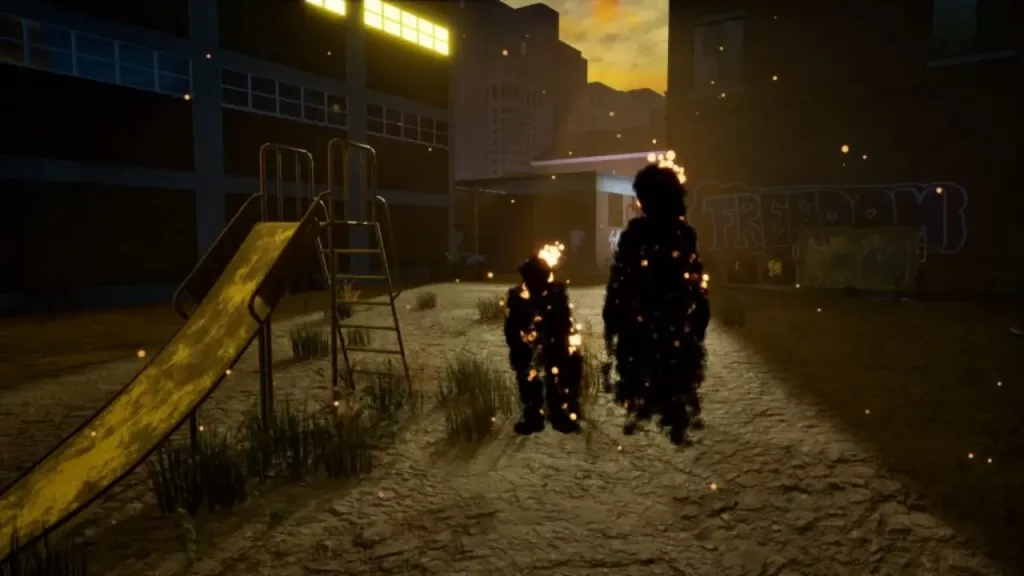
From there, Mark moves to another unsettling work, BRAINS IN THE STATE OF SUSPENSION by Kakia Konstantinaki. “It plays very directly with the conventions of horror, but this piece too sits close to the territory Maisha Wester explores in her research: the way beings can be reduced, framed, and feared as monsters”. The setup is darkly absurd: cryogenically suspended brains wake up in a post-apocalyptic world without humans. To survive, they possess inanimate objects, become monsters, and then face the logic of self-destruction as a defence. Mark Atkin reads it as an allegory of AI and trust, but also as a commentary on the drive to dominate, and humanity’s willingness to destroy even itself to maintain control.
A connected work is THE PLEDGE, by the artist duo mots (Daniela Nedovescu & Octavian Mot): a chilling mechanism that sees you standing on a plinth while a machine assesses you, produces an evaluation, and asks you to read it back into the system. The verdict is often wrong, yet people comply, and that compliance is the artwork. “It’s looking at our readiness to accept automated authority, not unlike how we click through terms and conditions without reading them. It becomes a simple, unsettling test of how easily we bow to a system, and what that says about trust when the system gets it wrong”.
That theme flows directly into a major new work developed with Danish artist Cecilie Waagner Falkenstrøm, presented as a kind of first commission of CPH:DOX. Supported through a grant from the Carlsberg Foundation, Celestis Obscura looks back to the Gold Rush and draws parallels to today’s space race, where private companies can now take objects into space for those who can pay, and where the exploitation of cosmic resources is no longer science fiction but a business strategy. “The piece asks who gets to claim space’s materials, which power structures decide who can exploit them, and whether we’re simply exporting Earth’s inequalities into outer space. The implication is that this is already underway, something many of us barely register yet, but that could reshape things in deep, profound ways. And, again, it points to a broader condition: how completely corporate power is coming to structure our lives, and how powerless we can feel in relation to it”. An in-depth talk with the artist will take place at CPH:DOX on March 16 at 6:00 PM.
Immersive art can therefore respond to personal trauma and questions of social identity, but it becomes especially compelling when it turns its gaze toward geopolitical-scale extraction, corporate sovereignty, and systems of control, while still maintaining intimacy through a multisensory approach: a combination that often defines CPH:DOX Inter:Active and its lineups.
Building hope together
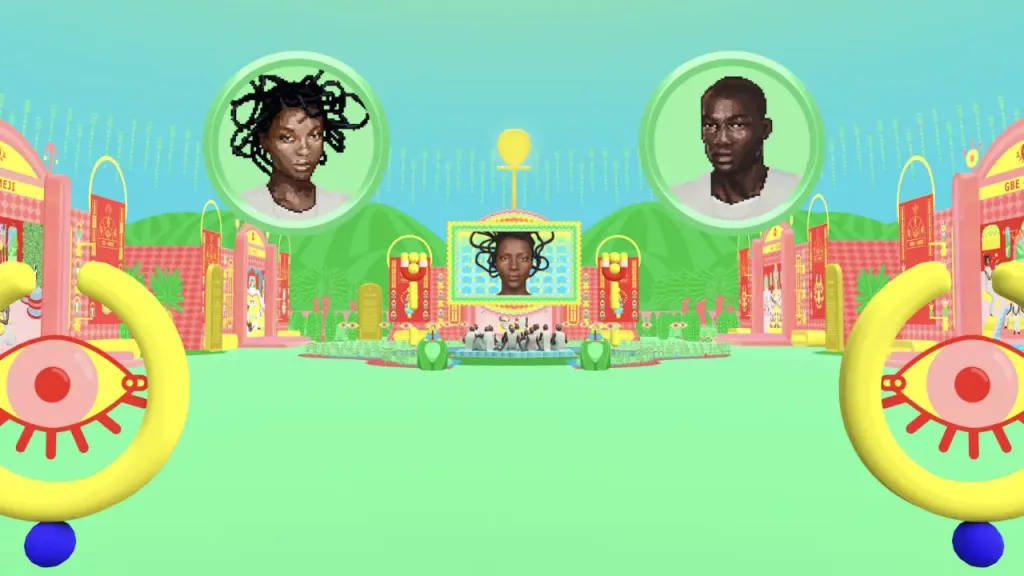
CPH:DOX Inter:Active deliberately positions THE SANCTUARY OF DREAMS by Pierre-Christophe Gam as both the first and the last piece visitors encounter. It’s based on the collective dreams of people across Africa and people of the African diaspora, who have been asked to imagine what the world would look like if you were living more in harmony with nature, spirituality, and love. “It’s there as an antidote to all of the horror and all of the sort of hypervigilant stuff”, Mark explains, “It’s strikingly beautiful. It’s almost sun-drenched, and it’s filled with hope: the idea that we might be able to come together and create a much, much better society. This is the first thing you see as you enter the exhibition, and it’s also the last thing as you leave it. So we hope that people will take a little bit of the idea of the sanctuary with them. It can be a place where they linger for a moment, and then start working out how we need to learn from the dire experiences and the horrible things we’ve done to other people, and start living in a much better way”.
This placement is one thing I also considered very smart. It recognises the weight of the programme, but it also reframes the role of festivals. Inter:Active is not trying to win by being the most shocking. It’s trying to lead audiences through intensity, horror, and trauma, and return them to the world with the possibility of a new start: a necessity if we want to overcome what hypervigilance is teaching us.
Bigger, more multi-sensory, more collective: a new direction for CPH:DOX Inter:Active and for storytelling
In this edition, Inter:Active is no longer confined to a dedicated exhibition zone; it spills into the wider festival through live events and presence in shared areas. “It’s no longer a case of ‘we’re here and the rest of the festival is there’”, Mark comments. Instead, immersive becomes “part of the visible fabric of the festival experience”, something you encounter as you move through the festival rather than something you seek out separately. THE PLEDGE is one of the pieces that challenges the place that immersive work usually has at events like this. It takes place in the courtyard, and it’s the first time the programme moves into such a public area of CPH:DOX.
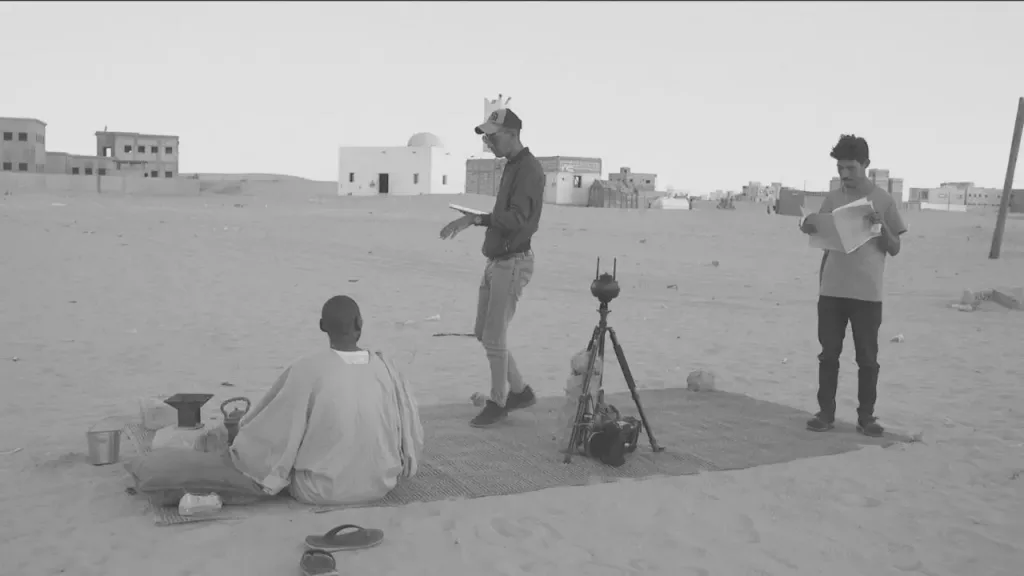
But the Inter:Active section also pushes beyond the festival’s boundaries this year, presenting two works off-site. The first is a preview of TALES OF A NOMADIC CITY by Med Lemine Rajel and Christian Vium. The piece traces the history of Nouakchott, a city shaped out of the desert by nomadic communities. It may lack the fixed, easily legible centre of many cities, but it holds a strong identity rooted in story, history, and shared experience. The work, Mark explains, “points to a particularly compelling direction for immersive storytelling through the involvement of poets, storytellers, and artists from diverse disciplines”.
The second piece is the peculiar BURDEN OF OTHER PEOPLE’S DREAMS: CHAPTER ONE – GANYMEDE by Joe Bini, a “surreal, abstract memoir of Joe Bini’s life as a film editor and storyteller, presented as a live cinema experience for one audience member at a time”. As Mark Atkin explains, “For Bini this is an entirely new way of making a movie – something that is more akin to painting or writing. It brings into question who is the creator and who is the author as it opens up interior spaces of the imagination and asks us to question how we interpret work and infer meaning”.
I’m always terribly fascinated by works like this, where the roles of creator and audience blur, overlap, and keep shifting. To me, that’s one of the key reasons so many people are drawn to immersive and XR, so I cannot wait to experience it at the festival. “It takes up a whole room”, Mark continues, “and we were struggling to find the right space until in a chance conversation with the festival sponsor, the furniture company Montana, we discovered that they have the perfect set-up: a mocked-up lounge in their showroom just a short stroll from Charlottenborg”. A show that should not be missed, as the curator confirms.
Together with this spatial shift, there’s also the narrative one, and the festival itself suggests that multisensory work is becoming central because it changes where immersive belongs. “In practical terms, these are experiences you can’t really have at home. That’s another trend: perhaps we’re moving away from the idea that people will sit at home and put on a VR headset”. The implication is not just technical, but social: fewer isolated headset moments, more formats that feel inherently communal.
Framed this way, Inter:Active aligns with a broader cultural logic. “People talk about the ‘experience economy’: the idea that people are looking for experiences rather than buying things, particularly younger people who feel they’ll never be able to buy a house anyway, so they spend their money on experiences. In a way, the festival as a whole reflects that”.
Immersive, here, isn’t an add-on, but intensifies what festivals already do: bring people out of private space and into shared, time-bound encounters that can’t be replicated elsewhere. One of the many reasons I return to this event year after year with such genuine enthusiasm.
CPH:DOX Inter:Active will take place at Kunsthal Charlottenborg in Copenhagen from 11 to 22 March 2026. Tickets can be purchased on the festival’s official website.
Leave a Reply
You must be logged in to post a comment.