In this new series of articles we want to go deeper into our discussion with XR creators and their art, to better understand the immersive DNA. Our first episode is with François Vautier, director of RECODING ENTROPIA – presented this year at Venice VR Expanded – and previously author of I SAW THE FUTURE and ODYSSEY 1.4.9.
François Vautier – The RECODING ENTROPIA approach is in line with my previous concerns (and works) around evolution. Human evolution, space, the future of man … but also to look for the origins of the appearance of life. And with a real poetic desire, through a concept which allowed to marry mineral and biological references. I am passionate about science, but I also had to take creative liberties to create an all-new universe.
F. V. – If my films have the appearance of science fiction, or cyberpunk sometimes, this is something that I discovered afterwards – through audiences. These are innate influences, obviously from my cinematographic references, but not a voluntary approach. It may seem quite paradoxical, especially after adapting Kubrick on ODYSSEY. For some, I also refer to STAR TREK, although I do not know the series! There are elements of my films that arise from the storytelling itself.
F. V. – I use VR for what it is, and the support itself asks a lot of questions. Where to take the spectator? For me, there is a real proximity between creation and its content. In my first film, it was diving into a futuristic speech by Arthur C. Clarke. This form of virtual representation was the most relevant to represent him.
RECODING ENTROPIA : the genesis
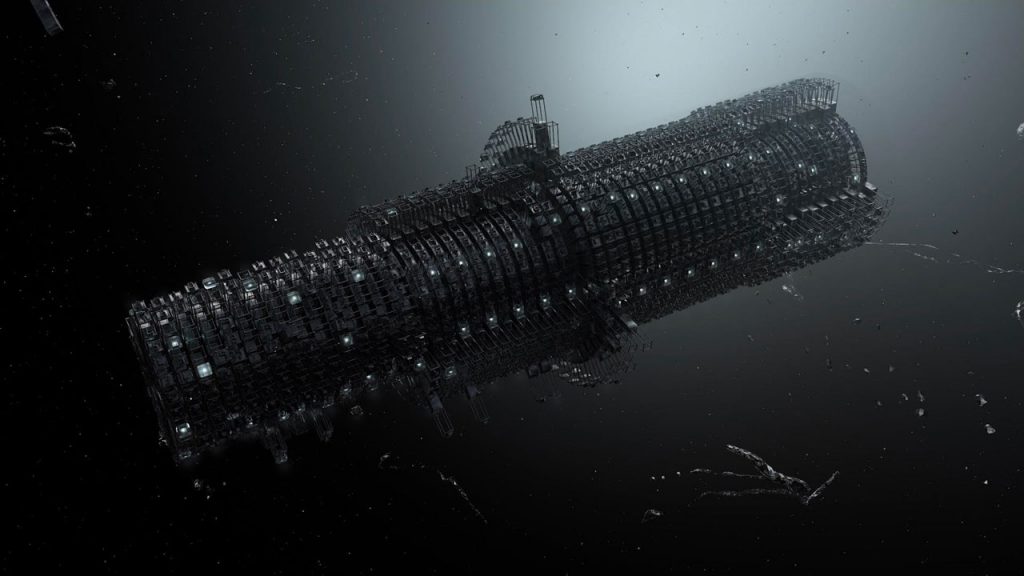
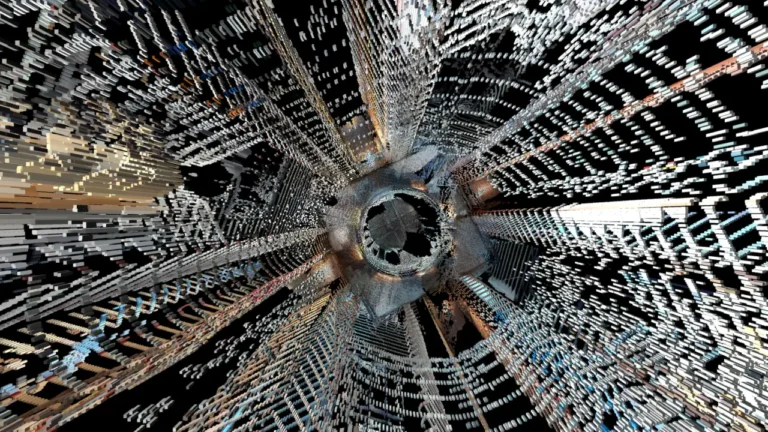
This is the very first image I made – before I even imagined making a movie of it. RECODING ENTROPIA was a happy accident from my lockdown period – which I experienced like everyone else in the spring. I let myself be carried away by this image, which also convinced my producer Jeremy Sahel. I did it quickly, as a concept around a procedural system, and it was this idea that started the real production.
It sounds complex, but in reality it’s very simple: it’s just a tiny module created in Cinema 4D software, with a writing pattern laid on it, all duplicated automatically. In the end, it looks like a spaceship to the viewer. For me, we remain on a mechanical and biological structure at the same time, with rotations, vibrations which are the expression of living things.
At scale
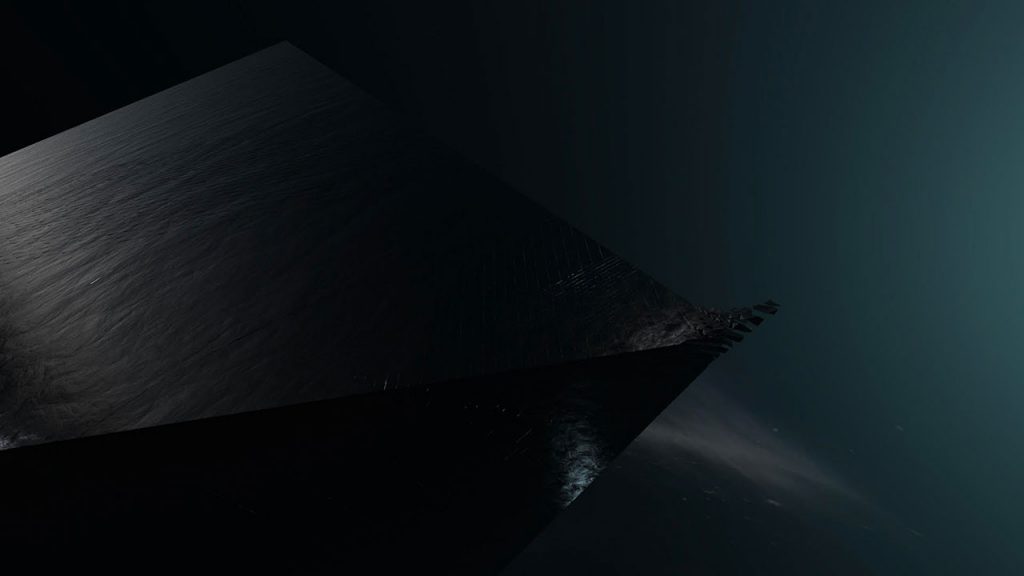
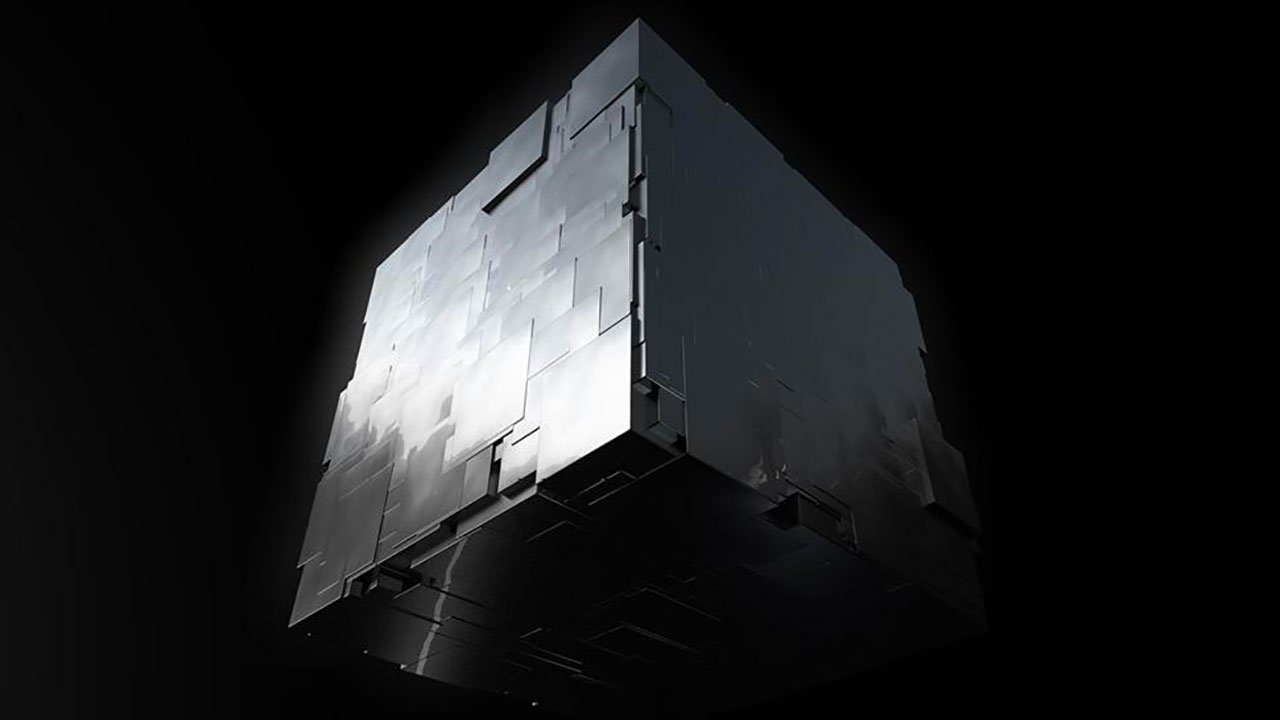
The previous cylinder (ship) arrives in the second part of the film. It had to be staged, working the story backwards. I had to find the origin of this first idea, and come up with a coherent universe around it: science fiction and its codes, especially music (composed by Pascal Bantz).
I worked here on the issue of scale, especially with stereoscopy. It really helps to understand space, to understand that the object in front of us is monumental. It’s a metaphor for this ship, but it freed me from any model to better create one freely: there is no reference here to design it. No need for realism, overbidding on form. Obviously you can see in it as a reference to the monolith in 2001, A SPACE ODYSSEY, like a beginning, the departure of something – see the philosophical idea of panspermia (the spatial origin of life).
Everything is texture
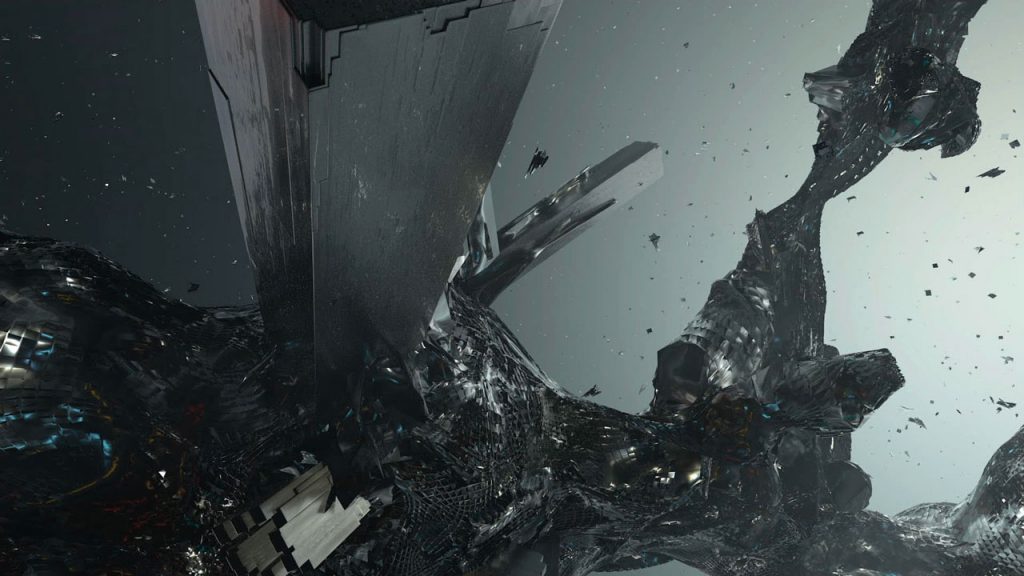
Contrary to what you can imagine, here is a really simple image … in its mechanism. We are at the heart of the story, where all materials are melted, transformed. For me it is a chrysalis of carbon with different materials, from which the pyrite (stone) emerges. Everything here resides in the texture of the materials, which is just a skin on top of the synthetic effects.
I always put constraints on myself, and here is something I didn’t know how to do. VR can have limits – for I SAW THE FUTURE I only discovered its final form at the end of production. Here I regularly checked the progress directly in virtual reality, to verify the texture, the materials, the stereoscopy. And it was all the more complex in sequence shots.
I couldn’t use the depth of field here, I had to work around the light to bring depth to the story.
Deformation
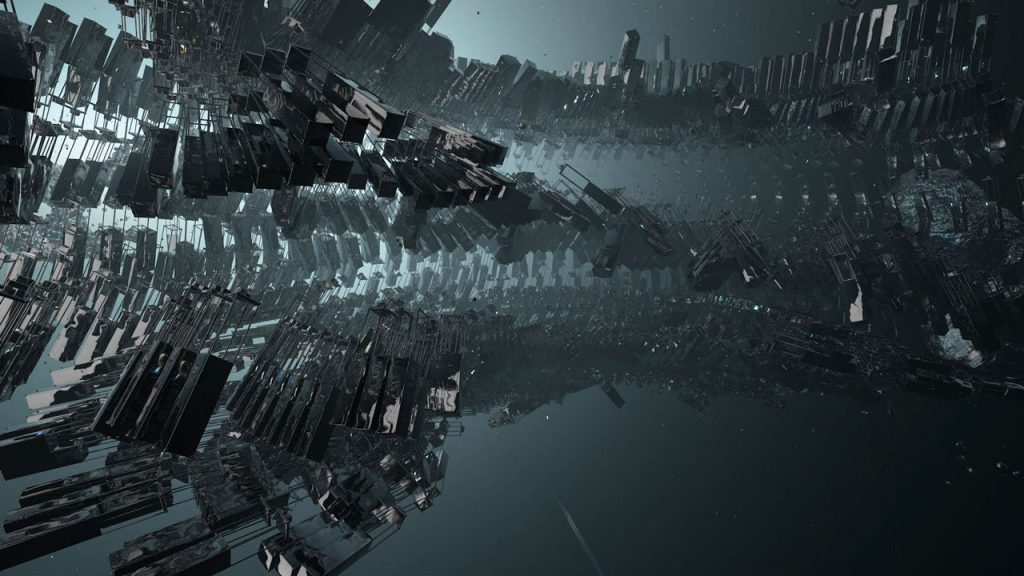
This is the continuation of my central image. Today RECODING ENTROPIA is a non-interactive film, but I still wanted to imitate a form of interactivity with this moment. The ship deforms, surrounds us in a real mutation to interact with the spectator. From the start I wanted our presence to influence the environment.
At times like this I work a lot on sound design and music. Male and female choirs, etc.
Why not Asimov?
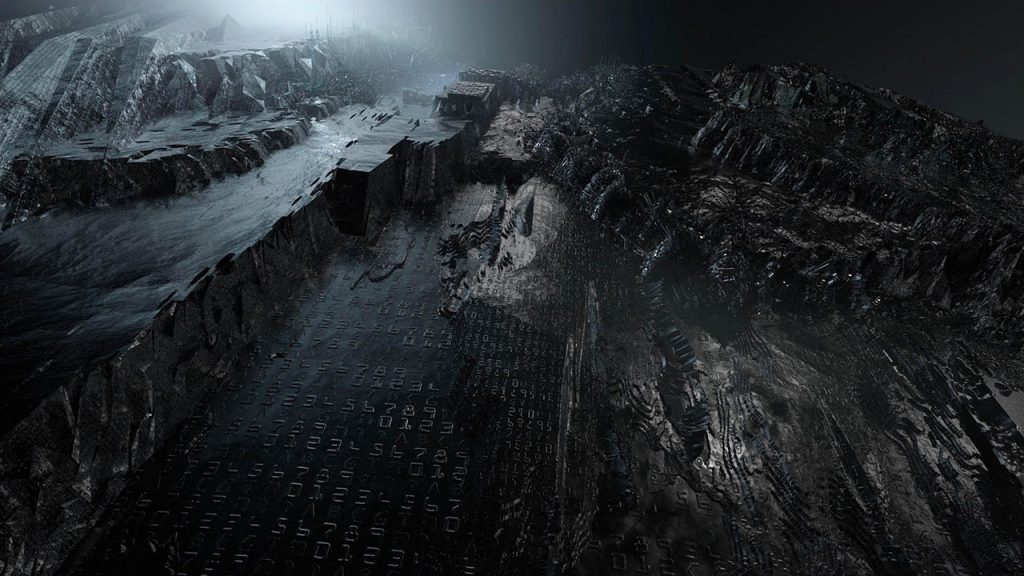
This is what I call GAÏA 2.0. In the very first version of the film, delivered to the Venice VR Expanded festival, it didn’t exist. We could see a planet in the distance, there was an idea of the end of the cycle. And then I founded this (even dreamed of it!) of applying a layer of digital letters on the planet. Within the timeframe set with the festival, we pushed our efforts to the end to finalize this set where we find the matrix of elements already seen in the film.
There is a complex relationship here between this huge planet (the scaling, the great outdoors …) and its details on the ground. I wanted to experiment with dynamics, which appear little but are there. The sequence involves complex lines of code, influences between the different objects with computation times that had to be respected. I let the imagination of the universe unfold like a timelapse – terraforming over several centuries. There is a bit of Asimov in all of this.
I like to confront myself with things I don’t know how to do. On RECODING ENTROPIA I learned every step of the way during these 6 months of production. With real acceleration during confinement, 14 hours a day on average, to be ready for Venice VR. Today I’m starting to train on Unreal to explore new possibilities …