
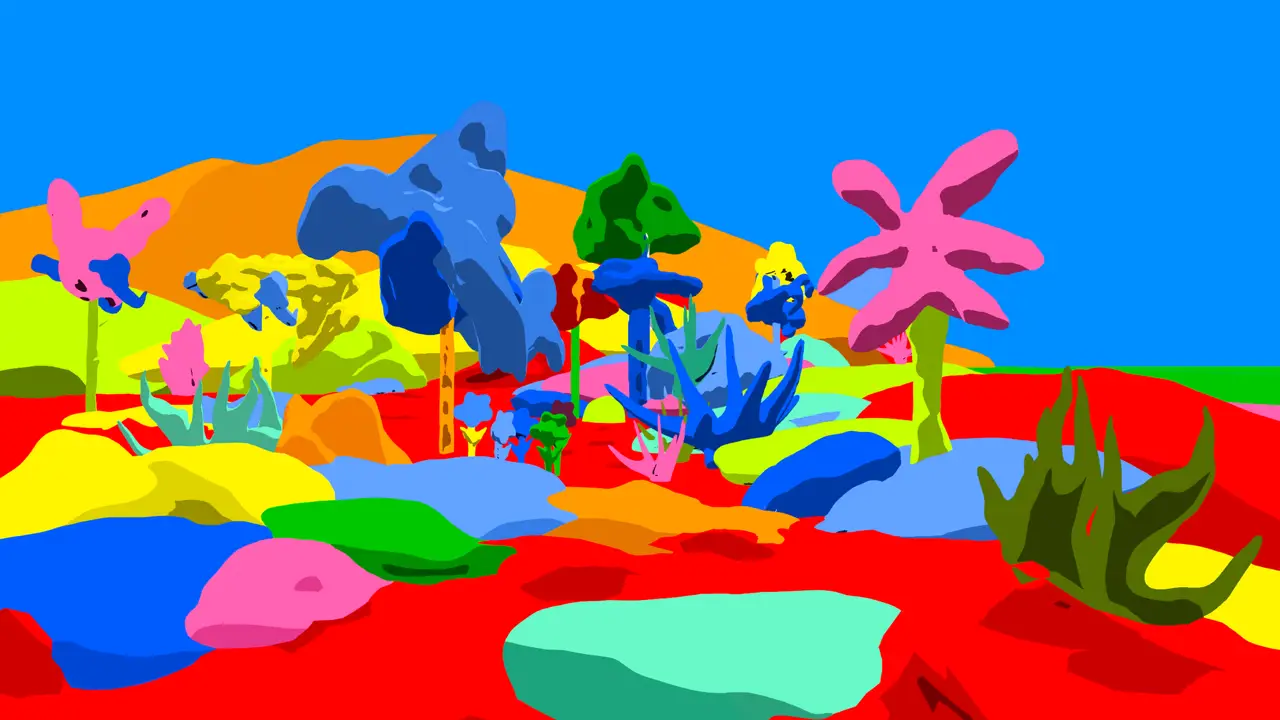
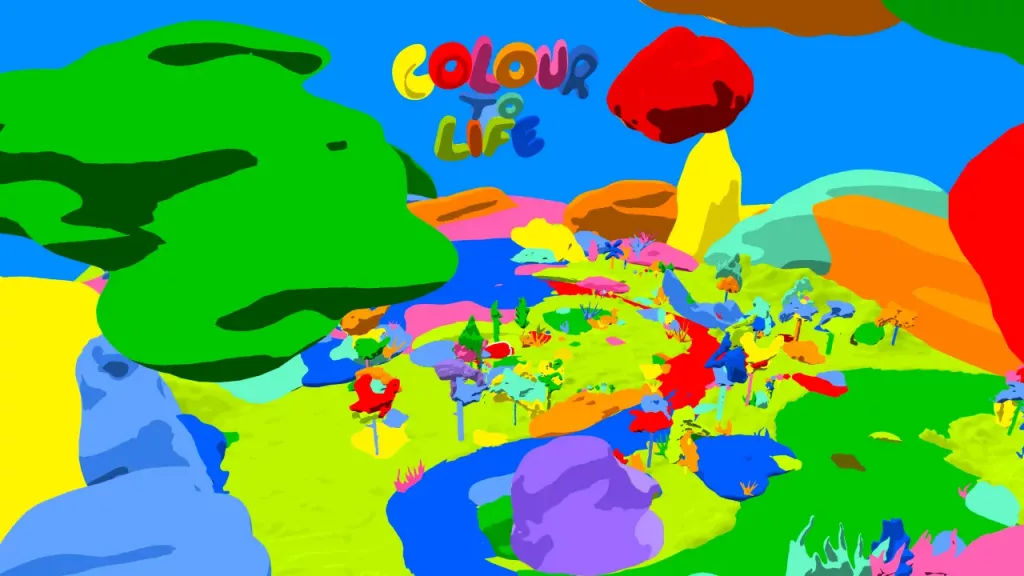
COLOUR TO LIFE is a project created by two students from a HEAD – Genève, Antonin Ricou and Peter Ha: a virtual reality experience in which your gaze brings a monochrome landscape to life through colour and sound.
At GIFF 2025, COLOUR TO LIFE was one of the works that struck me the most. Born as a school project in collaboration with the Swiss Paraplegic Group, it manages to turn simplicity into something surprisingly engaging and brings back memories of those little puzzle games we used to do where areas marked with a dot had to be coloured in until they merged into a single image you couldn’t wait to reveal.
In a field where complexity often takes centre stage – and often produces truly extraordinary things, to be fair – it’s good to remember that you can also go in a different direction and create something beautiful and refreshing in a clear and easy way.
In this way COLOUR TO LIFE comes to join a growing line of reflections and projects that explore how the immersive field can improve people’s lives and help us all feel a little more at ease in the world.
We met Antonin Ricou and Peter Ha, creators of the work, to learn more about their first steps into VR and the idea that led to the development of this thoughtful project.
At the origin of COLOUR TO LIFE
PETER HA – We met the Swiss Paraplegic Group, our partner on the project, during a briefing in our classroom at HEAD – Genève,. They talked about the organization, what they do, and our task was to design a VR game or VR experience for their rehabilitation process.
We were really inspired by their patients. There were two, in particular, who stayed with us. One of them would count all the holes in the ceiling and could tell you exactly how many there were. That told us they had a lot of time and a really sharp sense of observation, and we wanted to build on that. In the other case, a classmate asked a patient what she did for fun and whether she played games. She explained that she didn’t play games but painted, so we knew we wanted to bring in creative expression as well. That is where our inspiration came from.
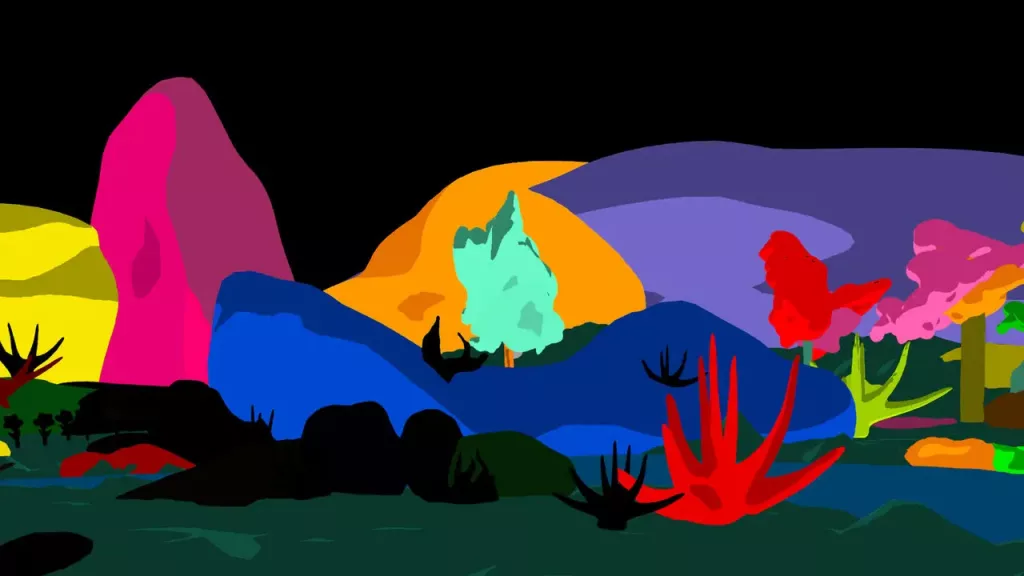
We also started thinking about coloring books and how they are used in art therapy. However, we wanted to flip that idea and place the player in a black environment instead of showing everything right away, so you really have to explore the space and slowly reveal it. And that’s how COLOUR TO LIFE began to take shape.
ANTONIN RICOU – I’d only had one previous experience with virtual worlds myself, and Peter hadn’t really had any, so that was our first big challenge. Without many references it is hard to understand a medium and how to design for it, so we began by digging into existing VR projects.
The other challenge was the people we were designing the project for. Thinking about that helped us define our rules: for example, assuming that players might not be able to move very much and might only be able to use their gaze or at least their head. We wanted the experience to be as inclusive as possible, and we probably would not have come up with this concept without that initial brief. As Peter said, being able to ask questions directly to a patient really improved our ideas.
Both of these challenges guided us toward this result, even though we had many ideas but it took some reflection and ideation to find the right one.
P. H. – I also see this project as an evolution of what we’ve done before. In that same class we had already worked in 3D and had to learn a lot of different software, which helped us create the assets for this experience. In that earlier project, I know Antonin was already thinking about combining 2D and 3D and playing with optical illusion, and that thinking fed into this one. So it wasn’t just a one-off response to this brief. It also grew out of a collection of experiences we had in school.
On approaching VR
P. H. – I come from Canada and I co-founded a graphic design practice, Equal Parts Studio. I’m familiar with designing for websites and apps where user experience is important which helped a bit with designing COLOUR TO LIFE. I’m also a self-taught creative coder and in my artistic practice, I mainly explore form and color in motion.
For creative projects, I always like to examine the medium I’m working with and really ask: what is this medium, how is it different from others, what makes it unique? VR offers an experience that is immersive – although I’m still trying to grapple with whether it’s truly immersive. You’re putting on this headset, which is still a bit clunky for me. I wear glasses, so I’m very aware that something is on my face and I don’t feel completely immersed in the world. But you are in a 3D space, and that certainly makes it more immersive than any other medium.
A. R. – I also have a graphic design background specialized in print and editorial design. I like to think with images and their representation in order to answer societal challenges. But what I really enjoy in my practice as media designer is about hacking things – using a tool or medium not for its original purpose, but twisting it for another one. That creates a sense of surprise, and it’s something I love to do in my design.
For me, that is exactly what happened with this project. We usually expect VR to mean a very complex game and a fully immersive world. Here, instead, it became an exploratory space where you can simply draw.
Navigating challenges through simplicity
P. H. – I struggled with some of the project requirements. One crucial piece of information we were given was that we must not induce motion sickness, which is something many people experience in VR. For paraplegic patients, in fact, this is especially dangerous, because with limited mobility, if they were to vomit it could actually be life-threatening.
So we knew the experience had to be very still and at the same time engaging. That is difficult to achieve in VR, because the intuitive thing you want to do in this medium is move through the space.
Another challenge was the sound. We used GarageBand, and I went through pretty much the entire catalog to curate the different sounds. I would only play one note, and I made sure everything was in the key of C, so all the sounds stayed coherent and consistent. Then, when you bring them into the VR world and activate the different objects, all the sounds feel like they belong together. It took a few iterations to figure out exactly which combinations of sounds and instruments would work best.
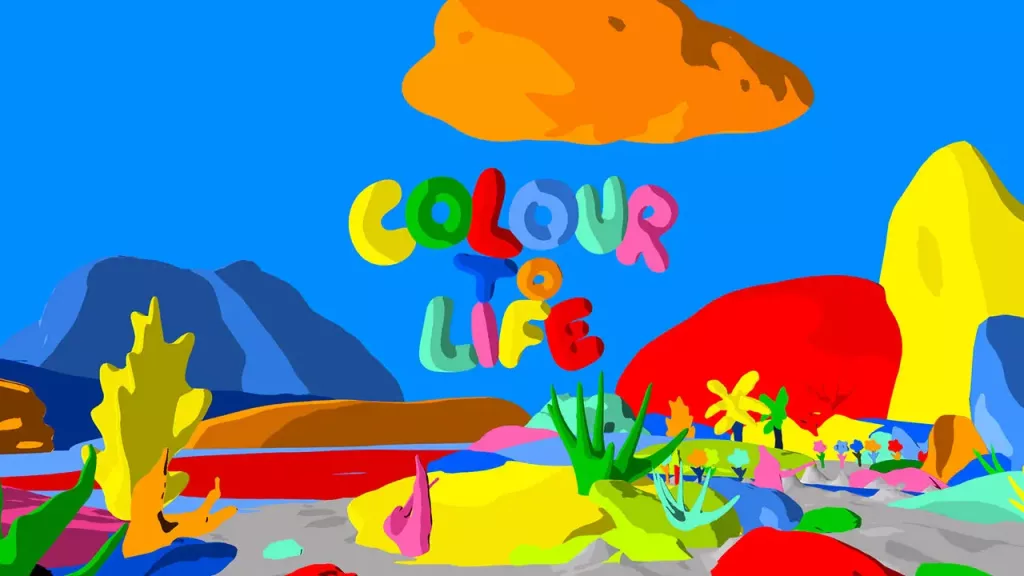
A. R. – Simplicity was one of our main strategies. Once you start to gamify VR, it quickly becomes complex. But this new/old technology already has many layers of uncertainty , and we didn’t want to add more. We aimed to find the most straightforward way for people to use and experience our work.
So it’s through this whole process that Peter and I understood that a VR project works best when it stays simple. And this was confirmed by the audience at GIFF: a lot of people came to us to say that they loved our project because it was easy to understand and super relaxing. It actually seemed to calm people down, which was a really interesting discovery for us.
GIFF, the audience and beyond
P. H. – What’s really nice about our program, the Master Media Design at HEAD Genève, is that we have program assistants who help us submit our work to festivals. They really try to get our projects out into the public, which is amazing for students, because otherwise they can easily stay inside the institution. That’s how our piece ended up at GIFF: through the support of the school.
A. R. – We had the chance to go to the Digital Night at GIFF, with all the partners, press and artists involved in the VR section. A lot of people came to try our project and we received really nice feedback. At one point, two women from an association dealing with mental health at Hôpitaux Universitaires de Genève (HUG) told us they were interested in showing our work to some of their patients. And a teacher of HEAD in interior design who also teaches VR was really keen to present the project in his course. To see that this kind of people, but also kids and older ones enjoyed the project was very special for us, because it means COLOUR TO LIFE can somehow speak to all kinds of audiences.
P. H. – I was really surprised by this response and that people wanted to stay so long and complete the objective of finding all the objects. For us, that’s not really the main goal. The goal is to simply be in this space and relax. We added the progress counter mainly so people would know there is an end. But one person tried COLOUR TO LIFE – and it was their first VR experience – and afterwards they told us they were going to buy a VR headset. It was really nice to feel we could have that small kind of impact.
A. R. – We didn’t just get good feedback. We also came away with ideas on how to improve the work and where it could live next.
P. H. – Indeed, every time we share COLOUR TO LIFE with a different audience, we get very useful feedback. For instance, when we showed it to the Swiss Paraplegic Group, they gave us comments about the sound, and we made revisions based on that. For GIFF, we received some comments on the onboarding and how to make it clearer, so we added a progress counter, which wasn’t there before, and some prompts. Each new submission for a festival or an event is an opportunity to implement new features, and that’s also a big motivation for us to keep working on this project.
Imagining the next iteration of COLOUR TO LIFE
P. H. – Right now we’re very focused on our studies, but we submitted the project to the Swiss Design Prize, and in that presentation we also had to outline possible future features. So we already have a kind of roadmap we’d like to develop, especially if there is more interest in the work.
For instance, since the project was created for paraplegic patients in rehabilitation, we would love to turn it into a multiplayer experience. At the Swiss Paraplegic Group they have a robot that moves between patients with a tablet they can use to communicate with each other. We imagined using that so patients could share the same relaxing world and colors together.
Realistically, the next step for us might be to introduce more animation. At the moment, the only animation comes from the color appearing and the shading. To make the world feel more alive, we could add some movement.
A. R. – The sound is also something we would like to work on in the future. We’d love to make it customisable – for instance, to let you switch the style of music. It’s part of a wider set of ideas about letting people change things themselves inside the experience, so it becomes even more engaging: you could personalise it by choosing the season, or the landscape, or the mood. That’s definitely another direction for the project.
Understanding VR, one step at a time
P. H. – Working on COLOUR TO LIFE really changed how I see VR. For me, it was about staying open-minded, because I really came in as a hater of VR. Honestly, I didn’t get it. I didn’t understand the appeal. I just thought: you put this headset over your head, it’s distracting, and maybe it’s just a gimmick. But after going through the process, seeing how positively people reacted, and realising it could actually help in a medical context, it really opened my eyes. It truly did.
A. R. – Maybe I’ll be repeating myself, but I think the most important thing I’ve learnt is: go simple. At first sight, VR seems to be all about games, but you can use it in so many other fields! I think there should be an actual shift in how we see this medium, which is still quite niche: it can be used for so many things. That’s something that I like to consider in my own practice: building bridges between design and science, or history, or other areas; using design or technology to improve something or to learn something, rather than just playing. Even though “just playing” is important in life, of course, having a purpose or a reason behind it feels necessary to me.
P. H. – We’d love to explore VR more now and see how we can really push the medium. What is it about VR that can bring people together, even while you’re shutting yourself off from the physical world with a headset on? I think that relationship is still an interesting one, and it’s something that needs to be explored further.
Leave a Reply
You must be logged in to post a comment.