
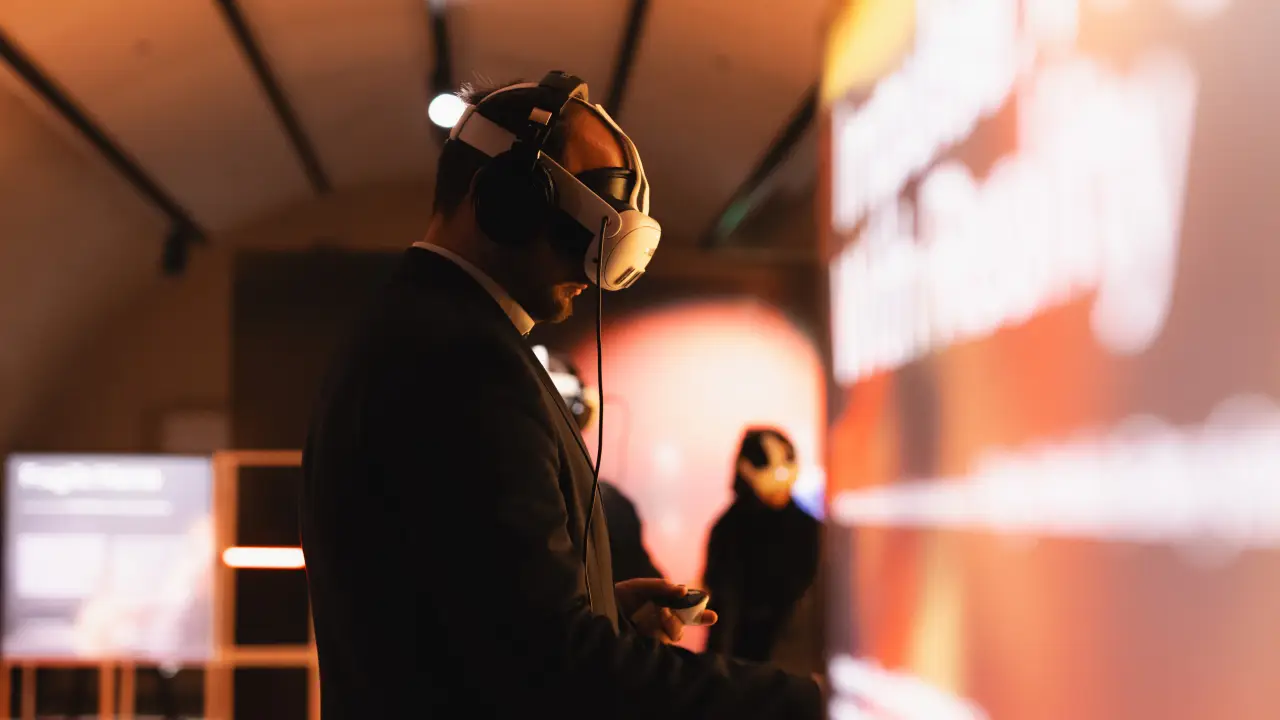
Film Fund Luxembourg occupies a singular position within the European ecosystem: a powerful public instrument, backed by a structured audiovisual policy, that has gradually expanded its scope toward immersive creation without weakening its historic foundation. In this interview, Guy Daleiden—its director—looks back at the logic guiding this evolution: supporting innovation when it becomes a lever for cultural competitiveness, while staying attentive to the real conditions of production, co-production, and, above all, exhibition. For producers and creators in the cultural and creative industries, the value of this feedback lies in its operational nature: it is not a trend-driven narrative, but a diagnosis of what enables—or prevents—an immersive sector from taking root sustainably.
Cover: Immersive Days 2025 @ Luxembourg City Film Festival 📸 Michel Logeling
This article is part of our French XR in Benelux coverage, a 2026 initiative in partnership with Institut français in the Netherlands, the French Embassy in Belgium, and Institut français du Luxembourg, to promote the dynamism of local ecosystems dedicated to immersive creation. https://xrinbenelux.fr
A structuring fund at the European level, and a controlled diversification
Immersive creation only makes sense, from a public-policy perspective, if it is embedded in a coherent industrial strategy. Supporting XR at the Film Fund Luxembourg is therefore not about “adding a line item” to an existing support system; it means committing to long-term work on skills, networks, and a territory’s ability to co-produce and circulate works. This approach helps explain why the Luxembourg institution has been able to expand into new formats while remaining legible: XR is treated as an extension of established audiovisual logics (development, production, co-production, internationalisation), not as a standalone silo.
Guy Daleiden stresses a key point for producers: innovation is not a separate sector, but a layer that reshapes the entire value chain. In XR, that reshaping is immediate: the technical pipeline, the role of real time, the question of interaction, the robustness of the setups, and the management of iteration all weigh directly on schedules and budgets. For a fund, supporting immersive work therefore requires a nuanced reading of production cycles, and close attention to teams’ ability to turn a prototype into a showable work.
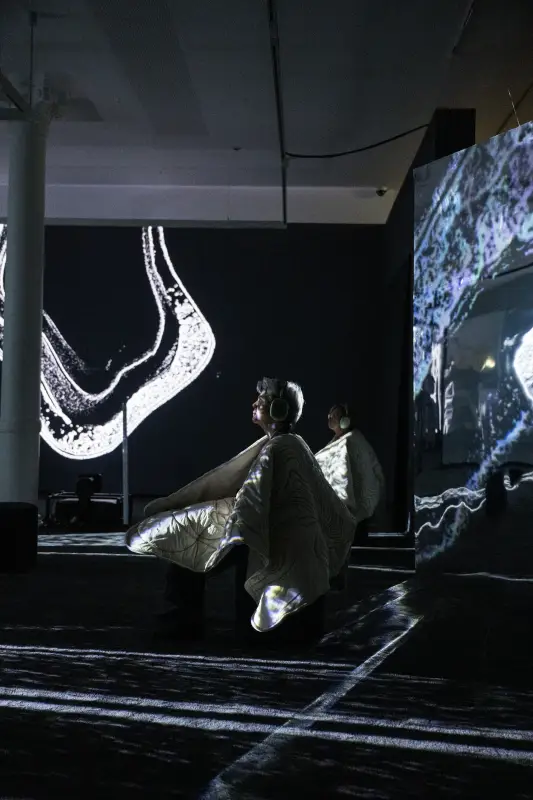
Another strong axis is scale and method. The Film Fund Luxembourg does not operate solely as a funding desk; it contributes to an ecosystem logic in which international cooperation is a tool for competitiveness. Its director points to partnership dynamics with “comparable” territories (small countries, agile markets) that can pool skills and risk, and give projects an international reality from the outset. For producers, this is a working framework: co-production is not just a financial assembly, it is a distribution accelerator and a way to structure teams across multiple projects.
This perspective also goes beyond XR: the current attention paid to video games, and to prototyping. Guy Daleiden does not frame this as an opportunistic pivot, but as a logical extension of capabilities in animation, interactivity, and real time. For the cultural and creative industries, it is a signal: permeability between audiovisual, XR, and gaming is becoming structural, and the players who can connect these ecosystems (talent, studios, tools, financing) will gain a strategic advantage.
From funding to distribution: the economic bottleneck remains exhibition
And distribution is not overlooked—quite the opposite. Guy Daleiden describes a tension the entire sector is grappling with: producing more does not stabilise the field as long as exhibition remains intermittent, costly, and dependent on a limited number of contexts (festivals, pioneering institutions, events). The question then becomes less “how many projects should be funded?” than “under what conditions can works be shown, toured, recouped, and turned into a lasting relationship with audiences?”.

The reasoning here rests on very concrete parameters: transport, installation, space requirements, mediation, technical maintenance, safety, insurance, and visitor-flow management. He highlights the gap between scenographic ambition and operational reality: the heavier an experience becomes—and the more it depends on a specific setup—the more likely it is to lose mobility and touring potential. This is not an artistic critique; it is an economic observation that speaks directly to production design. For creators and producers, it means distribution has to be built in from the start: modularity, installation constraints, partial standardisation, technical documentation, mediation—and sometimes an explicit choice for longer runs in fewer venues rather than an extensive tour.
It is in this context that the Immersive Pavilion of the Luxembourg City Film Festival, a major national and international event, takes on strategic value—especially through its professional networking programme, the Immersive Days, programmed with the Quebec-based PHI team. The Pavilion operates as a testing and learning tool for exhibition: curation, hosting conditions, mediation, audience training, and coordination across multiple venues. The goal is not simply to “show works,” but to strengthen the link that is most often missing in the chain: a recurring, legible framework capable of giving projects a real public life.

As long as immersive distribution is not densified, business models will remain hybrid—combining commissions, audiovisual work, installation formats, institutional partnerships, and public support. The director of the Film Fund Luxembourg does not dramatise this; he treats it as a market condition. The issue then becomes gradually reducing dependence on the exceptional: increasing the number of equipped venues, fostering cross-border cooperation between exhibitors, upskilling operational teams, and designing works that are better suited to a wider range of hosting realities.
2025: XR Focus / Luxembourg: a champion of immersive production
Immersive Days 2026: aligning creation, production, venues, and funders
The Immersive Days 2026 extend this logic by creating a space for professional structuring. Where the Pavilion acts as a distribution demonstrator, the Immersive Days focus on market conditions: exhibition models, circulation, financing, and the integration of immersive art within established cultural institutions (museums, theatres). Guy Daleiden stresses the importance of these exchanges in reconnecting immersive creation to a broader cultural and creative continuum—at the crossroads of audiovisual, visual arts, live performance, and digital innovation.
The next professional days will take place in Luxembourg on 4 and 5 March 2026, split between Mudam and neimënster. The Immersive Pavilion will then run from 5 to 22 March 2026 at neimënster, Mudam, and Villa Louvigny. This matters for professionals because it signals a real anchoring effort: immersive work is positioned within clearly identified cultural venues, with different hosting frameworks, rather than only within a temporary event space.

From a sector standpoint, the value of the Immersive Days lies in their ability to address today’s frictions with a level of granularity that is genuinely useful for producers: interactive documentary, for instance, calls for complex production assemblies (research, rights, narrative design, interaction), while exhibition becomes a production topic in its own right (hosting engineering, mediation, operations). The fact that these discussions are anchored to a major support mechanism and a real programme strengthens their relevance: they are connected to works, constraints, and partners.
The interview also underlines the importance of international partnerships—especially with players able to bring both expertise and networks. For European producers, these ties facilitate project circulation, access to venues, and a clearer understanding of operational standards that are gradually stabilising. Finally, the director of the Film Fund Luxembourg highlights the relationship with higher education and audiences in training: beyond visibility, it is a lever for skills development—and therefore for the robustness of a still-young sector.
Overall, this assessment points to an approach that matches the role of a leading fund: immersive creation is not treated as a parenthesis, but as a component of the cultural and creative industries that must build infrastructures, recurring rendezvous, operating standards, and distribution networks. For producers and creators in the Benelux and beyond, the March 2026 milestones in Luxembourg represent both a vantage point and a space to connect with a central actor in the financing and structuring of creation in Europe.

Leave a Reply
You must be logged in to post a comment.