
Page
A Brief History of Immersive Creation
From expanded cinema and early computer experiments to virtual reality, interactive installations, digital worlds and location-based experiences, immersive creation has never followed a single path. This timeline looks back at some of the artworks, inventions, institutions and cultural shifts that have changed our relationship with digital space — and gradually shaped a creative field still very much in motion.
1950–1979 — Imagining Immersion
1952 — Cinerama expands the screen
Long before virtual reality, cinema was already trying to escape the frame. Cinerama combined three synchronized projectors with a huge curved screen to create a panoramic image filling much of the audience’s field of view. The technology was cumbersome and required specially equipped theaters, but the intention was clear: cinema could become something larger than an image projected in front of an audience.
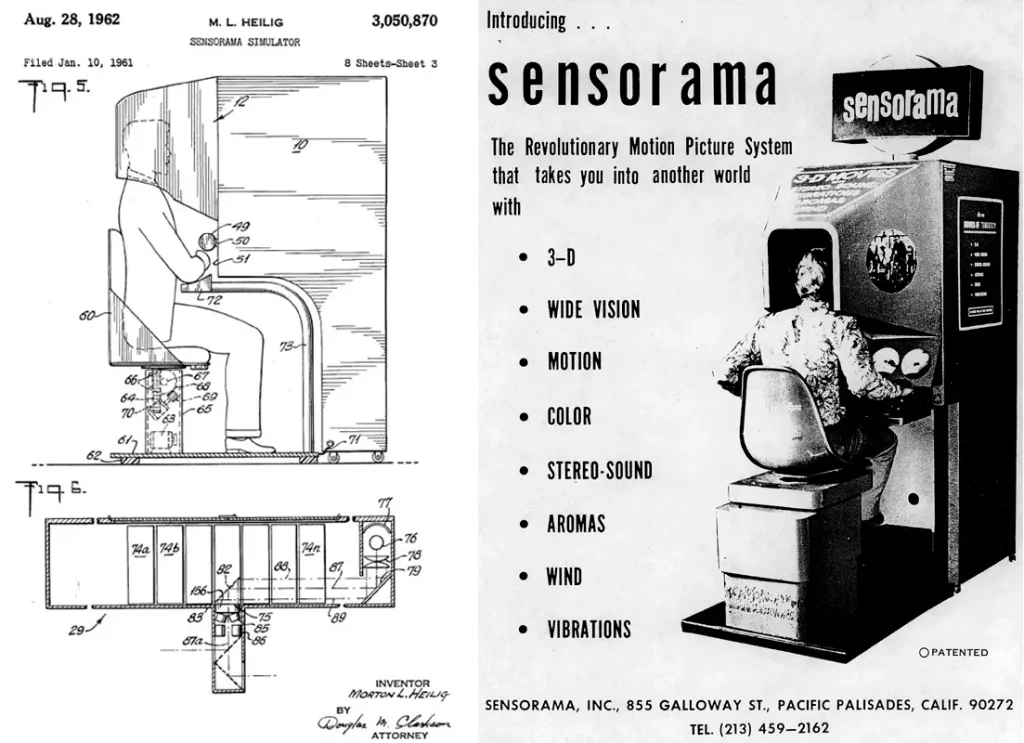
1957 — Morton Heilig imagines the Sensorama
Filmmaker and inventor Morton Heilig saw cinema as a multisensory medium rather than simply an audiovisual one. His Sensorama, developed around the turn of the 1960s, combined stereoscopic images, sound, vibration, wind and even smells. There was no real-time interaction, but many ingredients later associated with immersive entertainment were already present: a wide field of view, stereoscopy, physical sensations and the ambition to surround the spectator.
1965 — Ivan Sutherland describes the “Ultimate Display”
Computer scientist Ivan Sutherland published The Ultimate Display, a short text imagining an environment in which computers could control our perception of objects and space. His vision went far beyond displaying information on a screen: digital objects could behave as though they had a physical presence. It remains one of the early conceptual landmarks for virtual environments and, decades later, spatial computing.
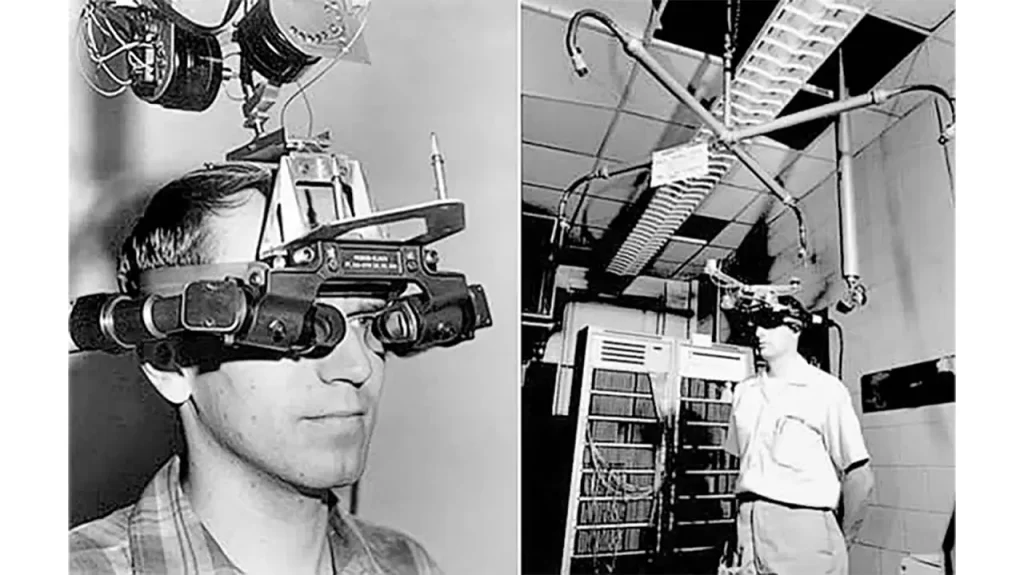
1968 — The Sword of Damocles
Ivan Sutherland and Bob Sproull developed one of the earliest computer-connected head-mounted displays. A tracking system adjusted simple wireframe graphics according to the user’s movements, establishing a principle still found in contemporary headsets. The apparatus was so heavy that it had to be suspended from the ceiling, earning it the later nickname “Sword of Damocles.”
1973 — Videoplace turns the body into an interface
Artist and researcher Myron Krueger developed environments in which visitors interacted with computer-generated images through their own silhouettes. With VIDEOPLACE, there was no headset, controller or wearable device: cameras observed participants and the system responded to their movements. It opened another route towards immersion, built around bodies, interaction and projection rather than equipment worn by individual users.
1977 — Aspen becomes virtually navigable
Researchers at MIT developed the Aspen Movie Map, an experimental system allowing users to navigate through the streets of Aspen, Colorado using recorded imagery. Images captured from different positions could be explored interactively, creating an early approximation of moving through a distant place. Decades before services such as Street View, physical geography was already becoming navigable digital information.
1980–1994 — Inventing Virtual Worlds
1979 — Ars Electronica connects art, society and technology
Launched in Linz, Austria, Ars Electronica created a meeting point for artists, technologists, researchers and wider society. Its festival, the Prix Ars Electronica and later the Ars Electronica Center would accompany successive generations of digital practices. Its history is also a useful reminder that immersive creation developed within a much broader conversation around electronic and digital culture.
1984 — Neuromancer popularizes cyberspace
William Gibson’s Neuromancer gave enormous cultural power to the idea of cyberspace: a shared digital environment that could be entered and navigated. The technologies described in the novel barely existed, but the vocabulary quickly escaped science fiction. Virtual worlds, online identities and networked spaces now had an imaginary landscape from which artists and technologists could borrow.
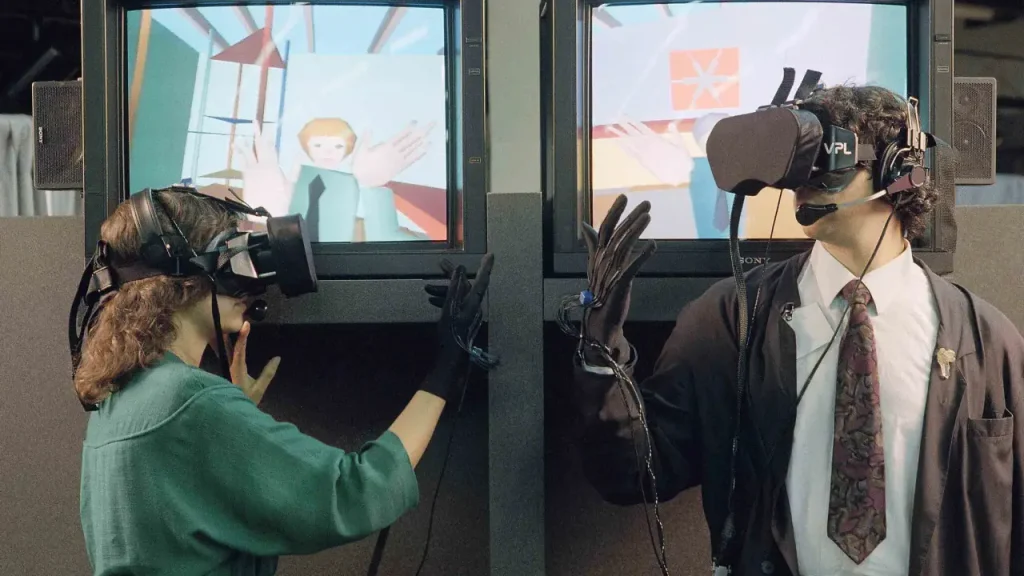
1985 — VPL Research gives virtual reality a recognizable form
Founded by Jaron Lanier and Thomas Zimmerman, VPL Research developed technologies including the DataGlove and EyePhone. Head-mounted displays, tracked hands and interactive computer-generated environments started to resemble the public image of VR that persists today. Lanier also helped popularize the expression “virtual reality”, giving a name to a field emerging from several decades of research.
1989 — The World Wide Web is proposed
Tim Berners-Lee proposed an information-management system at CERN that would become the World Wide Web. It was not an immersive technology, but the network culture that followed would become inseparable from digital creation. Online communities, interactive storytelling, shared identities and eventually persistent virtual worlds all grew from a web that turned connected computers into cultural spaces.
1992 — The CAVE turns a room into a virtual environment
Developed at the Electronic Visualization Laboratory at the University of Illinois Chicago, the CAVE surrounded users with stereoscopic projections displayed across several surfaces. Instead of placing one person inside a headset, the architecture itself became the display. Immersion could therefore be shared, spatial and collective — an approach that continues today in projection-based installations and immersive venues. First demonstrated at SIGGRAPH 1992.
1995–2006 — Immersion Becomes an Artistic Language
1992 — Char Davies begins exploring another kind of VR
Working at Softimage, Canadian artist Char Davies began experimenting with virtual environments that moved away from the dominant aesthetics of computer simulation. Transparency, ambiguity, nature and bodily sensation became central to her research. These experiments would eventually lead to OSMOSE, one of the defining artistic works of early virtual reality.
1996 — The SAT is founded in Montreal
The Society for Arts and Technology — SAT — was founded in Montreal around research, creation and dissemination at the intersection of art and technology. Its work would later expand into immersive environments, spatialized sound and the Satosphere. Places such as the SAT also helped establish a model in which cultural institutions could participate directly in technological and artistic experimentation.
1997 — Jeffrey Shaw explores interactive cinema
Jeffrey Shaw had been challenging conventional spectatorship since the 1960s, but projects such as PLACE brought these ideas into digitally navigable environments. His work questioned a basic principle of cinema: that spectators remain in one position while images unfold before them. Digital environments could instead be explored, manipulated and experienced from different points of view.
1999 — ZKM gives digital art a permanent institutional home
The ZKM | Center for Art and Media in Karlsruhe developed a model combining exhibitions, artistic production, research, archives and technological experimentation. Digital practices were gaining institutions able not only to exhibit them but also to produce, study and preserve them. Questions of conservation and technological obsolescence, still central to digital art today, became part of museum practice.
2003 — Second Life opens a persistent digital world
Linden Lab launched Second Life, a virtual world largely constructed by its own users. Social interaction, architecture, performance, commerce and artistic creation existed within the same persistent environment. Long before “metaverse” became an industry keyword, people were already meeting, creating identities, organizing events and building economies inside shared digital spaces.
2005 — YouTube transforms digital creation
YouTube dramatically lowered the barriers to publishing and distributing moving images online. Digital culture became increasingly participatory, global and dependent on platforms. Creators could reach audiences directly and develop formats around new interfaces and modes of consumption. The relationship between creator, distributor and audience was beginning to change.
2006 — Nintendo Wii brings physical interaction home
Nintendo’s Wii Remote turned movement into a mainstream interface for games. The technology was very different from contemporary spatial tracking, but the cultural shift was significant: moving your body could now be an ordinary way of interacting with digital content. Embodied interaction was leaving laboratories and installations to enter millions of living rooms.
2007–2015 — The Immersive Turn
2007 — The iPhone puts spatial tools in everyone’s pocket
The first iPhone combined a touchscreen, camera, internet connection and sensors within a device designed for everyday use. Smartphones would soon become an important platform for augmented reality and location-based experiences. Digital content could increasingly respond to where users were, how they moved and what their cameras could see.
2010 — Kinect makes the controller disappear
Microsoft introduced Kinect for Xbox 360, bringing affordable markerless body tracking to a mass audience. Artists and researchers quickly adopted the device beyond gaming. Interactive installations capable of responding to bodies, gestures and movement became considerably cheaper and easier to develop, making Kinect a familiar tool across digital art, performance and museums.
2012 — Oculus Rift restarts the VR conversation
The Oculus Rift Kickstarter campaign raised nearly $2.5 million and brought consumer virtual reality back into the spotlight. Better displays, tracking and components originally developed for smartphones made a new generation of headsets possible. Developers, filmmakers and artists began experimenting with the medium again, this time with the prospect of hardware eventually reaching a much larger audience.
2013 — NOTES ON BLINDNESS begins an immersive journey
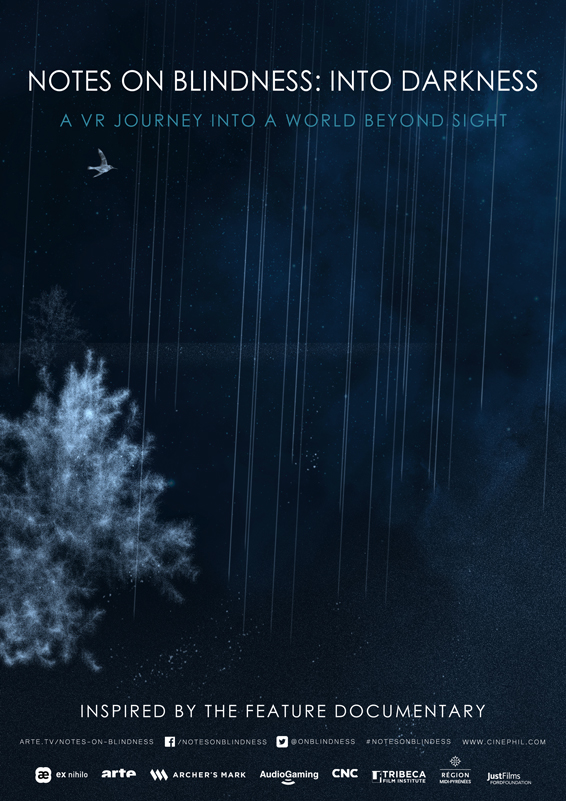
Based on the audio diaries of theologian John Hull, NOTES ON BLINDNESS developed across film and immersive media. Its VR interpretation used spatial sound and abstract visualization to evoke Hull’s changing perception after losing his sight. Rather than reproducing a physical environment literally, the experience explored how immersive media could approach memory, sensation and subjective perception.
2014 — Google Cardboard democratizes VR
Google Cardboard reduced a VR viewer to its simplest components: cardboard, two lenses and a smartphone. Technically limited but remarkably accessible, it allowed schools, museums, publishers, journalists and millions of users to experiment with stereoscopic and 360° content. For a few years, discovering VR could cost little more than the price of a piece of folded cardboard.
2014 — Facebook acquires Oculus
Facebook acquired Oculus for approximately $2 billion, dramatically changing perceptions of the emerging VR sector. What had begun as an enthusiast-driven hardware project was now part of the strategy of one of the world’s largest technology companies. Investment increased rapidly, together with expectations around VR as a future computing and entertainment platform.
2015 — Sundance gives immersive storytelling a major stage
Through New Frontier, Sundance became one of the important international platforms for emerging immersive forms. Filmmakers, artists, producers and technologists could encounter VR alongside cinema and interactive work. Festivals increasingly became places where a new professional ecosystem could meet, test projects and begin defining the language of immersive storytelling.
2015 — THE VOID imagines VR as a destination
THE VOID combined headsets and tracking with physical sets, allowing visitors to touch walls and move through spaces corresponding to virtual environments. Rather than waiting for sophisticated VR systems to enter every household, it proposed another model: audiences could travel to dedicated locations offering experiences that were difficult to reproduce at home.
2016–2019 — An Ecosystem Takes Shape
2016 — Oculus Rift and HTC Vive reach consumers
The commercial launches of Oculus Rift and HTC Vive brought modern VR systems to consumers. Room-scale tracking and motion controllers meant users could move and interact inside virtual environments rather than simply look around them. Creators had to consider space, embodiment, scale, agency and movement as fundamental parts of the experience.
2016 — Pokémon GO takes AR into the streets
Niantic’s Pokémon GO brought location-based augmented play to a huge international audience. Its use of AR was relatively simple, but its impact went far beyond the technology itself. Streets, parks and landmarks became components of a shared digital experience, while physical movement through cities became part of the gameplay.
2016 — Tilt Brush turns space into a canvas
Google’s Tilt Brush allowed users to draw directly in three-dimensional space using VR controllers. Artists could create around themselves rather than on a flat surface, working with scale, depth and movement from inside their own compositions. VR was becoming a tool for making digital art as well as experiencing it.
2017 — Venice VR enters the Venice Film Festival
The Venice International Film Festival launched a competition dedicated to virtual reality. Immersive works now had a substantial platform within one of cinema’s most established international institutions. Venice VR — later Venice Immersive — would become a meeting point for artists, studios, producers, distributors and programmers from an increasingly international ecosystem.
2018 — SPHERES raises the question of a market for VR works
The three-part VR series SPHERES, executive-produced by Darren Aronofsky and Ari Handel, attracted attention after a seven-figure acquisition was announced at Sundance. The figure reflected the considerable expectations surrounding narrative VR at the time. Producers and investors were beginning to test whether immersive works could develop financing, acquisition and distribution models closer to established audiovisual industries.
2018 — Museum of Other Realities builds an impossible museum
The Museum of Other Realities created a social VR space dedicated to immersive art. Works could ignore gravity, conventional scale and many of the physical constraints of exhibition architecture. It offered artists a venue specifically designed for spatial digital work while experimenting with what visiting a museum together might mean inside a virtual environment.
2019 — Oculus Quest cuts the cable
The Oculus Quest combined six-degrees-of-freedom tracking with standalone computing, removing the PC, external sensors and cables required by earlier consumer systems. The simplification changed how VR could be demonstrated and distributed. Standalone headsets were easier to use not only at home but also in festivals, museums, schools and cultural venues.
2020–2024 — Beyond the Headset
2020 — The pandemic sends cultural events into virtual worlds
When physical gatherings became impossible, festivals, conferences, artists and institutions experimented with online and virtual alternatives. VRChat, Mozilla Hubs and other platforms became temporary exhibition venues, meeting spaces and stages. The results varied widely, but the period accelerated experimentation around remote presence and virtual cultural spaces.
2021 — Immersive Van Gogh becomes a global phenomenon
Large-scale projected exhibitions inspired by Van Gogh and other major artists attracted substantial audiences internationally. Their artistic and curatorial approaches generated plenty of discussion, but their commercial reach was difficult to ignore. “Immersive” was no longer associated mainly with headsets: projection, architecture, sound and spectacle were becoming an increasingly visible part of the experience economy.
2021 — Facebook becomes Meta and bets on the metaverse
Facebook renamed itself Meta and placed the metaverse at the center of its long-term strategy. Investment and public attention surged around virtual worlds, avatars and social VR. The enthusiasm would later cool, but for a period the idea of persistent shared digital environments moved from specialist communities into mainstream business and popular culture.
2022 — Immersive performance develops its own vocabulary
Theater, dance, live performance and immersive technologies increasingly converged. Performers could inhabit virtual characters, audiences could participate remotely and physical stages could extend into digital environments. The distinction between recorded immersive content and live arts became less obvious, with human presence itself becoming part of the technological and creative setup.
2022 — Venice VR becomes Venice Immersive
The Venice program changed its name from Venice VR, to Expanded, and finally Venice Immersive. VR remained central, but the field increasingly included mixed reality, installations and virtual worlds alongside headset-based works. The new name reflected an ecosystem that had already started moving beyond a single format or technological category.
2023 — Gaussian Splatting changes how reality can be captured
The development of 3D Gaussian Splatting introduced another approach to reconstructing real environments from photographic data. Its ability to produce detailed spatial representations quickly attracted artists, researchers and immersive studios. Documentary, heritage and location-based projects began experimenting with the technique alongside photogrammetry, volumetric capture and other methods of recording physical places.
2024 — Apple Vision Pro reframes XR as “spatial computing”
Apple entered the headset market with Vision Pro while largely avoiding the established vocabulary of virtual and augmented reality. The company instead emphasized “spatial computing”, presenting digital windows and objects as part of the user’s surrounding environment. The launch brought another major technology company into a field that had spent years searching for a mainstream identity.
2024 — Location-based immersive experiences scale up
Free-roaming VR, immersive exhibitions and large-scale cultural experiences increasingly focused on throughput, repeatability and international touring. Creating an impressive prototype was only one part of the challenge: projects also had to operate reliably for large numbers of visitors. Venue design, operations and distribution were becoming increasingly visible parts of the conversation.
2025–TODAY — Towards a New Convergence
2025 — Immersive creation searches for permanent homes
After years dominated by festivals, prototypes and temporary showcases, the question of where immersive works can regularly meet audiences is becoming increasingly important. Museums, art centers, dedicated immersive venues and LBE operators are testing different approaches. Exhibition infrastructure is gradually becoming part of the creative and economic discussion around the medium.
2025 — Cannes launches an Immersive Market
The Marché du Film introduces a dedicated Immersive Market in Cannes, connecting immersive projects with venues, curators and distribution professionals. The initiative arrives as more attention is being paid to what happens after production: how projects circulate, how they adapt to different locations and how they can reach audiences beyond their festival premieres.
2025 — Generative AI enters immersive workflows
Generative AI is appearing across creative pipelines, from concept development and coding to images, environments, characters and interactive systems. Immersive creators are experimenting with these tools while questions around authorship, rights, aesthetics and production models remain open. As with previous technological shifts, experimentation is moving considerably faster than established practices.
2026 — Glasses return to the foreground
A new generation of lighter glasses is renewing a long-running ambition to integrate digital information into everyday vision. Improvements in displays, sensors, computing and AI are expanding what can be attempted without fully separating users from their surroundings. For creators, these devices open another territory between mobile screens, augmented reality and fully immersive headsets.
2026 — LBE, projection and XR increasingly overlap
The borders between immersive exhibitions, cinema, digital art, VR and live performance continue to blur. A project may combine projection, tracked audiences, spatial audio, headsets or performers depending on the venue and version presented. Technology increasingly becomes one component within a broader experience rather than necessarily defining the work itself.
TODAY — What comes next?
Headsets, glasses, projection, virtual worlds, AI, spatial audio and performance now coexist rather than replacing one another in a simple technological sequence. Immersive creation has grown at the intersection of several creative traditions, each bringing its own tools, audiences and ways of exhibiting work. This timeline is therefore not finished. New milestones are still being written.