
Page
XR in Popular Culture — A History of Virtual Worlds Before They Became Real
Long before virtual reality headsets entered our homes, fiction had already imagined virtual worlds, digital identities, intelligent simulations and information layered over reality. Books, films and television have repeatedly anticipated — and exaggerated — our relationship with immersive technologies.
Some visions proved surprisingly accurate. Others remain distant, impossible or deliberately dystopian. Together, they created much of the visual and cultural vocabulary through which we still understand XR today.
1930–1979 — Before Virtual Reality Had a Name
1935 — PYGMALION’S SPECTACLES imagines virtual reality
Stanley G. Weinbaum’s short story PYGMALION’S SPECTACLES introduces goggles capable of transporting their wearer into fictional environments involving sight, sound, smell and touch. Published decades before digital VR existed, the story describes something remarkably close to a multisensory headset experience, including the feeling of being physically present inside another reality.
1950 — THE VELDT turns an immersive room into a nightmare
Ray Bradbury’s short story THE VELDT (later included in The Illustrated Man, 1951) imagines a children’s nursery capable of generating realistic environments around its occupants. The walls disappear behind images, sounds, smells and sensations until the simulated African landscape becomes almost indistinguishable from reality. The immersive room appears here both as entertainment and as a technology powerful enough to compete with the physical world.
1956 — THE STARS MY DESTINATION imagines mediated presence
Alfred Bester’s science-fiction novel explores telepathy, teleportation and transformed perceptions of distance. It does not describe XR as we know it, but belongs to a period when science fiction increasingly questioned physical presence itself. Communication, identity and location were becoming technological concepts as much as geographical ones.
1964 — SIMULACRON-3 questions whether reality itself is virtual
Daniel F. Galouye’s novel describes a computer simulation populated by conscious artificial beings unaware that their world is artificial. Rather than imagining a headset, SIMULACRON-3 moves the question one level deeper: what if virtual reality were sufficiently convincing that its inhabitants did not know they were inside it?
1973 — WORLD ON A WIRE visualizes simulated reality
Rainer Werner Fassbinder adapted SIMULACRON-3 into the television miniseries WELT AM DRAHT, internationally known as WORLD ON A WIRE. Scientists operate a simulated world populated by thousands of artificial individuals, while the distinction between simulation and physical reality gradually collapses. The story anticipated a theme that would later become central to cyberpunk.
1976 — THE SHOCKWAVE RIDER imagines life inside networks
John Brunner’s novel explores a society dominated by interconnected computer networks, data collection and digital identities. There are no VR headsets, but the network itself becomes an environment shaping everyday life. Science fiction was moving away from computers as individual machines and towards the idea of a permanently connected society.
1980–1989 — Enter Cyberspace
1981 — TRUE NAMES imagines identities inside a computer network
Vernor Vinge’s novella TRUE NAMES follows hackers meeting inside a shared virtual environment while protecting their identities in the physical world. Published before NEUROMANCER, it anticipated several ideas that would become central to cyberculture: avatars, pseudonyms, online communities and the possibility of constructing another identity inside a network.
1982 — TRON enters the computer
In TRON (directed and written by Steven Lisberger), programmer Kevin Flynn is digitized and transported inside a computer system. Programs become characters, data becomes architecture and software becomes a navigable world. Its glowing grids and geometric landscapes established a visual language for cyberspace years before most audiences had experienced networked digital environments.
1983 — BRAINSTORM records human experience
Douglas Trumbull’s BRAINSTORM revolves around a device capable of recording and replaying sensory and emotional experiences. Users do not simply watch a recording: they experience another person’s perception directly. The film pushed immersive media towards an idea that remains powerful today — technology as a means of transmitting subjective human experience.
1984 — NEUROMANCER gives us cyberspace
William Gibson’s NEUROMANCER popularized “cyberspace”, described as a shared consensual hallucination represented as a navigable digital environment. Users enter it through neural interfaces and move through data as though it were architecture. The novel became one of the defining cultural references for virtual worlds, digital identity and the network culture that followed.
NEUROMANCER is currently being adapted by Apple+.
1985 — ENDER’S GAME mixes simulation and reality
Orson Scott Card’s novel places children inside increasingly sophisticated military simulations and tactical games. The interfaces differ from contemporary XR, but the story revolves around a recurring immersive-media question: what happens when simulation becomes convincing enough for users to misunderstand the consequences of their actions?
1987 — STAR TREK: THE NEXT GENERATION opens the Holodeck
The Holodeck offered perhaps the ultimate fictional immersive platform: an empty room capable of generating convincing environments, objects and characters on demand. No headset, controllers or visible interface were necessary. Over decades of STAR TREK (created by Gene Roddenberry), it became both a narrative device and an enduring reference point for researchers and creators discussing the future of immersive entertainment.
1989 — GHOST IN THE SHELL connects consciousness to the network
Masamune Shirow’s GHOST IN THE SHELL manga introduced a world where cybernetic bodies and direct neural connections have profoundly changed the meaning of human identity. People communicate through networks without conventional interfaces, while consciousness itself becomes vulnerable to manipulation. The manga established many of the ideas Mamoru Oshii’s film would later bring to an international audience.
1990–1999 — Virtual Reality Enters Popular Culture
1990 — TOTAL RECALL sells artificial memories
Paul Verhoeven’s TOTAL RECALL imagines a company capable of implanting the memory of an experience directly into someone’s mind. The technology bypasses VR entirely, but its promise is fundamentally immersive: why travel somewhere if technology can make you remember having been there? Reality becomes less important than the authenticity of the experience perceived by the user.
1992 — SNOW CRASH gives shape to the Metaverse
Neal Stephenson’s SNOW CRASH introduces the Metaverse, a persistent virtual environment represented as a vast street where people appear as avatars. Social status, economics, property and identity extend into this digital world. Three decades later, the terminology and many of its concepts would be adopted directly by the technology industry.
1992 — THE LAWNMOWER MAN puts VR on the movie poster
Brett Leonard’s THE LAWNMOWER MAN placed virtual reality at the center of a mainstream science-fiction film just as public interest in the technology was growing. Headsets, bodysuits, cyberspace and computer-generated environments were presented with considerable exaggeration, but the film helped establish what “VR” looked like in popular culture during the 1990s.
1993 — WILD PALMS brings virtual reality to television
Created by Bruce Wagner and produced by Oliver Stone, WILD PALMS imagined a near future shaped by virtual reality, media corporations and political manipulation. Broadcast as a major television miniseries, it arrived during the first wave of mainstream fascination with VR. Its mixture of immersive media, entertainment and power is characteristic of the period.
1994 — DISCLOSURE imagines navigating information in VR
Barry Levinson’s DISCLOSURE (adapted from Michael Crichton’s 1994 novel) includes a memorable sequence in which corporate files are accessed inside a virtual environment. Documents become spatial objects and information architecture becomes literal architecture. It captures a recurring 1990s assumption: the future of computing might involve physically navigating data rather than simply reading it on screens.
1995 — JOHNNY MNEMONIC navigates the internet spatially
Adapted from William Gibson’s short story, JOHNNY MNEMONIC (directed by Robert Longo) depicts data as something that can be physically carried and manipulated through gestural interfaces. Keanu Reeves’ character navigates information using goggles and tracked gloves, creating a distinctly 1990s vision of spatial computing that now looks both extravagant and strangely familiar.
1995 — GHOST IN THE SHELL blurs body, network and identity
Mamoru Oshii’s animated film brought GHOST IN THE SHELL to an international audience. Its future is filled with augmented vision, cybernetic bodies and minds directly connected to networks. There is little need for a conventional VR headset because mediation has moved inside the body itself. Its influence can be traced through cyberpunk cinema, games and later visions of augmented and connected humans.
1996 — OTHERLAND builds a network of virtual worlds
Tad Williams began his OTHERLAND series with a vast network of detailed virtual environments connected through advanced neural interfaces. Users can move between radically different worlds while maintaining digital identities across them. The series treated virtual reality not as a single simulation but as an entire ecosystem of experiences.
1998 — SERIAL EXPERIMENTS LAIN dissolves the boundary with the network
The anime series SERIAL EXPERIMENTS LAIN (by Ryutaro Nakamura, Chiaki J. Konaka and Yoshitoshi ABe) follows a teenage girl increasingly drawn into “the Wired”, a global communication network that begins to overlap with physical reality. There is no conventional VR platform at its center. Networked identity gradually becomes inseparable from everyday existence, anticipating a culture in which online and offline selves are increasingly difficult to distinguish.
1999 — THE MATRIX makes simulated reality mainstream
THE MATRIX, written and directed by Lana & Lilly Wachowski, transformed simulated reality into a global cultural reference. Humanity unknowingly lives inside a digital simulation perceived as everyday life, while the physical world exists outside it. The film combined philosophical questions about reality with cyberpunk aesthetics and created imagery that continues to influence how virtual worlds are represented.
1999 — EXISTENZ makes virtual reality biological
David Cronenberg’s EXISTENZ imagines game systems connected directly to the body through organic consoles and biological ports. Players move between nested realities until neither they nor the audience can reliably identify the original world. VR becomes less a piece of consumer electronics than an intimate extension of the human nervous system.
1999 — THE THIRTEENTH FLOOR returns to simulated reality
Inspired by SIMULACRON-3, THE THIRTEENTH FLOOR – directed by Josef Rusnak – depicts a computer-generated recreation of 1930s Los Angeles populated by artificial individuals who believe their world is real. Released the same year as THE MATRIX and EXISTENZ, it made 1999 an unusually rich moment for cinema questioning whether physical reality itself might be another layer of simulation.
2000–2009 — Avatars, Games and Digital Selves
2001 — AVALON turns immersive gaming into a way of life
Mamoru Oshii’s AVALON follows players of an illegal immersive combat game whose virtual achievements shape their lives in the physical world. The film explores identity and the possibility of layers of reality hidden inside one another. Games are no longer simply entertainment but places in which social status and personal meaning can be constructed.
2002 — MINORITY REPORT popularizes spatial interfaces
Steven Spielberg’s MINORITY REPORT (adapted from Philip K. Dick’s novel) presented information manipulated through large transparent displays and hand gestures. Its interfaces were not strictly AR or VR, but became hugely influential in popular representations of spatial computing. The film also explored biometric identification and personalized advertising embedded directly into physical environments.
2002 — .HACK turns the virtual world into a transmedia universe
The Japanese .HACK project unfolded across video games, anime, manga and novels, all centered around a fictional MMORPG called The World. Characters develop identities and relationships inside the game while events in the virtual environment have consequences outside it. Its transmedia structure was particularly fitting: a story about interconnected digital worlds was itself distributed across interconnected media.
2007 — DENNŌ COIL puts AR glasses on children’s faces
DENNŌ COIL presents children living in a city covered with digital information visible through lightweight glasses. Virtual pets, games and hidden digital spaces coexist with ordinary streets. Its vision feels particularly contemporary because augmented reality is treated not as an extraordinary event but as an everyday layer of childhood.
2009 — AVATAR rethinks remote embodiment
James Cameron’s AVATAR revolves around humans remotely inhabiting genetically engineered bodies. Although the technology is biological rather than conventional XR, the concept is fundamentally about presence: seeing, moving and interacting through another body until that mediated embodiment begins to feel more natural than the user’s original one.
2009 — SURROGATES asks what happens when avatars become physical
In the cinema adaptation of Robert Venditti & Brett Weldele’s comic-book series, SURROGATES (directed by Jonathan Mostow), humans remain at home while remotely operating idealized robotic bodies in the outside world. The avatar has escaped the screen and entered physical society. The film pushes virtual identity in another direction: mediated presence becomes safer, easier and potentially more socially desirable than appearing as yourself.
2009 — SUMMER WARS makes the virtual world social infrastructure
Mamoru Hosoda’s SUMMER WARS imagines OZ, a global virtual platform used for communication, administration, commerce and entertainment. People access it through colorful avatars, but events inside OZ quickly affect physical society. Rather than presenting a separate fantasy world, the film depicts virtual space as infrastructure on which everyday life has become dependent.
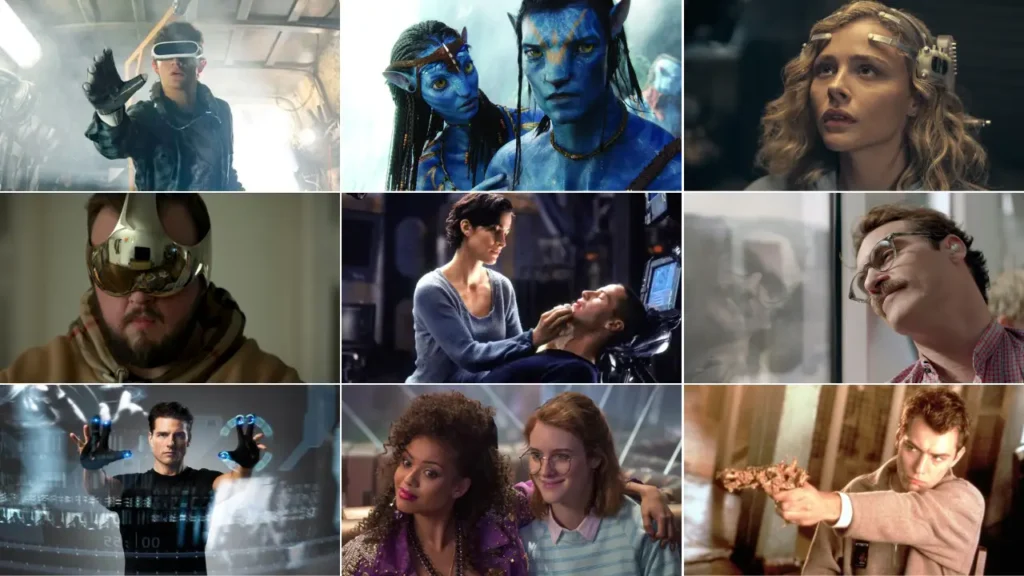
2010–2019 — The Metaverse Becomes Familiar
2011 — READY PLAYER ONE turns VR culture into the OASIS
Ernest Cline’s READY PLAYER ONE imagines the OASIS, a persistent virtual universe where people work, study, play, socialize and build alternative identities. Users enter through headsets and increasingly sophisticated haptic equipment, while corporations compete to control the platform. Published just before the Oculus-led revival of consumer VR, the novel arrived at an unusually appropriate moment.
Its importance to XR culture also comes from the way it combines technological imagination with popular culture itself. The OASIS is filled with games, films, music and fictional worlds that users can visit and remix. Virtual reality becomes both a medium and an enormous cultural archive — a vision that would become increasingly familiar as discussions around the “metaverse” accelerated during the following decade.
2011 — BLACK MIRROR begins questioning mediated reality
Across multiple episodes, BLACK MIRROR (created by Charlie Brooker) explores technologies involving recorded memories, simulated consciousness, augmented perception and virtual relationships. Rather than building one coherent future, the anthology repeatedly examines what happens when digital mediation becomes intimate enough to reshape memory, identity, love and death.
See THE BLACK MIRROR EXPERIENCE (2026).
2011 — THE ENTIRE HISTORY OF YOU turns memory into an interface
This BLACK MIRROR episode – directed by Jesse Armstrong – imagines an implant that continuously records everything a person sees and hears. Memories can be replayed through the user’s own vision or displayed on screens for others. The fictional technology combines augmented perception, recording and personal data into a device whose implications become more recognizable as cameras and wearable technologies move closer to the body.
2012 — SWORD ART ONLINE brings full-dive VR to a global audience
The anime adaptation of Reki Kawahara’s novels introduced millions of viewers to the NerveGear, a neural interface allowing players to experience a virtual world through all their senses. Its fantasy MMORPG becomes a place where friendships, communities and identities develop over time. Its darker premise — players discover they cannot disconnect — turns technological dependence into the central dramatic mechanism.
2013 — HER removes the headset
Spike Jonze’s HER imagines a future dominated not by spectacular virtual environments but by an intelligent operating system that accompanies its user through an earpiece. Screens almost disappear while technology becomes conversational and emotionally present. Its restrained vision offers another path towards immersion: computing becoming less visible rather than more visually overwhelming.
2013 — ACCEL WORLD layers digital competition over everyday life
Based on Reki Kawahara’s light novels, ACCEL WORLD imagines augmented interfaces permanently integrated into everyday perception alongside a hidden virtual fighting environment. AR and VR are not presented as competing technologies but as different layers of the same connected society. Physical surroundings, digital information and fully virtual spaces flow continuously into one another.
2014 — WHITE CHRISTMAS puts consciousness inside simulation
The BLACK MIRROR episode introduces digital copies of human consciousness that can inhabit simulated environments where time passes differently. Virtuality is no longer simply somewhere a person visits. A digital self can exist independently, raising questions around identity, ownership and rights that would return throughout later BLACK MIRROR stories.
2016 — SAN JUNIPERO imagines a virtual afterlife
The BLACK MIRROR episode SAN JUNIPERO presents a simulated environment where people can inhabit younger bodies and, eventually, continue existing after physical death. Unlike many dystopian representations of virtual worlds, the episode allows its digital space to become a place of liberation, intimacy and possibility.
2016 — POKÉMON GO makes fictional AR partially real
From Niantic, POKÉMON GO turned a fictional universe already familiar from games, animation and trading cards into a location-based layer over the physical world. Players travelled through real streets and parks to find virtual creatures. An established imaginary world was no longer confined to a screen: it had been mapped directly onto everyday geography.
2017 — BLADE RUNNER 2049 gives holograms emotional presence
Denis Villeneuve’s BLADE RUNNER 2049 (sequel to 1982’s BLADE RUNNER based on Philip K. Dick’s DO ANDROIDS DREAM OF ELECTRIC SHEEP?) depicts artificial companion Joi moving through physical space as a projected presence. Her body has no physical substance, yet she participates in domestic and emotional life. The film explores whether presence necessarily requires embodiment, a question increasingly familiar in discussions around avatars, AI characters and mixed reality.
2018 — READY PLAYER ONE gives the OASIS a physical form
Steven Spielberg’s adaptation of READY PLAYER ONE arrived six years after the Oculus Rift Kickstarter and two years after the commercial launch of a new generation of VR headsets. The timing changed the story. The OASIS was no longer simply a distant literary idea: audiences could compare its headsets, haptic suits and virtual social life with technologies already appearing on the market.
The film also gave the metaverse a spectacular mainstream visual identity. Players move seamlessly between games, social spaces and entertainment franchises while maintaining persistent avatars and inventories. Its vision remains far beyond contemporary XR, but the basic concepts — virtual identity, digital ownership, shared worlds and platform control — were already becoming real industry discussions.
2018 — BANDERSNATCH makes Netflix interactive
Netflix released BANDERSNATCH, imagined by Charlie Brooker and David Slade, allowing viewers to make choices that alter the narrative. It was not XR, but its release brought interactive storytelling directly into a major streaming platform. The boundary between watching a story and participating in its construction became visible to a mainstream audience.
2020–TODAY — Fiction Meets the Technologies It Imagined
2020 — UPLOAD turns the virtual afterlife into a service
UPLOAD (created by Greg Daniels) imagines consciousness being transferred after death into commercially operated digital environments. The virtual world comes with subscriptions, upgrades, customer service and unequal access depending on income. The series treats digital existence less as technological magic than as another platform economy.
2020 — BELLE imagines identity inside a mass virtual platform
Mamoru Hosoda’s BELLE takes place partly inside “U”, a vast virtual world populated by billions of users represented by algorithmically generated avatars. For its protagonist, virtual identity becomes a means of expressing something she cannot communicate in physical life. The virtual world works less as a technological destination than as another space in which identity can be constructed.
2021 — FREE GUY looks at the virtual world from inside
FREE GUY (directed by Shawn Levy) follows a non-player character who gradually realizes that his world is a video game. Instead of asking what humans experience when entering a simulation, the film reverses the perspective and looks at the inhabitants already living there. Virtual worlds become environments with their own culture, rules and potentially autonomous inhabitants.
2021 — THE MATRIX RESURRECTIONS returns after VR became real
More than twenty years after THE MATRIX, Lana Wachowski returned to a world in which simulated reality had become part of popular vocabulary. Between the two films, social networks, smartphones, consumer VR and virtual worlds had transformed everyday digital culture. Ideas once presented as cyberpunk speculation had become familiar metaphors for life mediated by technology.
2022 — THE PERIPHERAL combines VR, telepresence and artificial bodies
The television adaptation of William Gibson’s novel follows characters able to inhabit artificial bodies located elsewhere through a neural interface. The experience is not quite virtual reality and not quite physical telepresence. Perception is transferred elsewhere while the user’s original body remains behind, extending the avatar concept beyond screens and virtual environments into physical embodiment. It was created by Scott B. Smith.
2022 — PANTHEON asks what happens after immersion
The animated series PANTHEON (created by Craig Silverstein) explores Uploaded Intelligence: human consciousness scanned and transferred into computational environments. Once the mind itself can inhabit digital space, the need for headsets, controllers and even physical bodies begins to disappear. The series takes virtual-world fiction towards another possibility — not visiting the computer, but existing inside it.
2024 — 3 BODY PROBLEM makes the impossible headset immediately understandable
Netflix’s 3 BODY PROBLEM (adapted primarily from Liu Cixin’s REMEMBRANCE OF EARTH’S PAST trilogy) introduces an apparently minimal headset capable of producing an extraordinarily convincing multisensory simulation. Nothing comparable exists commercially, but the scene requires little explanation for contemporary audiences. Put on the device, disappear from the room, enter another reality: after decades of fiction and several generations of real VR hardware, the ritual itself has become culturally familiar. It was created by David Benioff, D. B. Weiss and Alexander Woo.
TODAY — The headset is no longer the most futuristic idea
Fiction increasingly looks beyond conventional XR hardware towards neural interfaces, artificial bodies, AI companions and uploaded consciousness. Once real technology catches up with part of science fiction, fiction moves the boundary again.
Yet the older references remain everywhere. The Holodeck, Gibson’s cyberspace, GHOST IN THE SHELL, THE MATRIX, SWORD ART ONLINE and the OASIS continue to provide shorthand for technologies that are still difficult to describe. XR has developed its own hardware and creative ecosystem, but much of its imaginary landscape was built first in books, films, manga, anime and television.