
Decoding XR: THE PANTHEON OF QUEER MYTHOLOGY, Enrique Agudo
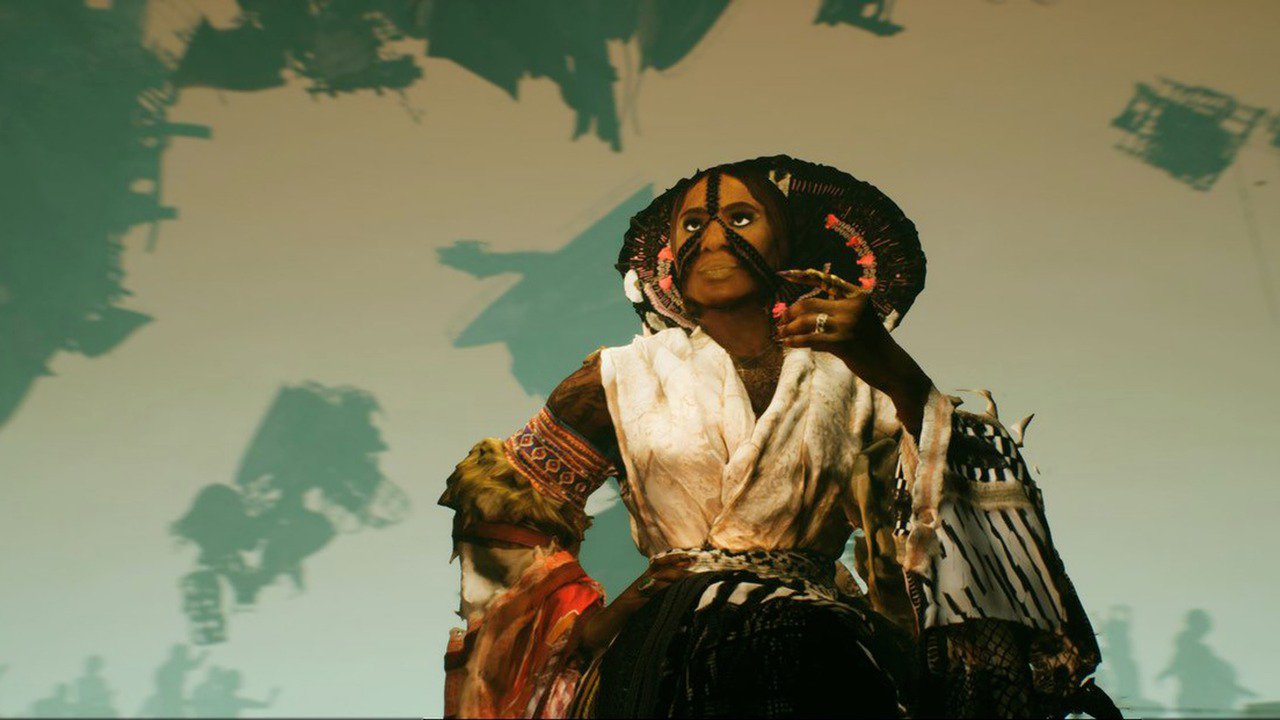
We discovered Enrique Agudo’s last immersive work during the online Tribeca 2020 edition where it got its World Premiere. Since then this visual and narrative mosaic has been selected in several festivals. We had a chance to discuss with its creator what THE PANTHEON OF QUEER MYTHOLOGY was made of.

“Homodistortion”_Concept Rendering

In the initial stages of the project, I gathered research on issues that affect the Queer community, issues like Transphobia within the LGBTQ community, or issues like the masculinity-obsession and misogyny that affects gay men, racism within the community, or the lack of acknowledgement of Bisexual people as legitimately part of the Queer spectrum. I began creating images that described the issues in a way that would be both seductive and alarming, following the work of people like David Lachapelle or Francis Bacon. The idea was to create imagery that was packed with information, like a Dutch Still Life from the Golden Age. 

In this concept named “Homodistortion”, I begin to ponder questions of identity through the hookup apps that I use as a gay man, how the interface for connection is actually a layer that allows me to distort myself in order to become more attractive to other users on the apps. The problem with these layers is that the most popular profiles on these apps are mostly hyper masculine, cisgendered, white men that represent an aesthetic that is deeply rooted in heteronormative culture, and is therefore somewhat conflictive. Since my generation is the first generation that has met most of their sexual and romantic partners through the internet, it is not too farfetched to think that how we perceive ourselves and our sense of social value is deeply affected by our experience in these apps. The demons around who we are and how we would like to be become a mythological figure that I consider important to be acknowledged, because wether one plays into this myth or abstains from it, the reality is that it has a profound effect in the broader social norms among Queer people, so the work began to be a visualization of a cautionary tale that hopes to provide reference and acknowledgement, much like classic mythologies do.

Griyah Costume Sketch

One of the most important parts of the process of this film was the incorporation of real life models and costumes into VR worlds through the use of photogrammetry. Queer culture has always used everyday objects and reappropriated them to suit the aesthetics of the underground narratives we lived in: Trans queens, drag queens, ballroom queens, fashion queens, kinksters, have made a legacy out of the reappropriating of what was left, what was discarded, doing it exquisitely. That is why the costumes were exclusively made with clothes and scraps from charity shops and thrifting bins. The found clothes were torn apart and resewn to provide the regal luxurious costumes, fit for the godly deities in this mythology. I followed the work of fashion legends like John Galliano in Dior in the 2000s or Claude Montana or British Artist Daniel Lismore, in an effort to provide intricate detail that would then be carefully picked up by the process of photogrammetry. 

Gracie Cartier as Griyah – Scanning of the Deities

As the costumes were finished the models were scanned in a full fashion production. Teams of hair, makeup, styling assembled the looks to make the production seamless. Costumes were designed with little reflective materials in an effort to maimise precision when scanning. Metallic objects and shiny surfaces were sprayed down to make them matte.

Virtual Worlds

Just as with the process of design of concept images and costumes, the environments required to include full attention to every element in the scene. Because of the immersive power that VR has, the placement of each object in the scene had to be intentional, like those Dutch still life paintings but now to a much more elevated level of intricacy, in 360o. The narrative is not linear, it is spatial. The viewer might pick up on certain elements that can thread together a story or simply admire more superficially the contents of the scene. Much like classic mythologies, the power of allegory carries the message of human nature and provides the moral reference in these stories.

In this scene, the silhouettes of gay men and women dancing with their backs to the Trans Goddess Griyah, tells the story of trans people being at the forefront of the fight for Gay Rights, and yet being pushed aside by queer men and women as a way to assimilate with common oppressors. The sinking landfill contains objects of consumption and oppression like assault riffles, MAGA hats, and bathroom gender signs. Griyah sits regally over the water, holding her grace, providing comfort to all her queer siblings.

Iyyanna and the collection of memories

Iyyanna poses the question: If one was to gather the objects that have been meaningful to one throughout their life, would that be a more accurate expression of identity than being defined by a gender? This genderqueer deity lets us take a look at the manifestation of their life experiences and development of self, expressed through important, defining objects, where maleness and femaleness don’t matter, what matters is that our memories turn into our legacy, that we become an expression of what we have lived through.

This scene is a journey through a collection of memories, some good, some not so much, it is an account of someone’s life and legacy independent from labels. The importance of VR to tell these stories cannot be understated. The youth of the medium means that VR could be the first medium to be inclusive and intersectional from the very beginning. Therefore to have stories that don’t simply tokenism LGBTQ people, but that contain complex issues that affect queer and people of colour means that equality will be more likely in the years to come.
As mythology was once born as a way to make sense of the things that we didn’t quite understand, the technological paradigm in which we now exist presents similar kinds of uncertainties. Where certain layers of the natural world have been decoded or demystified through science, and mythology and folklore have been disassociated from empirical forms of knowledge, we are now confronting new concepts of unknowns. The mythologies that I present are the claim that there is a space for this kind of storytelling. There is a place for designed forms of folklore around technology, that technology is a product of culture and that in turn technology is inevitably one of the producers of culture. VR is part of that technological future and so it is crucial that we make culture that contains the stories and fictions can assist certain voices often less heard within the system, and in turn those same stories can give them a platform from which to establish a spot in that culture and be counted, be seen, and equally importantly as a way to reclaim their presence in history, which is where The Pantheon of Queer Mythology stems from.

Learn more on www.thepantheonofqueermythology.com

Leave a Reply

@ Magazine

Preview/ MONS VENUS, with Paula Orlando (creator) and Rocio Pichirili (producer)

Dealing with the question of pleasure (physical, emotional…) in virtual reality is a real question for creators, but an obvious destination when working with a medium that can manipulate the senses. By confronting the viewer with his or her own

“Apple’s Vision Pro is both a continuation and a revolution” – Stephen Stewart (Chief Technology Officer, FACTORY 42)

FACTORY 42 is an immersive technology & experience studio dedicated to impact entertainment, recognised as one of the most prolific XR producers, notably through their collaboration with Sir David Attenborough. The medium is not an issue for them, having delivered

“Our aim is to support a new wave of artists, curate and exhibit innovative stories that resonate with our audience” – David Massey (Wales Millennium Centre)

Inaugurated by Queen Elizabeth II in 2004, the Canolfan Mileniwm Cymru (or Wales Millennium Centre) is one of the UK’s most dynamic venues, with creative multi-programming ranging from cabaret to musicals, from performances to immersive experiences. We talk to David

“I hope people will feel connected to our experiences, whether of Japanese tradition or more personal stories.” – Katsutoshi Machiba (Cinemaleap)

FEATHER in 2019 (Biennale College), BEAT in 2020, CLAP in 2021, TYPEMAN in 2022, SEN and SYUHASUU (FREQUENCY) in 2023… It’s hard to see a more regular schedule than Keisuke Itoh and the team at Cinemaleap, Japan’s leading XR studio,

VIVE Arts, Musée de la musique – Philharmonie de Paris and Atlas V to Debut PLAYING WITH FIRE, a New Immersive Concert Experience with acclaimed Pianist Yuja Wang

The pioneering mixed-reality installation PLAYING WITH FIRE: AN IMMERSIVE ODYSSEY with Yuja Wang offers audiences a bold reimagining of the classical concert experience. Using a combination of live recital, visual art, mixed reality (MR) and virtual reality (VR) technologies, and

Digital Inter/Section Case Study 1 ⎜CHRONIQUES 2024 and Market of Digital Imagination Fair

How can digital arts organisations bring in a business mindset while maintaining artistic integrity as major producers of digital art? DI/S – Digital Inter/Section, a multiyear project supported by Creative Europe, is releasing four case studies of new business models