
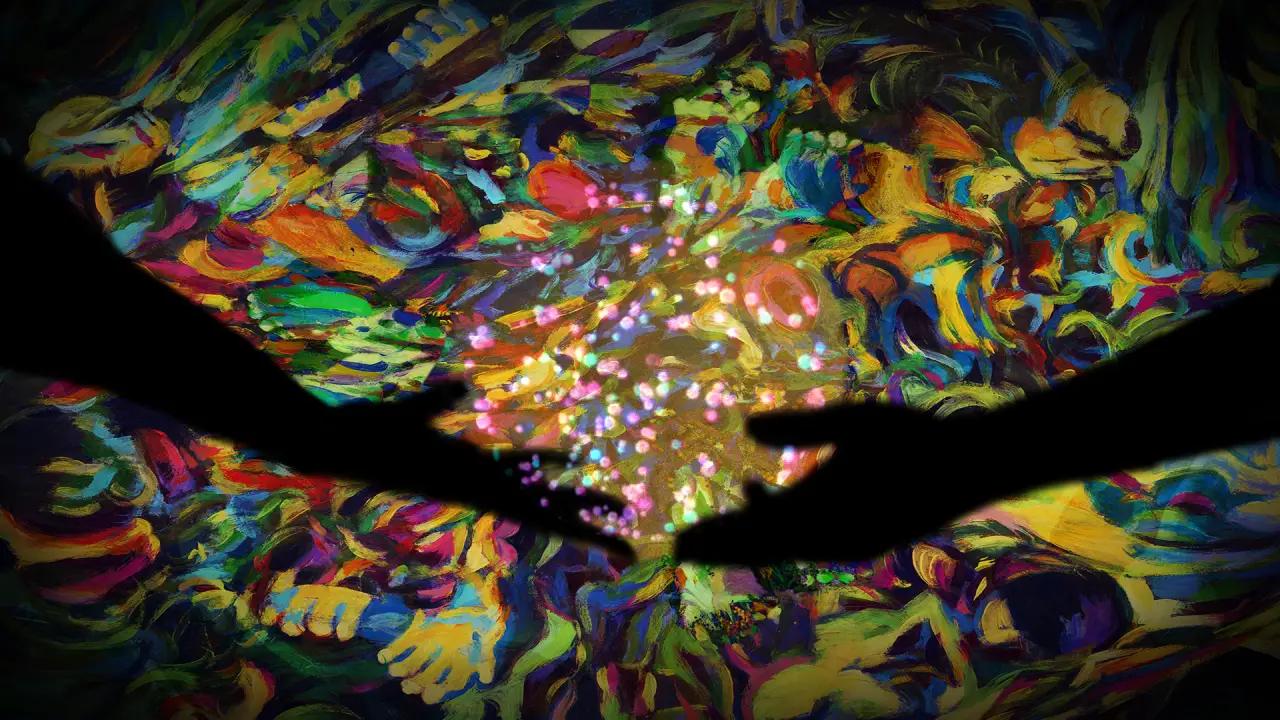
How does an immersive work come to life and evolve? At XRMust we often ask ourselves this question, and one of the most rewarding experiences for me, both as a writer and as a participant, has been the chance to follow from afar the evolution of THE GARDEN SAYS… (formerly GARDEN ALCHEMY) by Michelle and Uri Kranot.
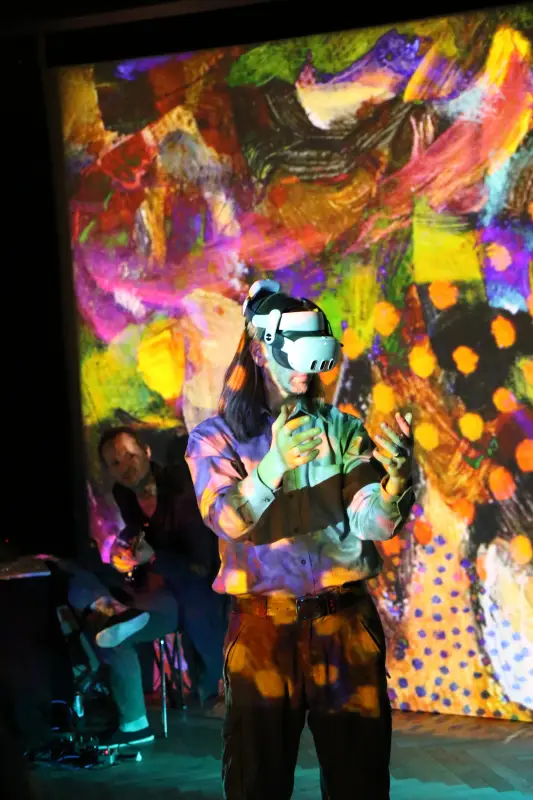
After seeing an early (prototypical) result at Venice Immersive 2024, I then witnessed the full performance of THE GARDEN SAYS…, presented during an event at CPH:DOX Inter:Active 2025.
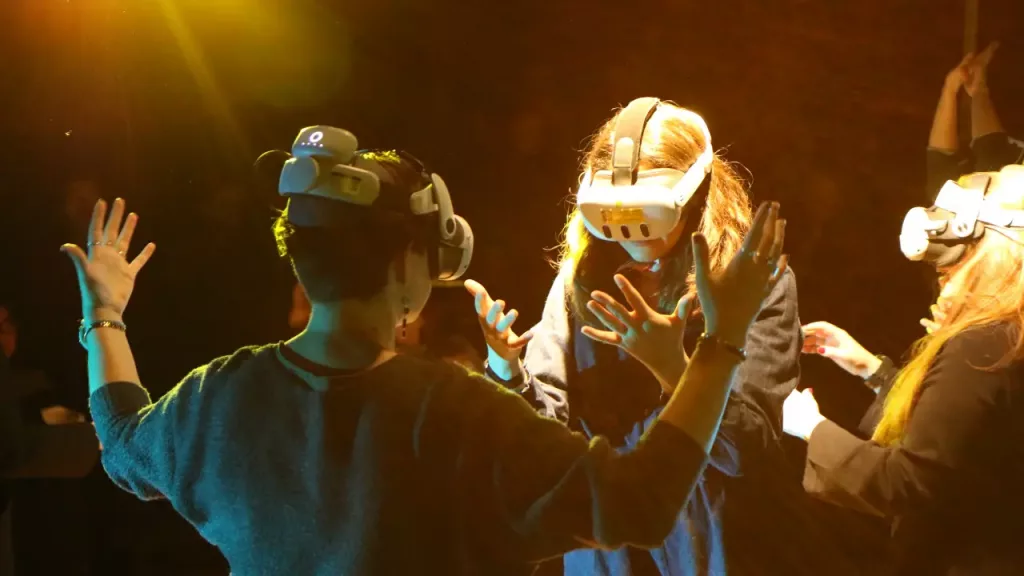
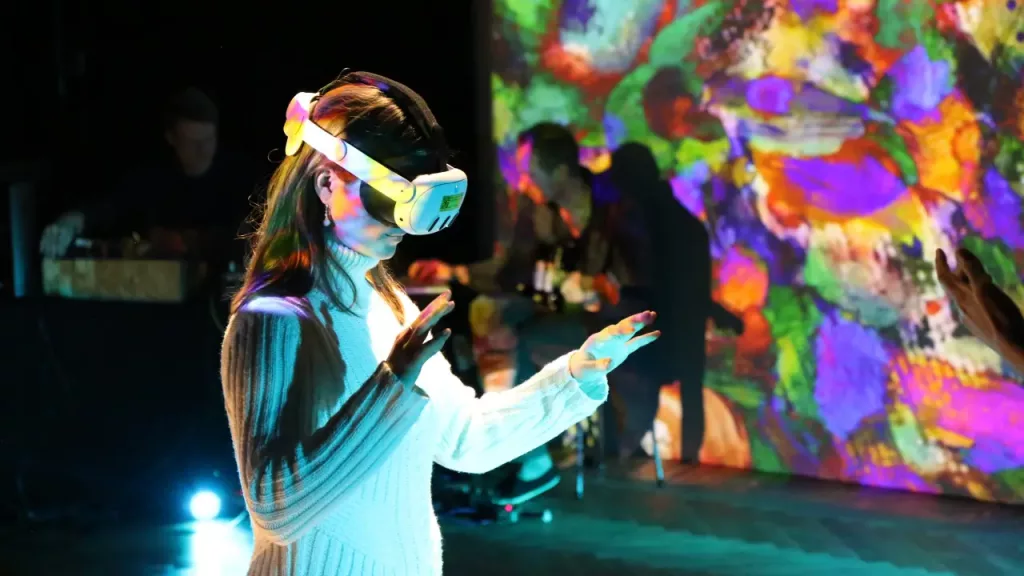
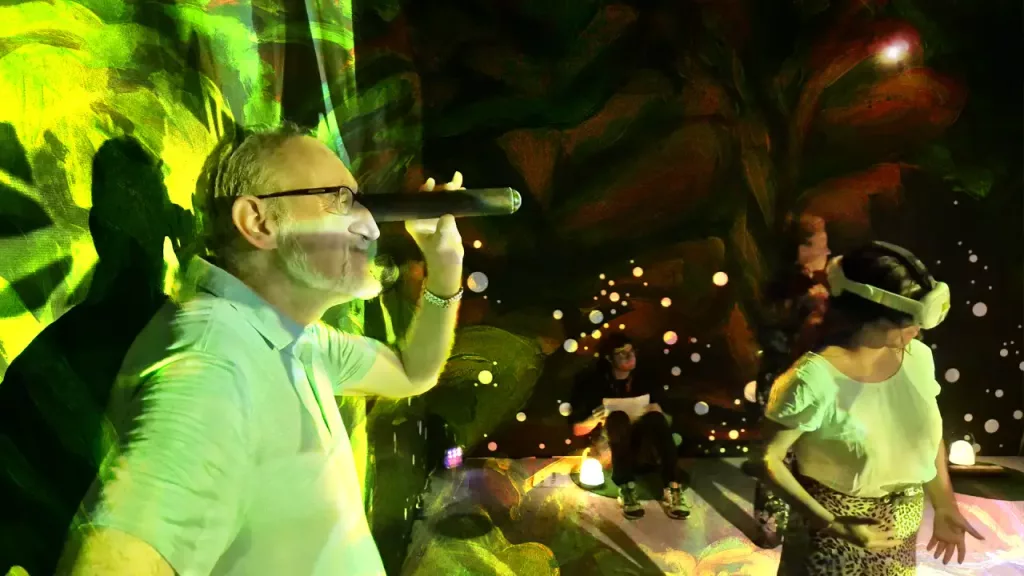
Picture this: an audience gathered in a small yet welcoming cinema hall. We’re immersed in darkness except for the screen, where these marvelous drawings are projected – bursting with color, bursting with life, blending and shifting almost like in a kaleidoscope, constantly giving birth to new compositions. Then the music begins, played live, while people from the audience move fluidly on and off stage, putting on their headsets to join the experience or taking them off to go back to their seat. With graceful movements, they help shape this Garden, generated by their gestures, and by their connection with the other participants.
It becomes almost a dance, as fascinating to witness as it is to perform. During that event, I didn’t even feel the need to wear the headset myself: it was mesmerizing enough just to watch people gradually immerse themselves in this garden of their own making, brushing past each other, exchanging smiles, mirroring their movements with one another. It was like a poem coming to life, as beautiful as it was spiritual, thanks to all those who contributed to its creation.
In just a few days, the exhibition at Museum Jorn, featuring THE GARDEN SAYS…, will open. We met with Michelle Kranot, who created the piece together with Uri Kranot, as well as Peter Fisher and Kathrine Fremming of Khora, the production studio which, with The Animation Workshop/VIA University College, helped bring their artistic vision of this extraordinary work to life.
From art to industry: Khora’s multidimensional approach
Peter Fisher – Khora has been around for nearly a decade. Today, we’re a team of 34 full-time professionals working in-house, combining artists, developers, 360° filmmakers, project managers, business developers, and everything in between. At our core, though, we’re an XR studio: our goal is to pioneer the medium and help collaborators and partners navigate it in the right direction, so they can fully tap into its potential and make the most out of content creation in this emerging space.
P. F. – To me, XR is still a growing and evolving field. We try to take a broad approach, working across different industries. It’s a direction that I deeply care about, and that Kathrine and many others on our team explore with great creativity.
P. F. – Certainly, collaborating with artists feels natural to us. It’s something that fuels our creativity and gives us a meaningful outlet for artistic expression. At the same time, we’re active in academia and often involved in publicly funded projects, including European Union consortiums. On the commercial side, we work with medical companies and sustainability-focused energy firms, creating both narrative-driven content and practical training simulations.
P. F. – This means our work spans from abstract, highly creative art to very concrete, functional solutions, all under the umbrella of XR, which remains our main area of expertise.
P. F. – Our ambition is to become the go-to studio worldwide for anyone curious about XR and eager to engage with it. We have an international team with a deep collective understanding of the medium, shaped by many years of shared experience.
Building immersive stories and artworks
P. F. – For me, the key to good immersive storytelling is to design the project with the medium in mind from the very beginning. I’ve often said this to clients in the commercial world: if the idea doesn’t make unique use of AR or VR, then it probably doesn’t belong in that format. You shouldn’t force a concept into the medium.
P. F. – But if you’re genuinely making use of spatial design or the immersive qualities themselves, then it just makes perfect sense. There’s so much you can do with this empty space. It opens up incredibly exciting possibilities, at least in my view.
Kathrine Fremming – What I’ve really appreciated in the immersive art scene over the past few years is the shift we’re seeing. We’ve had lots of documentary film projects, a lot of 6DOF experiences, but now we’re entering a new phase with location-based artworks – experiences where you’re invited to explore for yourself. And with THE GARDEN SAYS…, you also have this feeling of being present together in a shared space.
K. F. – I think during COVID, and even before that, VR was often a solitary experience. Now we’re really seeing how immersive media can bring people together to share a moment, even inside this virtual realm, through the goggles, in a collective way. That’s what I really like and feel inspired by, these days.
Michelle Kranot – What defines meaningful immersive work, to me, starts with acknowledging that we’re not just dealing with individual taste or cultural context. We’re also part of a historical field, and so many layers are involved. And even the word “immersive” needs some unpacking. It carries different meanings, and those differences shape how we use and understand it.
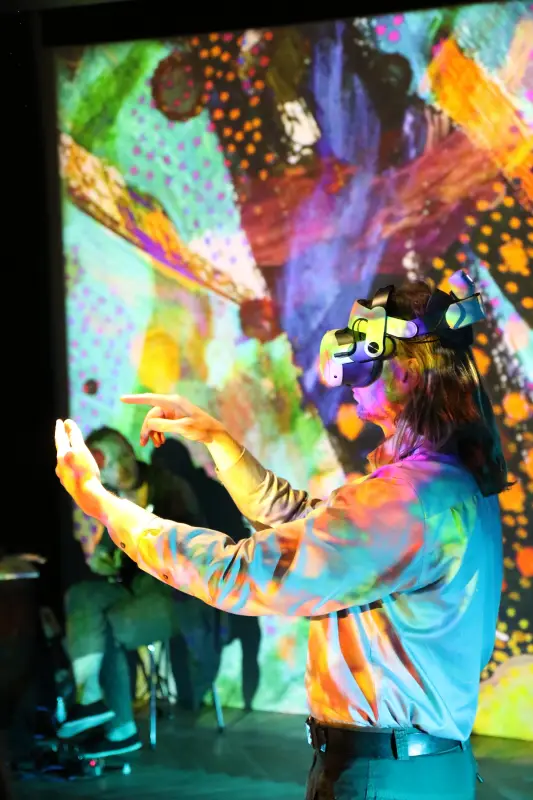
M. K. – In our case, the move from linear, screen-based storytelling to immersive environments has been strongly influenced by participatory art. That’s a whole culture and field of expertise that often goes untapped, especially when people come to XR with a purely cinematic background. Many early XR technologies were used by filmmakers, but the space is opening up now, tools are more accessible, and artists from other disciplines are getting involved. When you bring the know-how of participatory practices into these tech-driven environments, it adds real value..
M. K. – I don’t feel comfortable making firm judgments about what’s “good” or “bad.” That kind of binary feels unhelpful. As a curator, I’m definitely judgmental. But as an artist, I’m critical. In terms of what helps XR thrive, I think it’s about staying curious – curious about other disciplines, and driven by a genuine desire to make good art. It may not always succeed, but that intention lays a solid foundation for creative work.
The layered creation of THE GARDEN SAYS…
M. K. – The project actually began back in May 2022 as an audiovisual concert. It featured live music, live projections, animation – including live animation – and was staged in a surround projection environment. It created the kind of collective atmosphere you’d expect from a concert experience.
M. K. – At the time, we had just finished distributing THE HANGMAN AT HOME as a multi-user experience (WE ARE AT HOME), and it felt natural that the next step in exploring our themes would be to create something digitally mediated, and in this case, a mixed reality piece. The goal was to enable a large group to engage in a genuinely collective and interactive experience. So it all started as a live show and then went through many small iterations and a handful of early prototypes.
M. K. – Our process in the studio was quite messy. We worked closely with a technical director, and students would join us to try out different interactivity experiments. The headset visuals at that point were still quite rough. At the same time, I was developing the visual world through eco prints, textiles, and traditional intaglio printmaking. These physical elements were already present in the early versions of the piece.
M. K. – Eventually, we realized the project needed the support of a proper production company. We had been through several development labs – Biennale College, CPH:LAB – and it was our collaboration with Khora that really pushed the project to a different level. By the time we started working together, we already had four or five working prototypes, had been experimenting with a participatory theatre company, and had collaborated with various technologists. We moved from Unity to Unreal and back again. We began testing with an anti-latency floor to support the multi-user aspects.
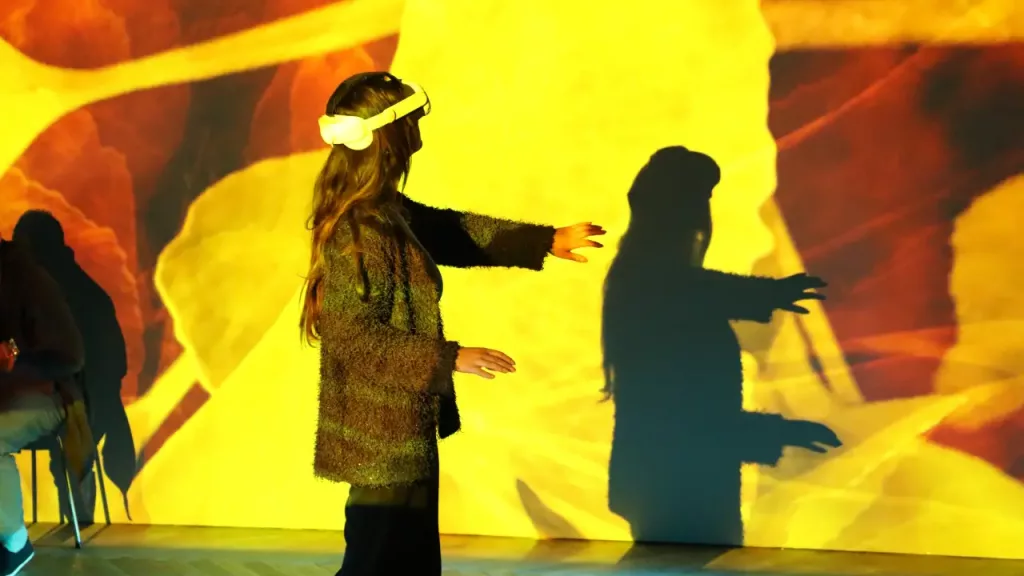
M. K. – Partnering with Khora marked a major leap not just in terms of refining the technology and concepts, but also in achieving the level of quality and artistic resolution I had envisioned. Beyond seamless interactivity and user experience, it was important for us to preserve the tactile presence of fine art techniques we bring to our work.
M. K. – The journey has been full of twists and turns, ups and downs, and many different types of collaboration. We held workshops with storytellers, with actors. We designed the user experience, though we didn’t call it so at the time. For us, it was simply playtesting, involving people with expertise across various disciplines.
Scaling immersion and pushing technical boundaries
K. F. – When we started working together, we developed the first prototype for Venice Immersive, as part of the Biennale College. That phase was a steep learning curve for our production team. We were trying to do things we’d never attempted before. One of the key goals was to have at least four players together in the same physical space at the same time, with the ultimate aim of reaching ten.
K. F. – We went through several rounds of development, layering and refining what we had built. The Danish Film Institute supported us in bringing the project forward all the way to its premiere at CPH:DOX earlier this year.
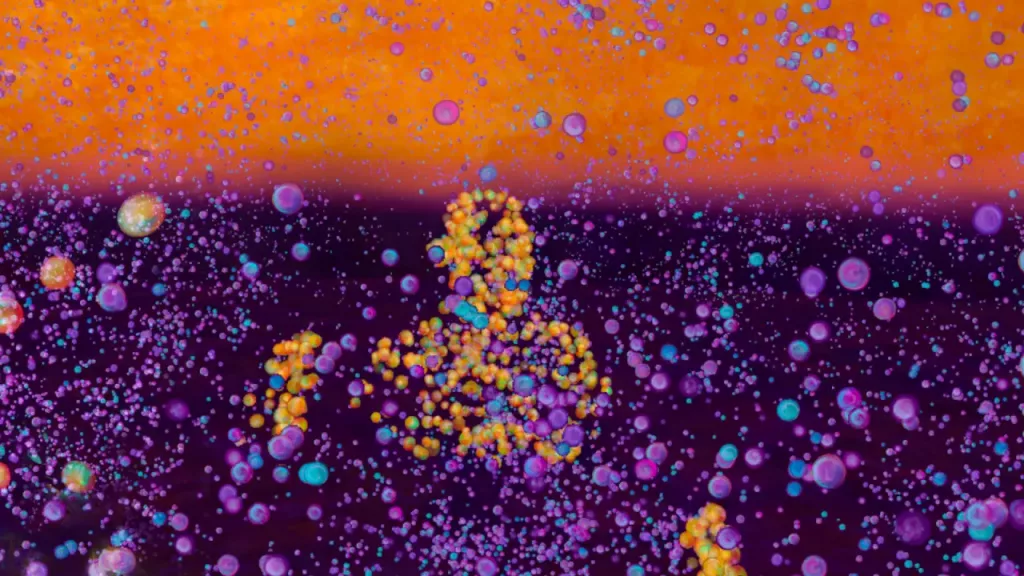
P. F. – And we’re still actively refining it. It’s not quite finished yet, but creatively it’s already been a very meaningful process. One of the key challenges has been taking the physical, tactile artworks Michelle created, like paintings and textiles, and translating them into the digital space without losing their integrity. Then we added this layer of magic: giving users the ability to touch digital elements that look physical, making them feel at once natural and otherworldly.
P. F. – For the team, it’s been a real pleasure to flex both technical and artistic skills, and to have that ongoing dialogue with the artists. The challenge of building a multi-user, persistent mixed reality space has pushed us all to rethink what’s possible with the medium, and to consider how it can scale.
P. F. – There are now many ways we could exhibit the piece, but choosing to make it run on standalone headsets was a core decision. It wasn’t easy – PC-based experiences offer much higher fidelity – but showcasing them and covering the hardware costs presents real challenges. So this became a shared creative constraint: pushing the boundaries of the medium without compromising performance, and crafting an experience that’s both persistent and technically solid.
Bringing THE GARDEN SAYS… to life
P. F. – For all these reasons, the premiere at CPH:DOX was truly magical. We built a large physical space and filled it with as many people as we could, all sharing the experience. And then, for one night only, we presented the full version as it was meant to be, complete with live performers and music. It was a huge milestone for all of us, something we had been working toward for a year.
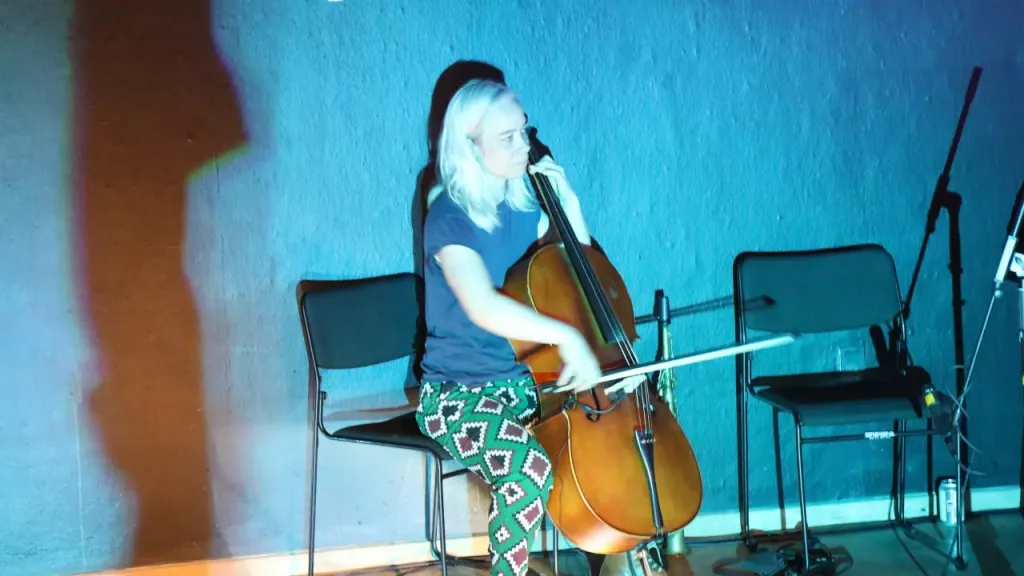
K. F. – That concert was also an important moment for our technical team. They finally got to see how the dynamics they had developed played out in a real setting.
K. F. – We had up to eight, even ten people in headsets simultaneously, and the drop-in/drop-out feature worked really well. It was a challenge to get that functionality right, but it was essential for the piece to move forward.
M. K. – That’s when I really appreciate having a strong technical team… because we can have a vision, describe it, and expect it to actually take shape. It’s pretty incredible.
M. K. – Considering how many different iterations this project has gone through, and how technically demanding it is, I never felt burdened by the technical side. As an artist, it always felt obvious to me that we could do it. And every time we needed to improve something, there was never any doubt. It just kept getting better.
M. K. – That made me realize how privileged I am. And going back to the early stages of the project, I think we were also extremely lucky to start with a solid concept and a strong sense of conviction.
M. K. – Part of that comes from our environment. We work at The Animation Workshop and are based in Denmark. We were able to work on this as a research project early on, though many prototypes, even if most of them never became finished works. Still, each step in that development process helped us refine our ability to express and describe what we truly wanted. And thanks to our experience with XR, we’ve learned to trust both the process and the team behind it.
M. K. – When we bring in an idea, we’re just as open to dropping it or reshaping it. True collaboration isn’t about compromise: it’s about adjusting your vision. And when you work with a team that understands the challenges, but is also open to change and willing to be pushed creatively, that’s a real privilege.
M. K. – During early development, a number of influential people played a role in shaping the direction of the project. One of them is Mathieu Gayet. He was one of the first people we spoke with about location-based experiences. In fact, back in 2020, we co-wrote a research paper on VR distribution. We interviewed so many people. Mathieu was focused more on venues and festivals, while I was thinking about the artists and creators. But the research brought both perspectives together, and one key conclusion emerged: the future had to move beyond single-user setups toward collective, location-based experiences. That became the central idea. And this vision really placed itself at the forefront of our work.
M. K. – If that’s where things are going, let’s make it happen. Let’s be the first to do it.
M. K. – We pitched THE GARDEN SAYS… in Geneva and at many other festivals and forums, and each of those moments helped us ask what a venue really needs. From the very beginning, we knew this had to be a drop-in/drop-out experience. That shaped the storytelling itself. We knew we wanted it to eventually function like a concert, with people coming in and out, and that fluid structure had to be built in from the start.
M. K. – If I look back at the early concept pitches, it’s remarkable how much the project has evolved and yet how true it has remained to its initial spirit.
M. K. – We set out to make something, and we made it. Along the way, we made adjustments, compromises, and allowed ourselves to be challenged. But the work stayed authentic, because it was open from the beginning to collaboration. It wanted to be tested by a technical team, by performance artists, by scholars. From every angle, it was built to be porous.
M. K. – It’s certainly not easy being an artist. And here I want to take a moment to mention Maria Høeberg Holmberg, our technical production manager. Her role was essential—she acted as the bridge. Yes, we came in with experience and openness. And yes, the programming team brought the same. But we needed someone to connect those two worlds.
M. K. – In our case, that person was Maria. She was the one who managed to translate our artistic vision to the tech team, and who then communicated the technical challenges back to us in a way that still allowed everyone to stay creative.
One project, multiple formats: the layered distribution of THE GARDEN SAYS…
M. K. – I want to clarify that what we’re doing isn’t strictly a distribution decision. This is an artistic piece that was developed collaboratively with a performance team. We’ve been working with a theater group called The Art of Listening, who have been creative partners on the project from the very beginning.
M. K. – The fact that the participants are choreographed… that was fully intentional. It was something we considered carefully during the concept phase. Of course, there are emergent behaviors and moments of happy accident, but every one of those was either invited or anticipated in some way.
M. K. – What you experienced at CPH:DOX could be seen, in distribution terms, as the “full package.” That version included the performance, the audience, live music, projection, and frame-by-frame hand-drawn animation. We’re lucky, though, that the project can be broken down and distributed in multiple ways. If it could only exist as the full performance, our ability to share and promote it would be more limited.
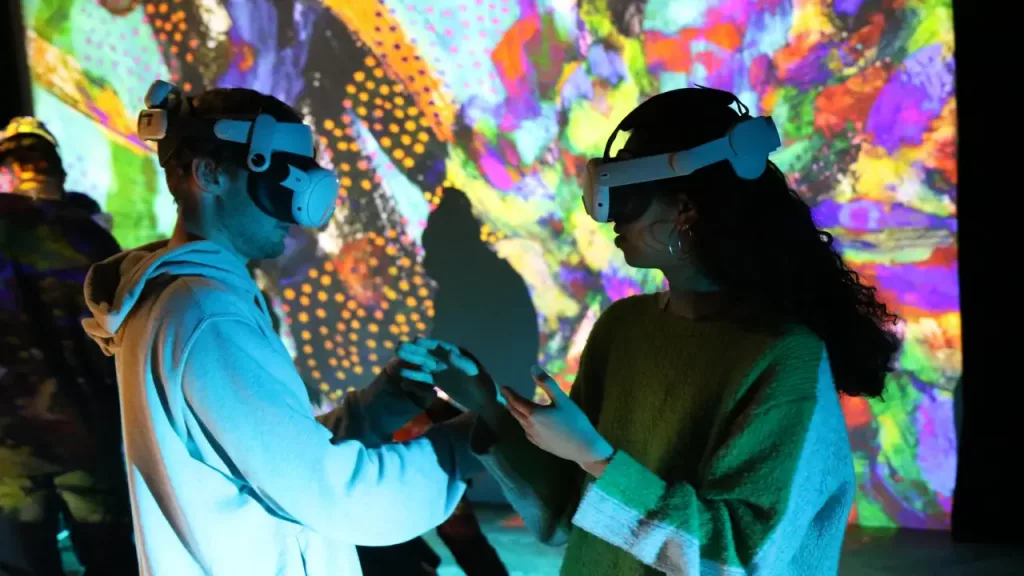
M. K. – So in fact, our distribution strategy is this multiplicity: each component of the project can stand on its own, while still belonging to a unified whole. The VR experience is strong enough to travel on its own, even though it’s not nearly as powerful without the hosting, the projections, and the other elements. At the same time, the theater performance is also touring independently, without the digital parts. We’re still doing live shows with music and performance without VR.
M. K. – Each of these components has its own distribution path, but they all come from the same source. THE GARDEN SAYS… is, at its core, a participatory performance installation.
M. K. – We’re also showing the work in museums over extended periods. That’s another world entirely for us when it comes to distribution, one we’re very eager to explore. For example, the piece will be part of a group show at the Museum Jorn, exhibited alongside works by Marina Abramović and Edvard Munch. The show explores new perspectives on art and well-being, anxiety, healing, and care, and will run from the 5th of September 2025 until the 16th of February 2026. For an XR piece to be installed in a museum for that length of time is rare, and I’m looking forward to the possibilities it opens. It signals a broader shift in how immersive works can live within institutional contexts.
M. K. – In terms of our distribution strategy, we’re focusing on getting the piece into museums, theatres, performance venues, and cultural spaces that wouldn’t normally host digital media. It’s about expanding where this kind of work can be seen… and by whom.
K. F. – We’re also looking into broadening THE GARDEN SAYS… internationally. That starts with connecting to curators around the world. The festival run plays a big role in that process and it’s been a key focus for us since the beginning of the year. We’ve spent time applying to festivals and meeting people at events like Cannes and CPH:DOX, which have both been important platforms for getting THE GARDEN SAYS… out into the world.
M. K. – Khora has done an extraordinary job on all these fronts. Partly, I think, because of their position, right in the heart of Copenhagen, but also because they’ve become something of a go-to studio, as Peter was saying. That visibility has brought us opportunities. Kathrine’s work, in particular, has helped us reach audiences who might not otherwise encounter this kind of piece. For example, we’ll soon be showing at the SMK (National Art Museum) in Copenhagen, and that opens the work up to a broader public.
M. K. – We’re really interested in building a wider European and international network of festivals, venues, and partners. Distribution is also about those relationships. What’s in it for them? How do we make sure that all the distribution partners benefit from all the hard work that we’ve been putting into the piece? Part of the answer lies in a simple concept: making the piece accessible. Easy to install, easy to set up, easy to run technically. That was part of our thinking even during early development. We wanted Kathrine to be able to bring this piece anywhere in the world without having to worry about whether it would work.
M. K. – As Peter said earlier, we’re still working on the project. One reason is that we’ve decided to create a new onboarding narration, a more digitally mediated form of guidance. When you’re working with a theatrical venue, there are clear structures in place, performers to pay, standards that need to be respected. But in most cases, especially when the piece is presented in a museum context rather than a theatre, it won’t travel with a dedicated performer. Instead, we’ll be training local hosts from the venues themselves.
M. K. – The host won’t replace the performer, but they will take on the role of introducing visitors into the experience. In XR, we call it onboarding and offboarding, but in adjacent fields, you might simply call it an invitation to participate. That’s the role we see for local hosts: to welcome people into the world of THE GARDEN SAYS….
Listening, learning, and building toward future research
M. K. – It’s really meaningful to hear people’s reactions. One of the most important things now that the project has launched is to listen: what do people see, what do they feel, what insights do they share?
M. K. – The showing at the Venice Biennale last year was especially important for us. Our team came and went throughout the event, and we were able to observe how audiences engaged with the piece. We made major adjustments and creative leaps after that showing. It’s rare to be able to do real user testing at a festival, but in this case, we were able to present the work in progress thanks to development funding from the Danish Film Institute and right on the cusp of entering full production. That phase gave us the chance to identify what really worked and what didn’t. The things that didn’t work, we fixed. The things that worked, we enhanced. It was a crucial step in the project’s evolution.
M. K. – Now that the project is officially launched, it’s still so valuable to hear what people think. But more than just collecting feedback, we want that input to feed back into the creative process. For me, that’s the next step, beyond distribution: placing stronger focus on the research dimension.
M. K. – As Peter mentioned earlier, Khora isn’t just a partner for artists and commercial clients, but also for researchers and scholars. They have deep experience in scientific collaboration, and THE GARDEN SAYS… is part of that body of work. It’s not just an artistic product being distributed.It’s also a case study for further research.
M. K. – We’re now looking at audience studies, trying to understand how we can evaluate experiential impact. We’ve created THE GARDEN SAYS…, but what about the next project? How can we better understand, measure, and define experiential value and emerging meaning? It’s wonderful to hear reactions, but we also want to place them into a rigorous framework. I believe this project can be a useful research instrument. Not just for us, but also for future collaborations with Khora.
Starting in September 2025, you’ll be able to experience the museum version of THE GARDEN SAYS… at Museum Jorn, as part of the exhibition Livsangst, which offers new perspectives on art and well-being, anxiety, healing, and care. LIVSANGST “is the first exhibition in a comprehensive two-year grant program supported by the Obel Family Foundation and the Augustinus Foundation. In addition, the exhibition is generously supported by the A.P. Møller Foundation and the Beckett Foundation”.
Leave a Reply
You must be logged in to post a comment.