

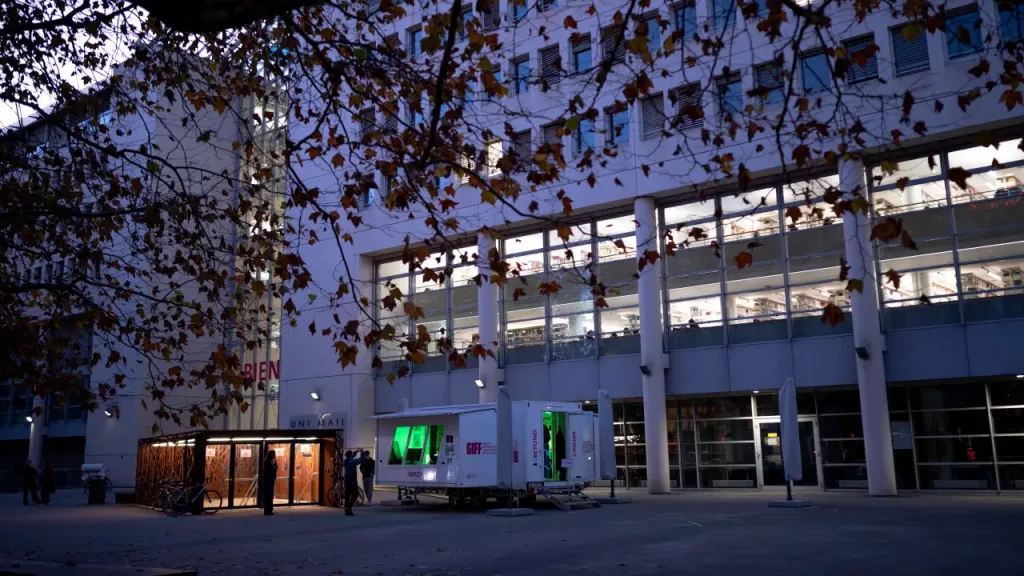
Presented in 2025 at SXSW and recently at the Geneva International Film Festival, FUTURE BOTANICA is an augmented reality work that reflects on the relationship between nature and the human element, while consciously stepping away from the perspective that usually frames this kind of discussion. Instead of placing humanity at the center, with the power to destroy or to fix, the project shifts the focus and asks what it means to look at the future from nature’s point of view.
Here, nature is not a fragile system waiting to be saved, but something that asserts its own presence and continuity, regardless of human action or intention. Through AR, FUTURE BOTANICA invites us into ecological futures that do not revolve around human needs, comfort, or survival, but around adaptation, resilience, and coexistence beyond us.
By allowing participants to generate speculative plants of unsettling, sometimes disquieting beauty, the work opens up a space of fascinating possibilities, immersing us in worlds that feel both alien and strangely plausible, and quietly challenging the way we usually imagine our place within nature.
Cover: FUTURE BOTANICA
After the work was presented in Geneva, we met with FUTURE BOTANICA’s director, Marcel van Brakel, who walked us through how the project first took shape, the new perspectives it opens up, and the way it was built through artificial intelligence.
What sparked the creation of FUTURE BOTANICA?
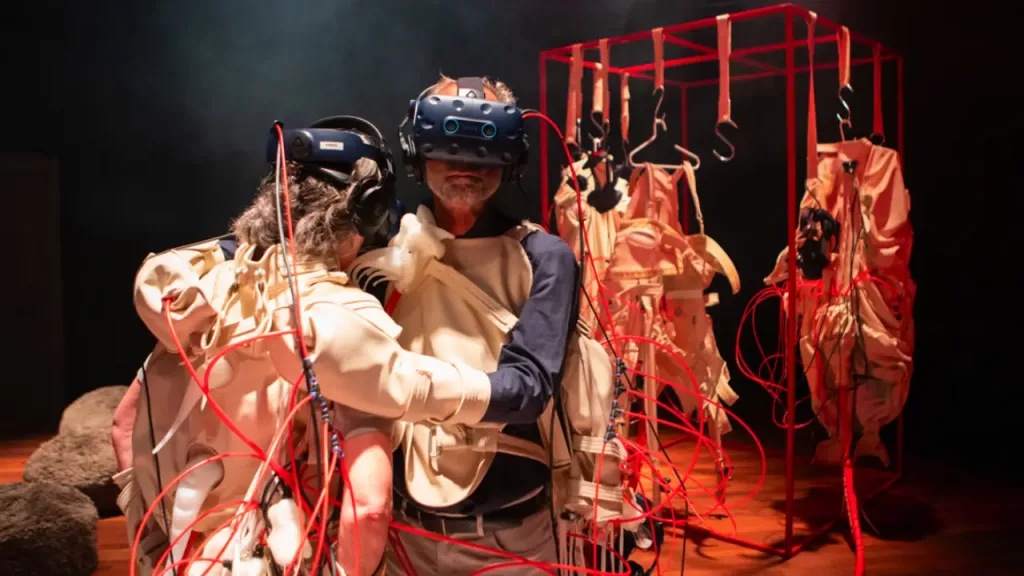
MARCEL VAN BRAKEL – Polymorf is an XR studio based in the Netherlands, and this project really comes out of an earlier work of ours called SYMBIOSIS (co-directed with Mark Meeuwenoord), which we made about four years ago. It was a multi-user VR experience produced by Polymorf and Studio Biarritz, exploring future narratives where humans would live in a more symbiotic relationship with nature. At the moment, both politics and ecology are deeply human-centered: nature exists inside our narratives and is expected to serve our goals. With SYMBIOSIS, we asked what would happen if humans were willing to share political and social power with plants and ecosystems. What kind of society would emerge from that?
The project was inspired by Donna Haraway’s book Staying with the Trouble: Making Kin in the Chthulucene, and especially by the Camille Stories at the end of it. It imagines future humans who respond to environmental crisis not by having more children, but by forming kinship with endangered species. SYMBIOSIS was very successful and toured internationally, but it was also very exclusive. It could host only six people per hour, and each run took about 45 minutes.
While we were deeply engaged with these ideas, we started asking ourselves how we could bring this topic to a much larger audience. That question directly led to FUTURE BOTANICA. We wanted to keep pushing this narrative, but in a more accessible, scalable way.
How did the concept evolve from that first idea?
M. V. B. – At first, we imagined it almost like a kind of digital LEGO system. We realized that nature creates leaves, flowers, roots, and other structures based on specific principles. What if we could catalogue those principles, digitize them, and let people assemble new forms of nature from them?
We went quite far with that idea, but then AI technology became much more powerful and accessible. At the same time, we realized that creating real biodiversity inside a fixed system is very difficult, while AI makes this much easier. So at a certain point, switching to AI became an obvious choice.
Conceptually, the core idea stayed the same. Our relationship with nature is always framed through human stories. If that framing can change, then the relationship itself can change.
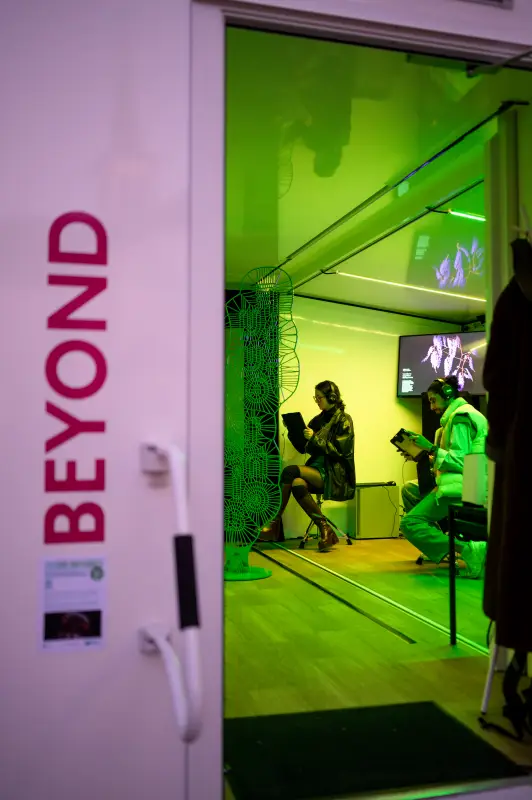
We wanted to collect as many different future framings of human–nature relations as possible. Right now, the app includes five scenarios, which were pre-designed together with designer and researcher Hazal Erturkan. These are meant as starting points, not as a closed system.
Ideally, in fact, we would love to open this up further. Scientists, ecologists, students, even children could contribute new scenarios. In that sense, the project could also function as a kind of anthropological study, showing how different people imagine the future of nature and humanity. We haven’t fully explored that yet, mostly because we ran out of funding, but it remains a core ambition.
How do the scenarios work inside the app?
M. V. B. – Each scenario describes a speculative ecological future. For example, there’s one focused on pollution and microplastics. We already know that some worms and plants can metabolize plastics. In a future saturated with plastic, these species might actually thrive and gain an evolutionary advantage.
For each scenario, we wrote an initial story-world prompt and fed it into AI to generate variations. We defined different types of outcomes, like bodily changes, structural adaptations, or environmental effects, and also used negative prompts to exclude certain elements. Each scenario required its own narrative logic and prompt structure.
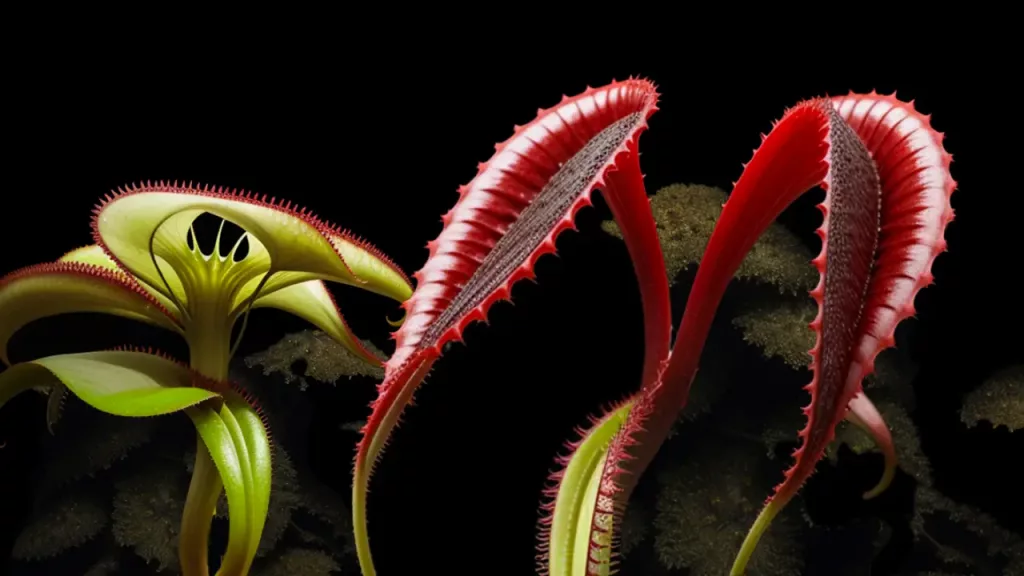
Inside the app, users collaboratively create artificial life forms or plants that inhabit these scenarios with the use of AI. Because the experience is multiplayer, we can track who creates what and run simulations on the resulting ecosystems. At the end, users see data showing whether their ecology is stable, how many offspring it might produce, and how resources are shared or competed for.
Our plan is for this data to appear as a three-dimensional mycelium-like visualization. For now, it’s still data-driven, but the simulation itself is already working. Visualizing it spatially is the next step.
How did you approach the AI design?
M. V. B. – That was a long process. The main idea was to build a prompt generator inside the app. Users don’t write prompts directly; instead, they scroll through choices that generate a sentence, which then becomes the prompt.
Because real biodiversity is incredibly complex, we had to narrow things down. Users choose what idea they want to push, what kind of lifeform they want, how it looks, and what abilities it has. Those elements together generate a prompt, which we send to a pre-trained generative model, within Stable Diffusion.
On the backend, there’s also a lot of invisible prompting. For example, if a user selects “tree” that’s one option on the front end, but on the backend the app randomly selects from around 150 different tree species. The AI draws from a vast cultural archive of plant imagery, both realistic and speculative. It recombines these patterns in ways that sometimes feel familiar and sometimes completely alien.
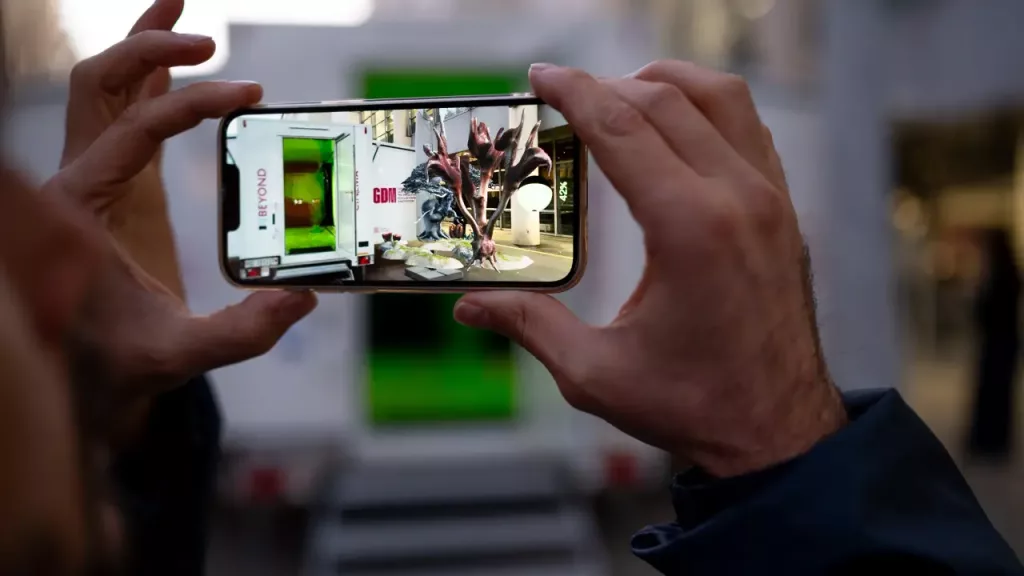
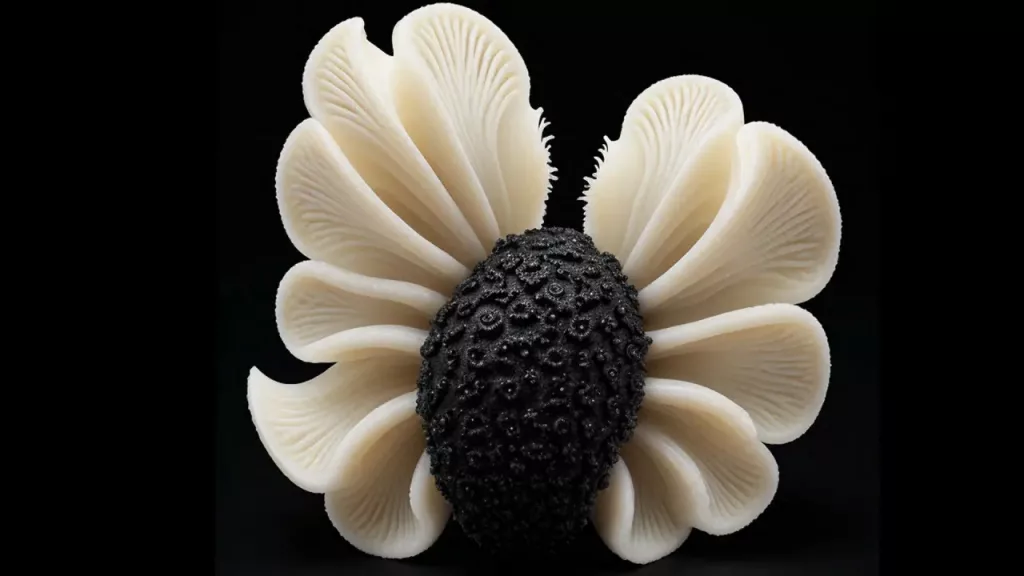
We’ve generated over 9,000 unique plant designs so far: an incredible database, that’s tapping into our cultural heritage and everything that is known about plants.
If you imagine that we were able to identify which gene expressions produce specific traits in a plant, you’re already very close to what the AI is doing. The system recombines traits in a speculative way, for example merging something like a spruce tree with a flowering structure that doesn’t exist in nature. Biologically, that combination doesn’t occur, but if both traits existed as genetic information, you could theoretically imagine editing or recombining them.
That’s why the analogy between DNA and prompting became important to us. In both cases, you’re dealing with a sequence of information that triggers a phenotype, shaping how something looks and how it behaves in a given environment. Some of these combinations wouldn’t be viable in real biology, of course, but many of them might be.
How do you deal with unwanted outputs and cultural bias in AI?
M. V. B. – We had to add a lot of negative prompting. We force black backgrounds, exclude objects like vases, and prevent animals or humans from appearing. If you send a completely neutral prompt to many models, you often get a half-naked woman back. That says a lot about how biased popular AI models are toward the male gaze.
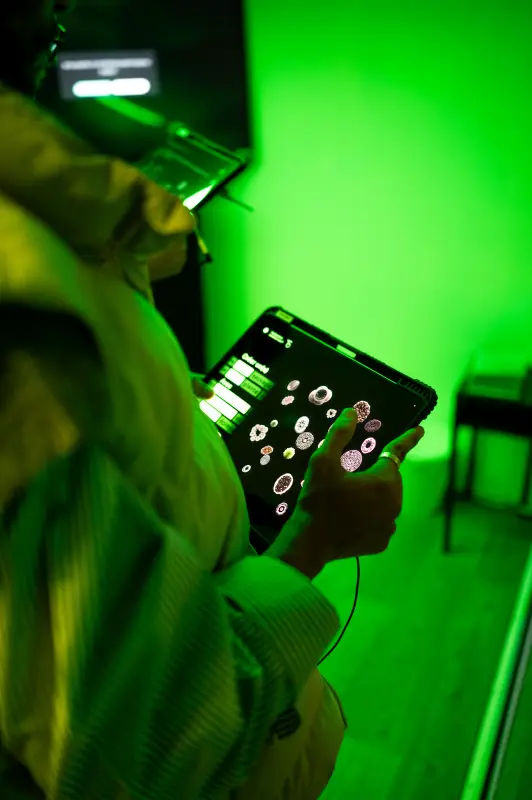
Even then, you can’t fully control it. During a show in Dubai, we realized that one prompt word, “aesthetic,” drastically increased the chance of female figures appearing. We removed it immediately. These are things you only discover by doing. You can’t fully anticipate them, simply because it is impossible to control AI completely, especially considering we use AI in many different ways: text-to-image, text-to-text for storytelling, text-to-speech for narration and multilingual voices, sound generation, and image-to-3D mesh conversion. When you design a plant, the app generates both a 2D image and a 3D model. And what’s great is that that model can be 3D-printed directly, which we’ve already done for exhibitions. However, the same 3D model can also live inside a virtual or augmented space, which is what we do in the app.
That opens up a much larger perspective. You can start generating entire environments, scenes, or objects in real time, even pre-animated ones. In the future, this means you could build highly adaptive worlds that respond directly to user input or behavior, all generated on the spot by AI. For me, that’s one of the most exciting directions.
The main limitation right now is the smartphone, of course. We had to simplify a lot and make compromises because of hardware constraints. On more powerful VR systems, you could push this much further and do all of this at a much higher level of complexity.
What does FUTURE BOTANICA reveal about its audience?
M. V. B. – It really depends on the context. From the beginning, we designed the project to work in different modalities. You can experience it in nature, in an outdoor environment, when you have time to stay with it, play longer, explore multiple stories, and build more complex ecologies. In that context, people tend to make different choices, because they slow down, take time to digest what they see, and really respond to the ecology they’re immersed in.
Most of the time, though, the work is shown in exhibition spaces. There, people are usually short on time. They’re excited, curious, and they want to try something quickly rather than explore everything in depth. What I find interesting is that in those situations, people almost always go for the extremes first. They want to see what a flesh-eating plant might look like, or something tentacle-like, dangerous, exotic, or bioluminescent. There’s a strong curiosity toward the unfamiliar and the spectacular, just to see what it might become.
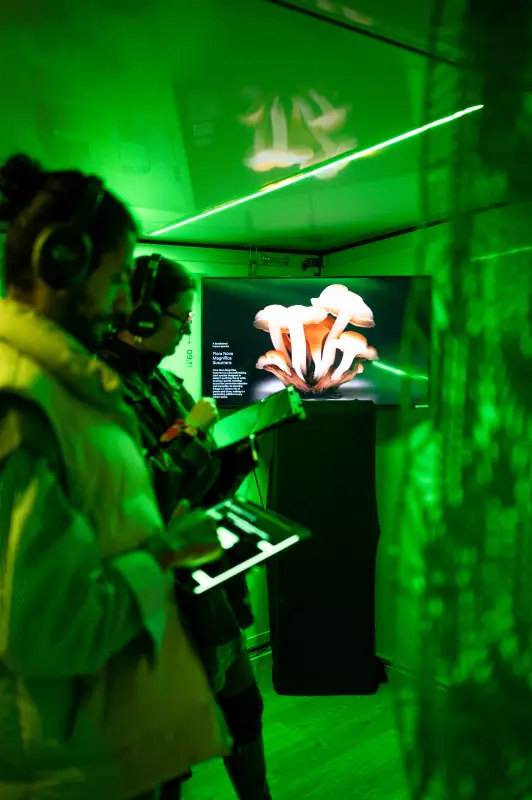
Certain scenarios are clearly more popular, like the “bewildered” one. It’s hard to say whether that’s pure curiosity or a deeper desire to imagine a less efficient, less human-centered world.
We currently have a permanent installation at the Hortus Botanicus in Leiden, and there the behavior is completely different. Visitors with botanical knowledge will spend a lot of time creating algae or slime molds and really exploring one niche deeply. You can almost read people’s personalities and interests through their choices.
What Do These Speculative Ecologies Reveal to?
M. V. B. – I’m genuinely excited to see how this develops over time. Sometimes the beauty of the plants that emerge is striking, and that’s always surprising. We also use AI to generate textual descriptions, so based on the choices you make in the app, the scenario you’re in, and the form you design, the system writes a description of the plant’s abilities within that specific ecosystem. Those descriptions can be unexpectedly rich, and they add another layer to the experience. There’s a constant sense of discovery in seeing what kind of potential comes out of this.
One aspect we found particularly interesting emerges in scenarios like the one focused on microplastics. On the surface, it deals with pollutants, things we usually see as purely negative. But if a new form of biodiversity starts thriving on those materials, it shifts the perspective. What is poisonous or disastrous for humans might enable a different kind of resilient biology. In that sense, it also humbles the human position.
The idea that humans are powerful enough to destroy everything is already deeply anthropocentric. The Earth doesn’t really care if it becomes a plastic world filled with plastic-eating worms, as long as it’s a functioning, thriving ecology. It might not be a pleasant place for humans, but that’s not the planet’s concern. That’s something we’re very engaged with: the idea that moving forward might require humans to take a step back, to be less human-centric and more open.
We’re interested in letting go of control, because control can be toxic. Every intervention has consequences, since everything is interconnected. If I design a plant that filters plastic, but plastic is the main resource sustaining that ecosystem, I might end up destroying another species that depends on it. So even actions meant to “heal” or improve things have side effects.
This fragility and interdependence is central to the project. Not everyone will consciously take that away from the experience, but it’s something we definitely want to push: the idea that ecologies are entangled systems, where every choice matters, and where human intentions don’t automatically align with what is best for the whole.
How do you see the future relationship between technology, biology, and XR?
M. V. B. – We tend to see technology as cold and inorganic, something boxy and disconnected from the body, while biology feels organic and alive. But that distinction is misleading. Current technologies often aren’t designed to be bodily or sensorially friendly, they reduce interaction to abstract signals, like a vibration on a phone when someone close to you calls. Yet they could be designed very differently, engaging smell, touch, or other senses.
At the same time, biology itself is a form of technology: complex systems operating without consciousness, made of biochemical processes that function like highly sophisticated machines. And now the movement is happening in both directions. Labs are creating robotic systems from frog stem cells, proteins that behave like machines, living structures designed to perform tasks.
In the long term, the boundary between the artificial and the biological will blur completely. The same is happening with intelligence. We used to think human cognition was unique, but we now see intelligence emerging in many forms, from animals to AI. These systems are made of the same material reality, just organized differently.
For me, this makes debates about whether AI is “really” intelligent less interesting. What matters is recognizing that intelligence, bodies, and technologies are deeply entangled, and that they will increasingly merge into hybrid forms over time.
What’s next after FUTURE BOTANICA?
M. V. B. – We’re currently developing a new project that moves away from VR and works instead with robotics and living organisms. There’s a tendency to equate XR entirely with VR, as if headsets were the only possible form of extended reality. VR is powerful, of course, but that discussion is often very limiting.
In this new project, we’re creating an immersive experience using around a million flies, which function as a kind of living robotics system. Through light and smell, we guide them to interact with the human body, creating haptic sensations and staging a ritual encounter with a species we usually try to exclude from our spaces. It’s still XR, just not in a headset-based sense.
We’re currently working with scientists on the first prototypes, and the next step is to build a space that visitors can physically enter and experience. If funding allows, we’d also like to develop a multiplayer version. For me, projects like this show how much potential XR has once you stop reducing it to VR alone.
Leave a Reply
You must be logged in to post a comment.