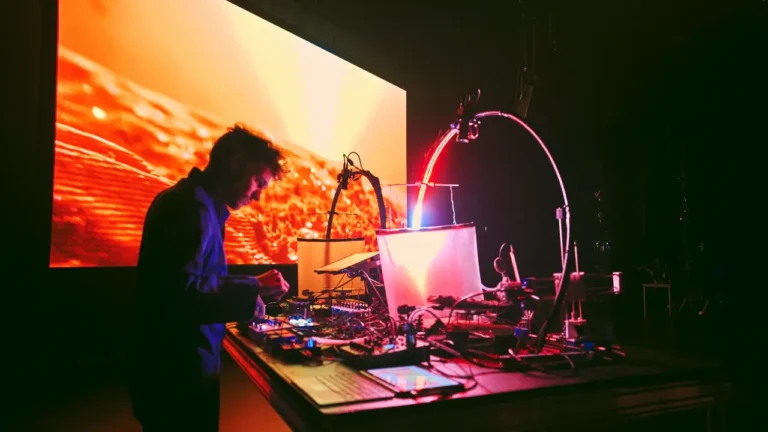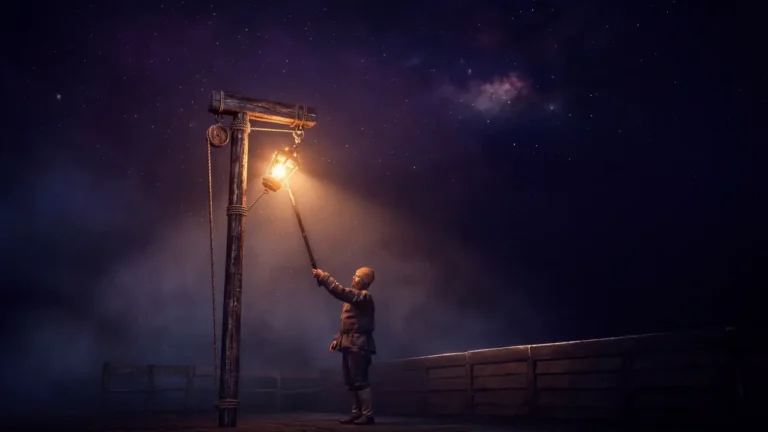
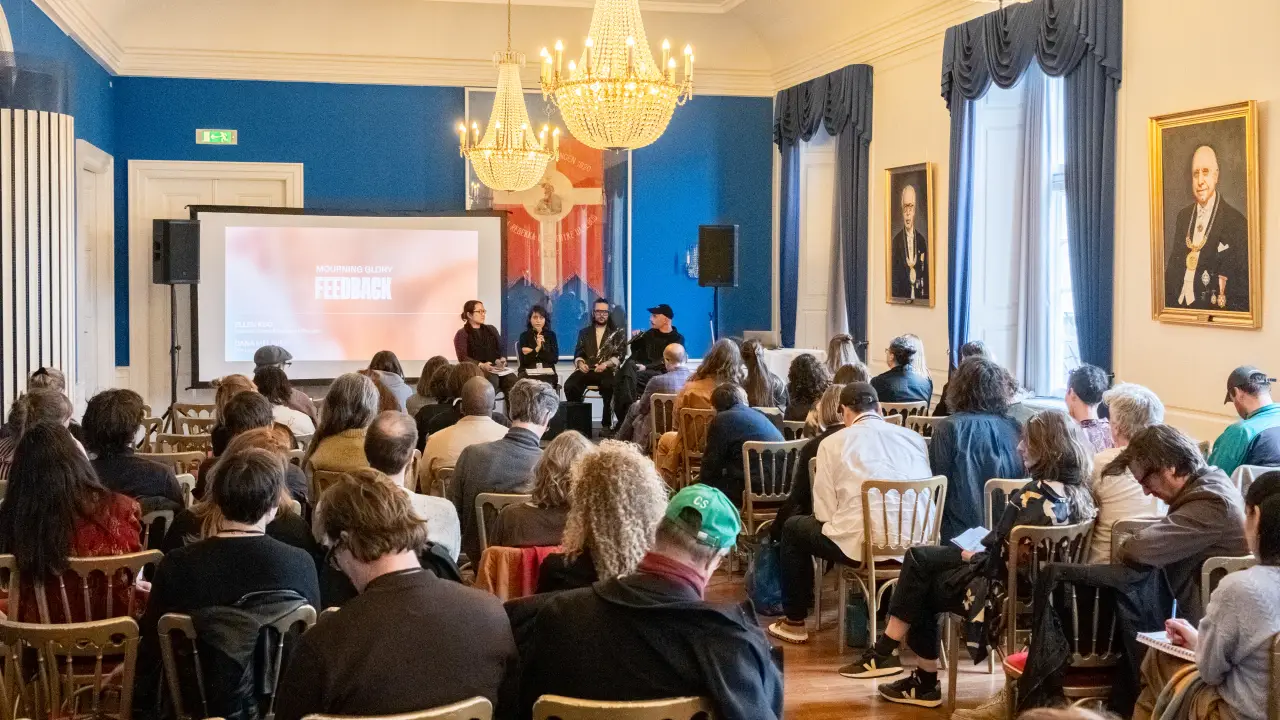
CPH:LAB, CPH:DOX’s talent development programme for boundary-pushing documentary and immersive work, concluded its latest edition in March. After following it for the past five years I have come to see it as a space in constant evolution: able to adapt, to reshape itself, and yet to keep at its centre what matters most, namely artists and their imaginaries.
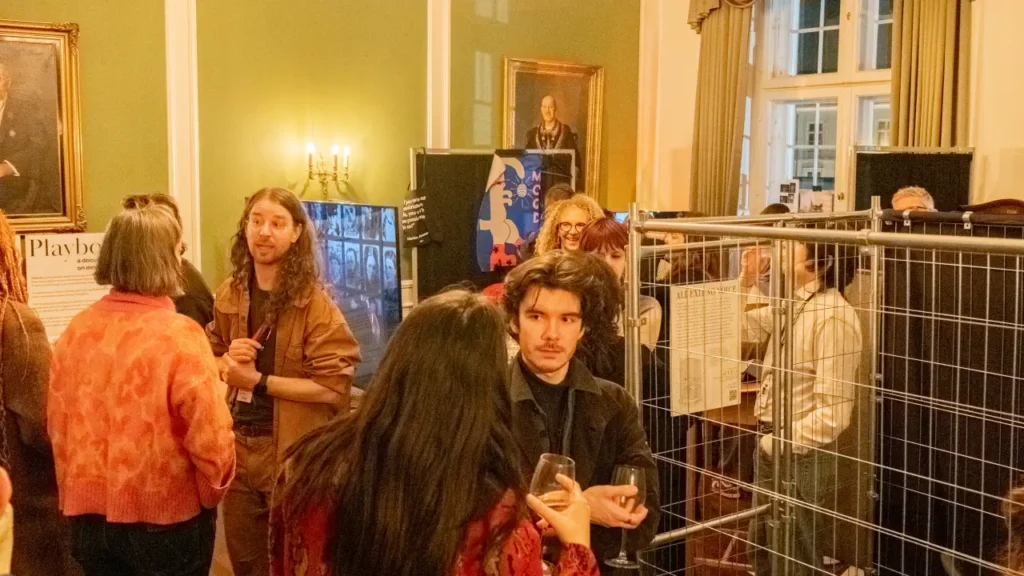
That is perhaps why, while attending this year’s LAB presentations, what struck me once again was the particular emotional atmosphere of that moment: you can feel the tension of the teams as they step forward, but also their excitement at finally sharing their work in public. Even from the outside, it is clear that this is a moment of arrival after months of development. And what stayed with me most, in the end, was that warm feeling of discovery that comes from watching people with very different backgrounds and levels of experience offer a fragment of their imagination, and do so because they believe in it deeply.
That sense of culmination, of a “small graduation ceremony” is something Stella Ntavara, CPH:LAB & INTER:ACTIVE Exhibition Manager, also emphasised when reflecting on this year’s edition during our annual interview.
Cover: CPH LAB Presentation 📸 Ivan Rozhdestvenskii
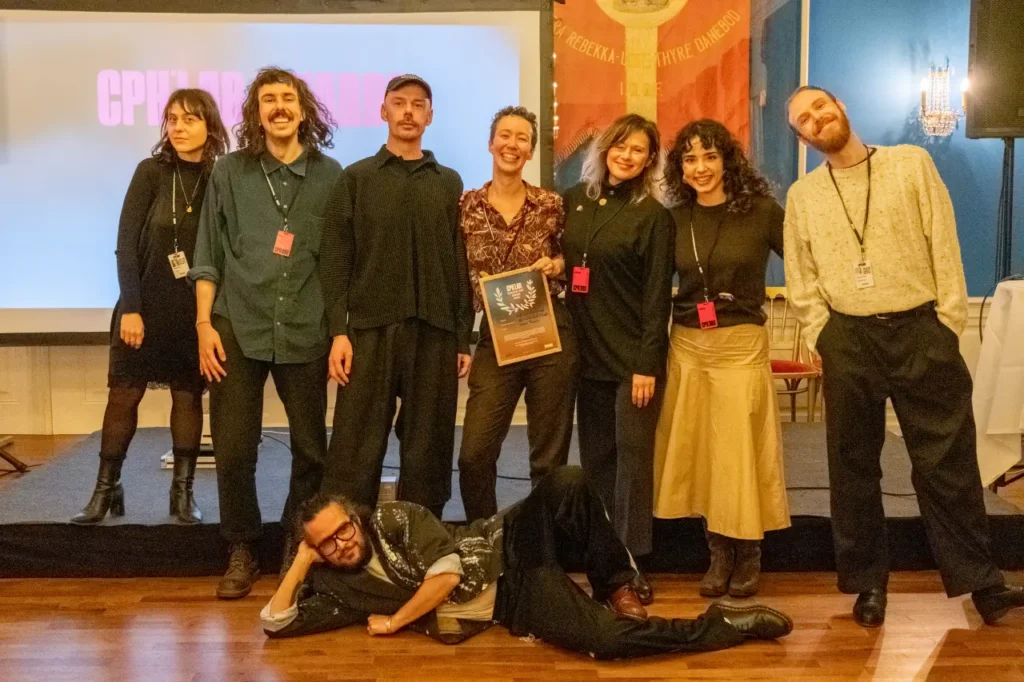
A year of growth and renewal
What the audience encounters during the festival is only the visible final stretch of a much longer process, which begins in the summer with the selection phase and continues with the October residency, before reaching Copenhagen again in its public form. Seen from that endpoint, Stella described this edition as a very good one, especially because of the different ways participants seemed to grow through it.
“Some participants told us that when they first applied, they had an idea but not much structure, and they came back saying that now they know what they want to do. Of course, they may still need a lot of funding, support, and everything else, but at least they found a clear direction. On the other hand, the people who arrived with a more solid idea felt they had been challenged in a positive way, to rethink things and make them even stronger.”
The value of the edition lay in precisely this coexistence of different approaches, both of which generated meaningful feedback. But while CPH:LAB keeps a recognisable format, it is never treated as something fixed. “We always try to tweak things, add new elements, and keep improving it. We need that ourselves too, as organizers, to keep the spark alive through change”.
For this reason, there were concrete developments to the LAB, that made this year feel particularly alive. Stella mentioned the new collaboration with DOK Leipzig as one of the most exciting additions, especially because it may allow the reflections developed in the Think Tank held during the festival to continue beyond CPH:DOX and enter a wider conversation later in the year. She also pointed to new mentors and new exchanges around sound design, multisensory storytelling, and accessibility in immersive experiences. “Every year, new people come into the lab from outside our usual circle”, she said, “and that is always enriching”.
Still, one of the reasons the LAB remains compelling is that it does not pretend creative development is smooth. Stella spoke very openly about the more fragile side of the process too: “There were also emotional moments, and moments of existential crisis for some participants. But I think if we didn’t have those, maybe it would mean we weren’t pushing in the right places”. That feels true from the audience’s side as well. The pitches were not always perfect, and at times that lack of clarity could be frustrating, especially when it left practical questions about the projects unanswered. But it was also understandable: it is not easy to stand in front of a room full of people and fully open up something that still exists, in part, inside your own mind. If anything, that tension often makes the experience feel even more human – which is one of the reasons I appreciate it so much.
“One of the challenges we face every year is how to deliver something meaningful from beginning to end with a budget that is far from unlimited”, she explained. “At the same time, the lab takes place within a very busy festival, where so many other things are happening, so another challenge is figuring out how to give our activities their own ecosystem and preserve that space, while also making them open and inviting to people who may never have engaged with the lab before. We want people to come to the presentations, see the prototypes, and take part in the Think Tank. So in that sense, the challenges are always both familiar and new at the same time”.
“Then again”, she added, “now that I’ve finished this edition and I’m starting the reporting process, I feel a real sense of gratitude. It was a very good year”.
A LAB built to push ideas that step further…
The structure of the lab already says a great deal about what it is trying to do. The October residency is fully in person in Copenhagen: “Everyone comes here, including Mark (n/a Atkin, curator of CPH:DOX InterActive and CPH:LAB’s Head of Studies) and the mentors we invite. It feels a bit like a school camp, all together in our offices in Copenhagen”. After that, the work continues online. Each team is assigned a dedicated mentor for five or six sessions, usually between November and February, while peer-to-peer sessions bring teams together every other week. Then, in January and February, the focus shifts to production meetings, from prototypes to spatial and technical needs.
That structure matters because it gives projects time to change. More than one participant told me in previous interviews (see our series of articles on past editions of the LAB) that the lab offered a rare chance to finally meet face to face with collaborators they were already working with, but had rarely had the time to stop and think alongside in a focused way. So, the LAB becomes a place where ideas are tested, reworked, and sometimes partially let go. Some participants, Stella explained, “come in with a loose idea, while others arrive with a very concrete one. In both cases, much depends on how willing and open they are to challenge that idea”.
Challenge, in fact, seems built into the rhythm of the week. Stella joked about what feels like a recurring law of the lab: “We always seem to have a crisis on the third day. The first day is still marked by enthusiasm, the second by exercises and questioning, and by the third some of the teams can be going through a kind of existential moment” And yet things don’t collapse. “By the fourth day they come back stronger”, she confirmed. “And they start focusing on making the project stronger, too”.
Because Stella is the first person reviewing the applications and doing the initial shortlisting, she sees that transformation from a particularly early vantage point. “On the first day of the lab they present their project in five minutes to the rest of the group, and then on the last day of the residency we have what we call the soft pitches, where they often end up presenting something quite different”. Even after just one week, some teams have already really reworked and reshaped their ideas. For many of them, that process continues all the way to the festival. “Not for everyone”, Stella noted, “but for many of them it is a significant transformation”.
Different languages sharing a common ground
One of the things the lab does particularly well is bring together people who do not necessarily arrive from within the immersive field. That, to me, is part of what makes the experience so valuable: the lab becomes not only a place to develop a project, but also a place to begin understanding, both professionally and humanly, how this field works and who inhabits it.
Stella pointed to Nano Party as one example, recalling Emmanuel Hadji (co-director of the work together with Jamie Perera), “a truly hardcore scientist and also an amazing person”. She remembered him telling her in October how eye-opening the LAB had felt, precisely because it brought him into contact with people and ways of working so different from those he had been used to throughout his career.
That openness matters because the lab does not gather one single kind of maker. Some participants come from theatre, some from performance, some from other fields that are not necessarily immersive in the way the lab might define it. “I tend to call everyone artists” She explained, “I don’t want to reduce them to labels like filmmakers or creative technologists, because their paths and even the categories themselves are often very fluid”.
It’s a fluidity that the lab actively looks for from the start. As Stella explained, when the shortlisted teams are interviewed before the final selection, one of the questions they are asked is not only what they hope to gain from the lab, but also what they think they will bring to the others. In a programme built around a week of intense shared work, that matters. The lab is not only asking what a project needs, but what kind of presence, knowledge, or energy a team might contribute to the group around, and the answers often regard their different expertises.
All this feels central to the immersive field itself. One of the strengths of immersive work is precisely that it is shaped by people coming from different backgrounds, with different habits, vocabularies, and ways of thinking. The lab makes that visible by placing those minds together. And if that encounter can sometimes be explosive, as Stella said, it can also unfold in a really beautiful way.
Challenging what we know about immersive
The growing visibility of the lab is reflected in the number and variety of applications it now receives. Since Stella began working on it five editions ago, submissions have kept increasing, reaching around 150 this year. Not all of them are eligible, of course, and some are simply too linear for the programme, but even after that first filtering there are still around 120 projects that deserve close attention.
What seems to energise Stella most is not just the volume, but the sense of expansion it signals. Each year brings familiar names alongside unexpected ones: artists and makers the lab already knows, sometimes even former mentors returning with a project of their own, but also “complete wild cards from countries and contexts we have never heard from before”. That, she said, makes the process more challenging, but also “really refreshing”.
Among the tendencies she has noticed, one stands out clearly: more and more teams are being formed across disciplines. Sometimes they are long-standing collaborations, but often they are newly formed duos or partnerships, built around a shared idea rather than a long history of working together. That means the lab is not only assessing the project itself, but also trying to understand whether these people can actually work as a team and carry the project forward.
Another strong pattern is the number of more traditional filmmakers who are beginning to look beyond linear formats. They may be working with archives, interviews, or documentary material, but want to explore what that body of material might become in another form. “They may know very little, or nothing at all, about immersive technology and all the possibilities around it. So, in a way it can feel like a risk to accept them, but at the same time it is also very rewarding to invite these people in and say, that’s fine, the lab is precisely about experimenting and trying to find the answers”.
It is an attitude that has proved effective. “Someone who has never worked in the field may sometimes come in with ideas that are much more radical or experimental than those of people who already know what this field is supposed to be or do”.
Hello from the other side…
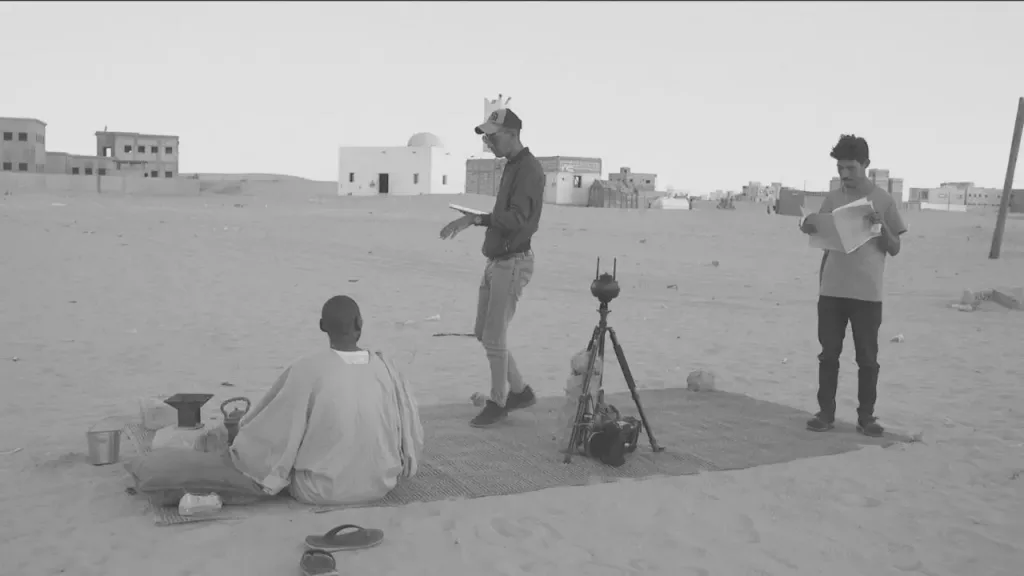
Tales of a Nomadic City is one of the projects that stayed with me most clearly from the previous editions of the lab. I had first encountered it at CPH:DOX in 2024, and this year it appeared in the lineup in a more advanced form. It made me wonder what it means, from Stella’s side, to see a project begin inside the lab and then continue travelling, growing, and reshaping itself elsewhere.
There is, of course, pride in seeing projects reach major contexts like Venice, a recent example being The Garden Says by Michelle and Uri Kranot, or return through Inter:Active in a new form. But what seemed to matter most to Stella was something less visible and perhaps more lasting: “Once you meet people at such an early stage in the development of their work, some of those relationships stay with you. You keep meeting again, they come back with questions, they say, ‘I have this new idea, what do you think?’ A relationship of trust starts to form. And even if they eventually premiere at another festival, or do not premiere at a festival at all, that trust relationship remains. It develops with us, with Mark, and with the lab. And I think that is one of the most valuable things about the lab: the relationships we build”.
Asking the right questions
When I asked Stella what she would recommend to those applying to the lab, she began with something very practical. Although “people can absolutely apply as solo artists, I usually recommend applying with someone else. The process is long and intense, and it really helps to have someone you trust professionally and feel you can go through the whole journey with”. As she had already noted, there are moments of self-doubt, so it matters to be able to support one another through them.
The other crucial point is clarity. One of the things the lab asks directly in the application is: “What is your question? What are you trying to answer by being in the lab?”. For Stella, what matters is identifying this fundamental question at the core of your project. “It can be many things, but I think it is important to be clear about it. Sometimes, when we read applications and review them together, we either struggle to understand that, or we feel that a project is already so advanced, so ready, and so self-sufficient that we begin to wonder what exactly they still need from the lab”.
That does not mean every project must fit a single model. There may be other reasons for applying, and “maybe it is a well-known project, and being in the lab could expose it to the right people or contexts”. But in that case too, “it is better to be honest about it”, otherwise a mismatch of expectations can easily emerge. “If you are expecting something from us that we do not really provide – for example support with distribution, or production in a practical sense – then perhaps we are not the right place for you, because we are an educational programme”.
“Most of the time”, she added. “I think there is some confusion, or people are trying to answer too many things at once. And I think that can also become overwhelming once they are selected, especially when the project itself is promising and the ideas are strong. Sometimes the people who are most interesting are also the ones who are most confused, because they are carrying so many questions already. Of course, as an artist, having many questions is completely natural, that is part of the process. But it is more about trying to take things step by step, and trying to prioritise. What is my roadmap? What is my path toward making this project happen?”.
Clarity matters not only for development, but for communication too. “Usually the people who have that kind of clarity are also better able to convey it”. Because in the end, “it is about convincing people, whether during meetings or presentations, that you know what you want to do and have a sense of how you want to do it, even if you do not yet have all the means to make it happen. It is about trust. If people do not feel they can trust your vision, or trust you in relation to your project, then I think it becomes very difficult to bring them along with you”.
The human side of pitching
This was probably the main point I kept returning to while watching this year’s project’s presentations. More than once, I felt very strongly the passion behind the projects. It came through in the way some of them were presented, in the urgency with which people were trying to share something that clearly mattered to them. Even when certain aspects were not completely clear to me, I could still feel how deeply they cared about what they were making.
At the same time, though, I often felt the need for a clearer understanding of the audience journey in particular. What do I actually see when I am in front of your project? What, literally, is the experience?
That lack of clarity could be frustrating, especially when it made it harder to see which people or contexts might actually be helpful to the team and to the project’s further development, which is a question I always ask myself. As Stella pointed out, however, for some participants this is “literally only the second time they are doing something like this”. First in October, in front of the lab, and then again at the festival. “They are not used to the context of a film festival. They are not used to the language of pitching – even if this is just a presentation”.
And that, in her view, is also what makes the process admirable: “They may already be very strong in their own field, but then they have the courage to place themselves inside a process like this, and in a setting that is completely outside their usual one. That takes a lot of courage”. …which is something we often forget as listeners. Sitting in front of someone presenting a work that is still taking shape, we can easily become judges, asking from the outset whether the project can be sold. That response is perfectly understandable within a distribution-driven economy, but it leaves less room for lateral thinking and for the possibilities a project might open up once properly developed.
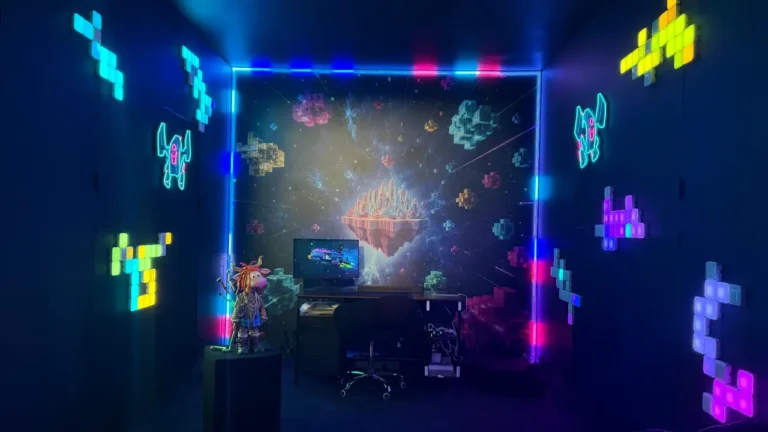
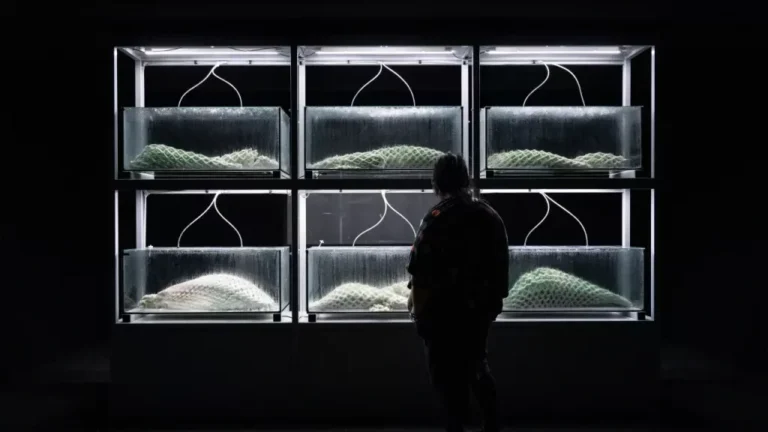
It is also why the lab insists on pairing presentations with prototypes. “That has always been the concept, to make the project more tangible and clearer in terms of what it could become”. Because many of these works are abstract by nature, “by combining the presentation with the prototype experience, we hope to offer something genuinely complementary”.
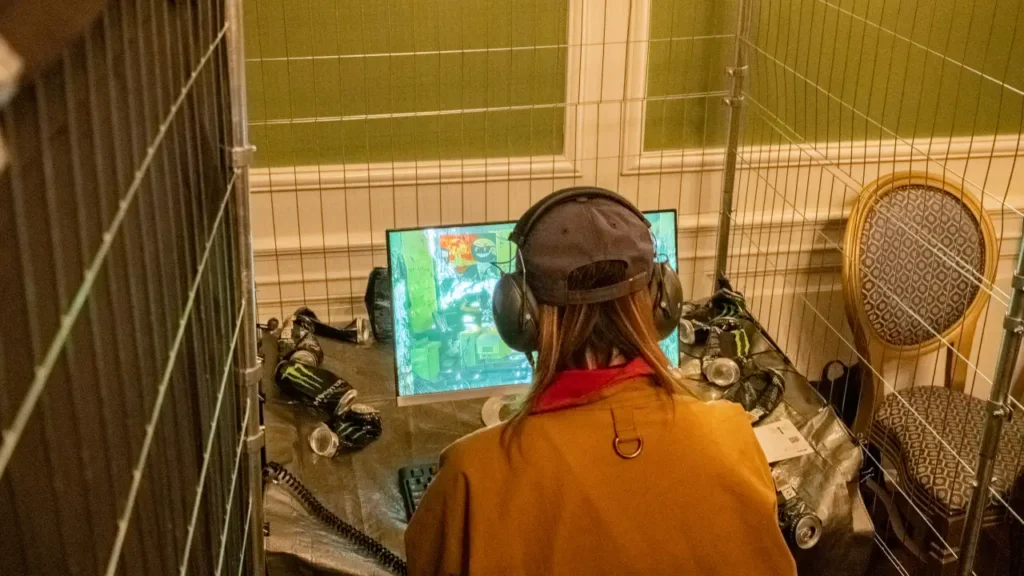
That felt true to me as well. Even when a prototype is still far from its final form, it gives you a way into the creators’ minds, and so can the conversation that happens around it. This year, for instance, I observed people playing a social game while locked inside a cage in All Exit, No Voice by Sylvia Rybak & Marco Winter: an unsettling setting, but also one that felt completely right for the work. Experiences like that are a reminder that what we call immersive does not begin and end with a headset or a screen, but often works by anchoring us more deeply in the space around us, while transforming it into something else. And then there was Playbook by Anja Tietze Lahrmann, Magnus Pind Bjerre and Rebekka Bohse Meyer, which became clearer to me through my conversation with its creator, as I began to understand not only the inspiration behind it, but also the research needs it still entailed and the kinds of connections that might help it move forward. In both cases, the encounter opened a door into the project’s logic, atmosphere, and way of thinking.
A lab in evolution
When I asked Stella whether each edition teaches them something about how to adapt the programme for the next one, her answer was immediate: “Yes, it does. I really value the fact that we keep trying to shake things up every year, because otherwise it risks becoming repetitive, even though in reality it never truly is. We also gather feedback, and I reflect on it on a personal level. It is important to me that we keep doing it better, in a more effective and better-structured way, while also staying connected to the reality of the world we are living in. We cannot simply create one programme and then keep repeating it unchanged. It has to remain in dialogue with the world around us and with the people taking part in it”.
The LAB is a moment of arrival, but also one of opening. What I carried away from this year, perhaps more than anything else, was that sense of the LAB as a space where unfinished ideas can still be shared without being flattened too quickly into judgment. Even when pitches are not perfect, and even when some questions remain open, what emerges is often a rare form of exchange: between people, between practices, and between visions that are still becoming. An exciting space to witness and, in some small way, be part of.