Astrea Immersive and Makropol are delighted to announce that END OF NIGHT is now available for Meta Quest 2 and coming to Steam.
David Adler’s critically acclaimed VR work END OF NIGHT, starring Jens Jørn Spottag, has so far only been available in Copenhagen and at festivals, but now it will be released worldwide. This will happen via the French VR distributor Astrea on Monday, May 8, which marks Victory Day in Europe over the Nazis.
Since its world premiere at the Venice Film Festival in 2021, where it won a Golden Lion for “Best Narrative”, ‘The End of the Night’ has toured prestigious festivals such as Cannes and Tribeca (NY), and in Denmark it even won the main prize for “Best International Debut” at Cph Pix Weekend ahead of a strong field of normal “flat” films.
The online release means that ‘The End of the Night’ can now reach all those who didn’t make it in the first place – including the 10% of Danes who, according to the Danish Film Institute, have VR glasses at home. The idea that people will now be able to share the experience at home and abroad, across generations and physical distances, delights Danish director David Adler:
The challenge of creating narratives in new media is that it is often more difficult to meet and connect with an audience. That’s why I’m particularly pleased that ‘The End of the Night’ is now so widely and launched on the anniversary of the surrender of the German troops. Hopefully, this means that we can start a conversation – across backgrounds, cultures and distances – about some of the heavy and unfortunately eternal topics dealt with in ‘The End of the Night’; about what makes people flee and how the traumatic flight is subsequently stored in the body and inherited through generations.
David Adler
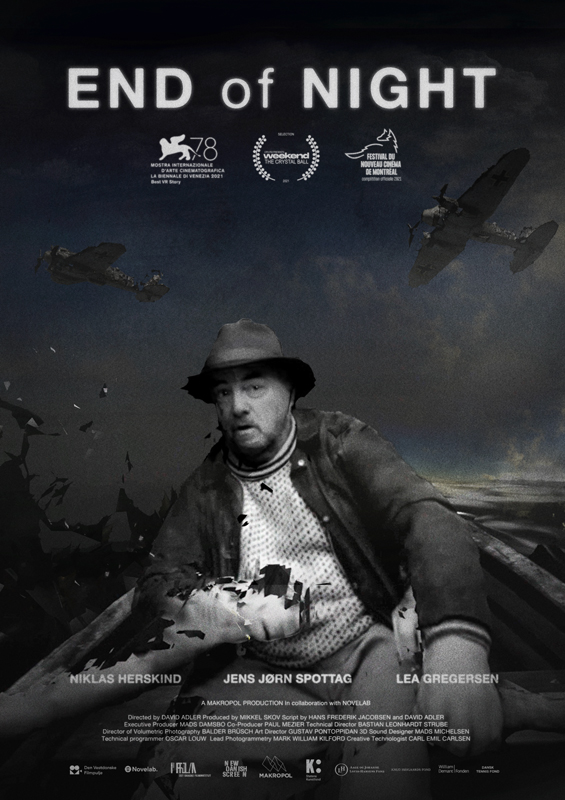
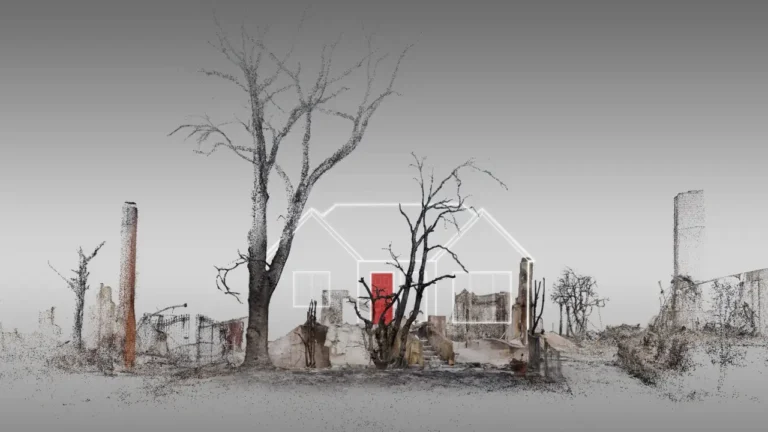
With a running time of just under 50 minutes, ‘The End of the Night’ belongs to the genre known as “narrative VR” – a kind of VR that, as the name suggests, focuses less on the interactive element and more on the narrative. Buoyed by Spottag’s intense performance as Joseph, ‘The End of the Night’ stands out from the crowd with its expressionistic, glitchy, black and white aesthetic that mirrors the porous nature and gradual dissolution of memory.
This is the first time that a Danish narrative VR work has achieved this level of dissemination. For this reason, everyone involved is excited to see how ‘The End of the Night’ will be received on a platform where cinematic experiences do not dominate, say the producer couple behind the production:
END OF NIGHT has from the very beginning been driven by a desire to create a complete cinematic narrative that utilizes the VR medium’s ability to lead the audience deep into the experience. Here, the audience is literally in the same boat as the main character, and it’s a unique way of telling a vulnerable story because it becomes a physical memory in the body. We believe that END OF NIGHT, in its ambitious format, points the way for the future of cinematic storytelling.
Mikkel Skov and Mads Damsbo
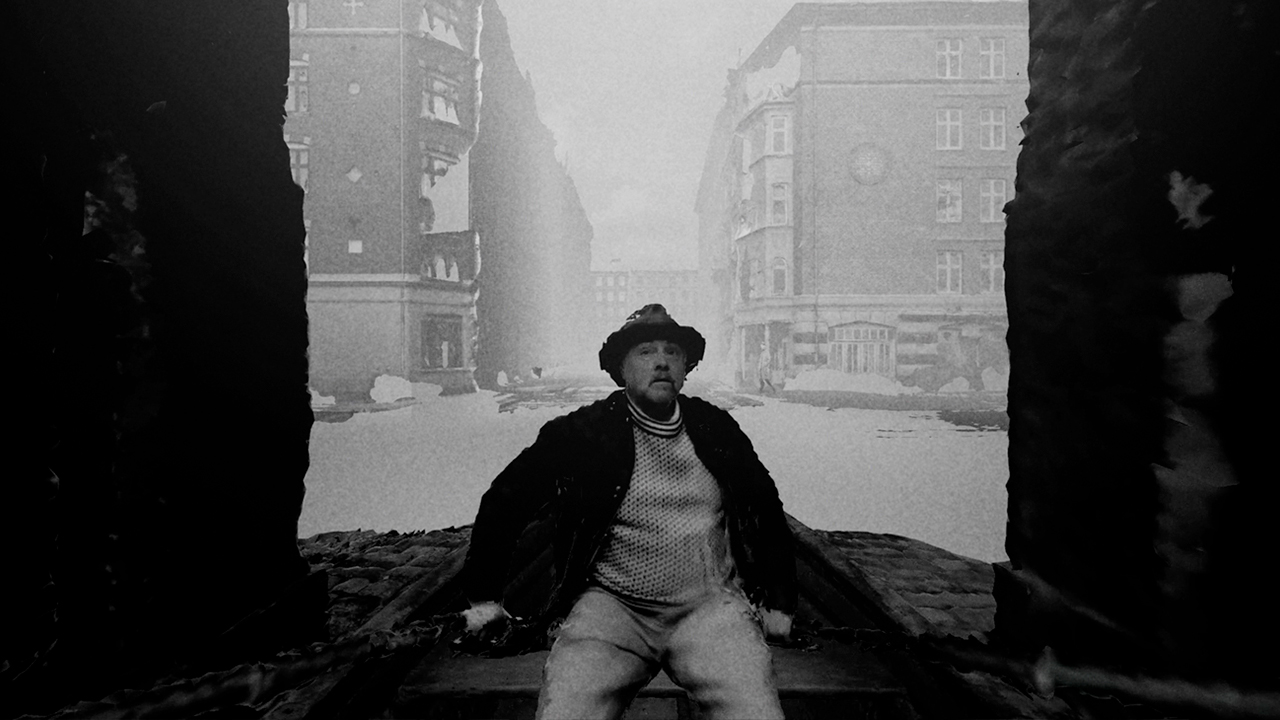
In END OF NIGHT, the audience finds themselves in a rowboat surrounded by darkness. Here they come face to face with Josef (Jens Jørn Spottag), who takes them on a sensory journey through his fragile memories of the fateful night in 1943 when he fled Nazi-occupied Denmark for safety in Sweden.
The work features an artistic blend of advanced technologies (photogrammetry and volumetric video) that merge into a flickering, collage-like 3D universe. Although the work is realistic in its depiction of war-torn Copenhagen, and based on real accounts of the occupation, the story is fictional – based on an original script specifically for the VR medium, written by David Adler himself together with Hans Frederik Jacobsen.
The app will also include extras where director David Adler talks about the making of the film. END OF NIGHT can be experienced in the original Danish and English, as well as subtitled in French, German and Hebrew.
END OF NIGHT is available in the Oculus App Lab and on SteamVR from May 8th at €2.99 and coming later to Steam.