If you have been part of a VR festival lately, you didn’t miss Faber Courtial messages from space. 2ND STEP and their latest VR film 1ST STEP are widely selected worldwide. We spoke with Maria Courtial, co-director of these projects, about their writing process and their successful way of sending us amongst the stars.
Creating the experience of space with 1ST STEP
Maria Courtial – We started 2 years ago with 2ND STEP, a VR film about future space missions For this purpose, we searched through a lot of satellite images from current cameras circling around the Moon. There is a lot of data to explore! It was very helpful to set up the textures, lights and details about the environment for the production of 2nd Step.
M. C. – When we decided to produce 1ST STEP, we only had 4 months (we planned to launch the film at the 50th anniversary of the first steps on the Moon) – which is not much time – but luckily we already had all this data and we knew how to deal with space in VR. A tricky issue because of the wide and infinite space and the risk that it looks like a wallpaper inside the headset due to the – still – low resolution. There isn’t anything which can be smaller than a pixel, by definition. But we used a trick and gave the pixels different colors (black, white, grey) depending on their actual size, to have a better feeling of this infinite space.
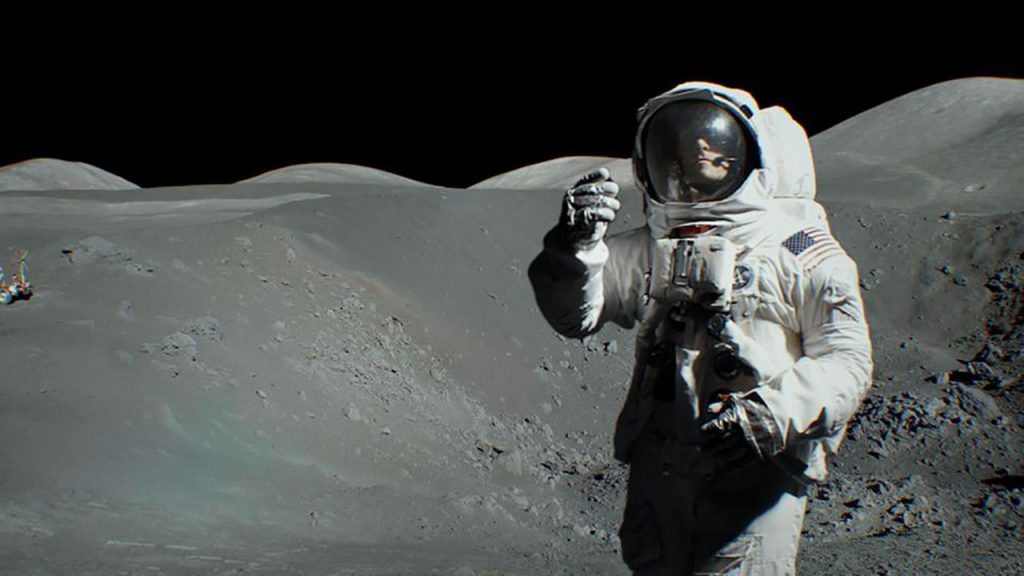
M.C. – Another important source of data came from NASA, of course. Luckily, they offer everything for free: you can download all kinds of archive photos and create stitched panoramas – NASA also provides the exact camera position of the astronauts who took the photos. So, we were able to work around those famous places and landscapes to create everything in 3D.
M.C. – In the beginning, 1ST STEP tells the story of Apollo 11, but then we go all the way to the Apollo 17 mission. This one offers more spectacular landscapes! We positioned our virtual cameras at the original places and projected the panoramas at our gathered altitude data. A real digital Heureka! Everything fitted perfectly and was another proof that the astronauts were actually on the moon.
Being in virtual space – a real feeling
M. C. – We always try to create things as realistically as possible. Watching our first created VR Moon shots was the utter confirmation for me why we needed to create these stories in virtual reality. It’s the ultimate way to feel like being in space while actually standing on earth. In 1ST STEP, there are spatial details that you cannot see on a plain photo, but that become perceptible in VR and 3D. When standing e.g. at Tracy´s Rock you discover a slope behind you, exactly where an astronaut stood at that time. That is why a realistic implementation is so important.
1ST STEP: building a story in 3 parts
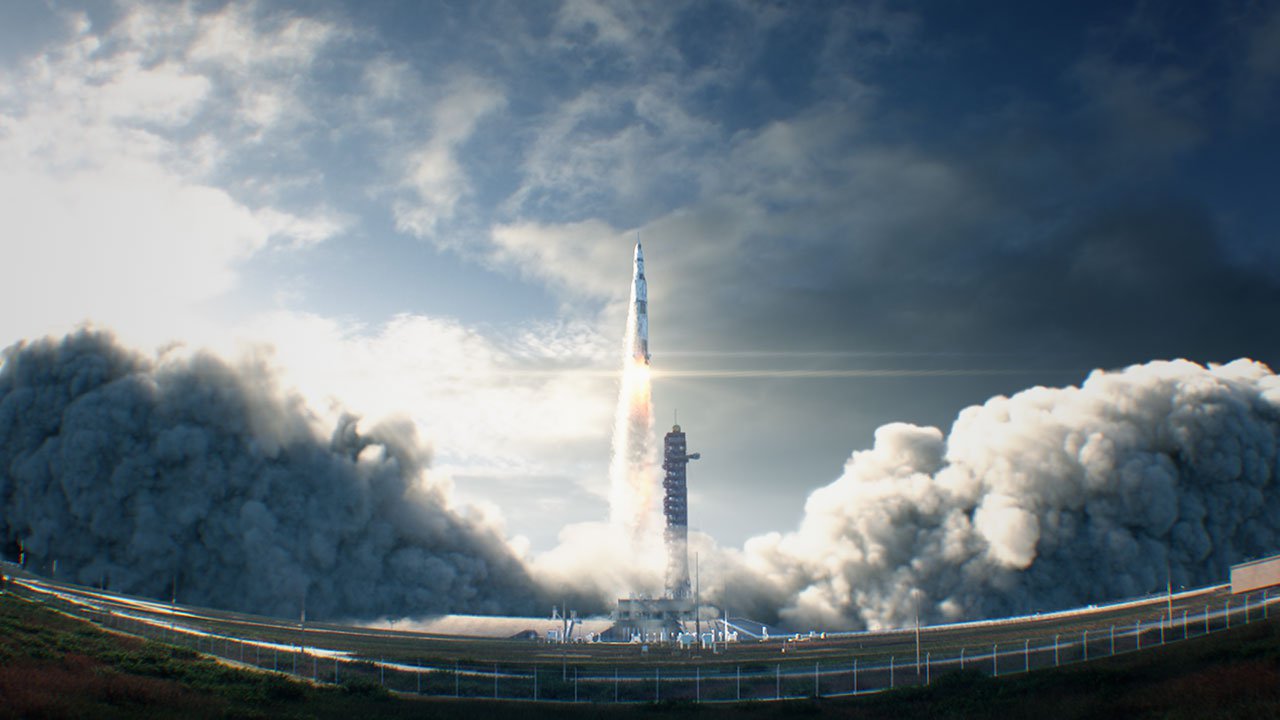
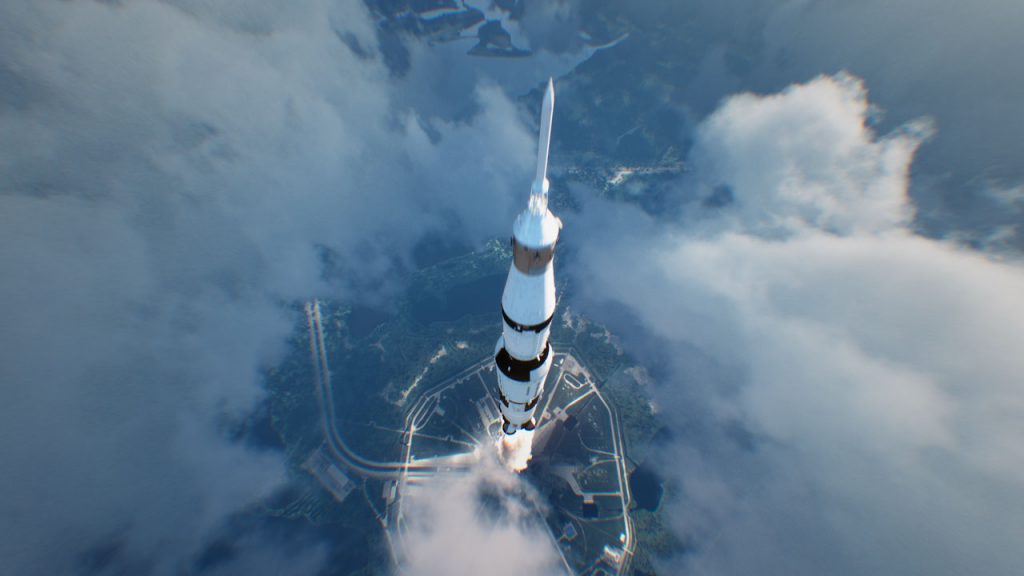
M. C. – From the beginning, we knew the frame of the story (it’s actually quite apparent), from the launch of the rocket to its fortunate return. Of course, there is a process of writing the whole piece and of defining the different perspectives. Yet, we weren’t sure which of the 6 missions we would like to have in the film. Apart from that we tried a lot of things, changed the order and the lengths of the shots and many preview shots that didn’t make it into the final film. Whereas others turned out right from the beginning. For example, the escalator rising up – a great feeling as if you were really in there, facing the rocket in front of you, feeling the excitement shortly before the start.
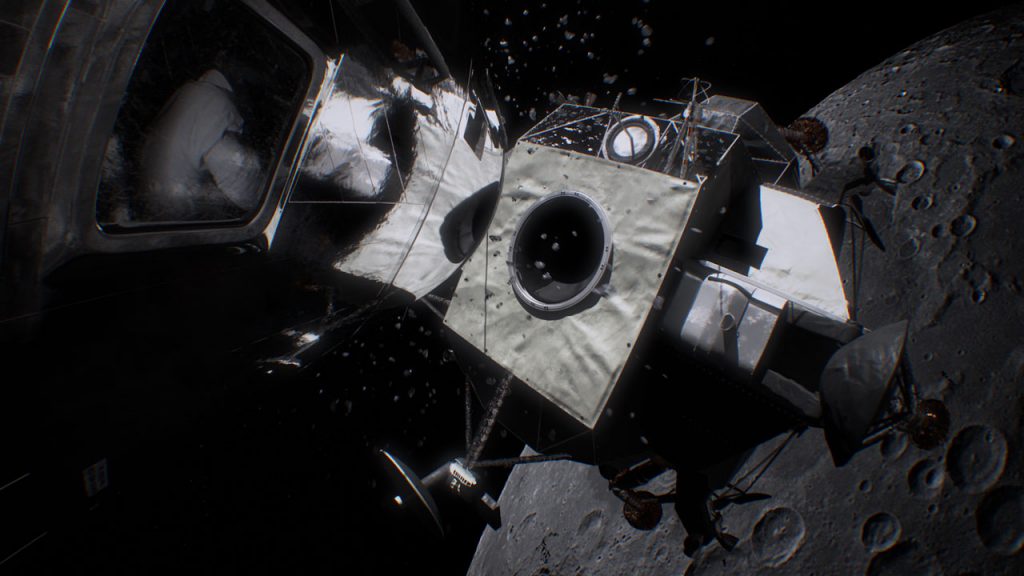
M. C. – Other things didn’t work out. For instance, after the launch we wanted the rocket to be seen as a “small finger” appearing through a sea of clouds. But we were disappointed when watching the preview.. So, my husband and co-director Joerg had the idea to create a special view. You have to look down through a cloud hole to watch the rocket coming towards you. Nobody will figure that out when first watching the film, but, why not, it’s worth watching it again. And selecting the two most spectacular panoramas of Apollo 17 was one of our last big content decisions. Combining the created 3D panoramas with a realistically built foreground generates an intense “like being there feeling”.