
“ I would like to offer more freedom to the user” – Charles Ayats (THE SCREAM VR, 7 LIVES)
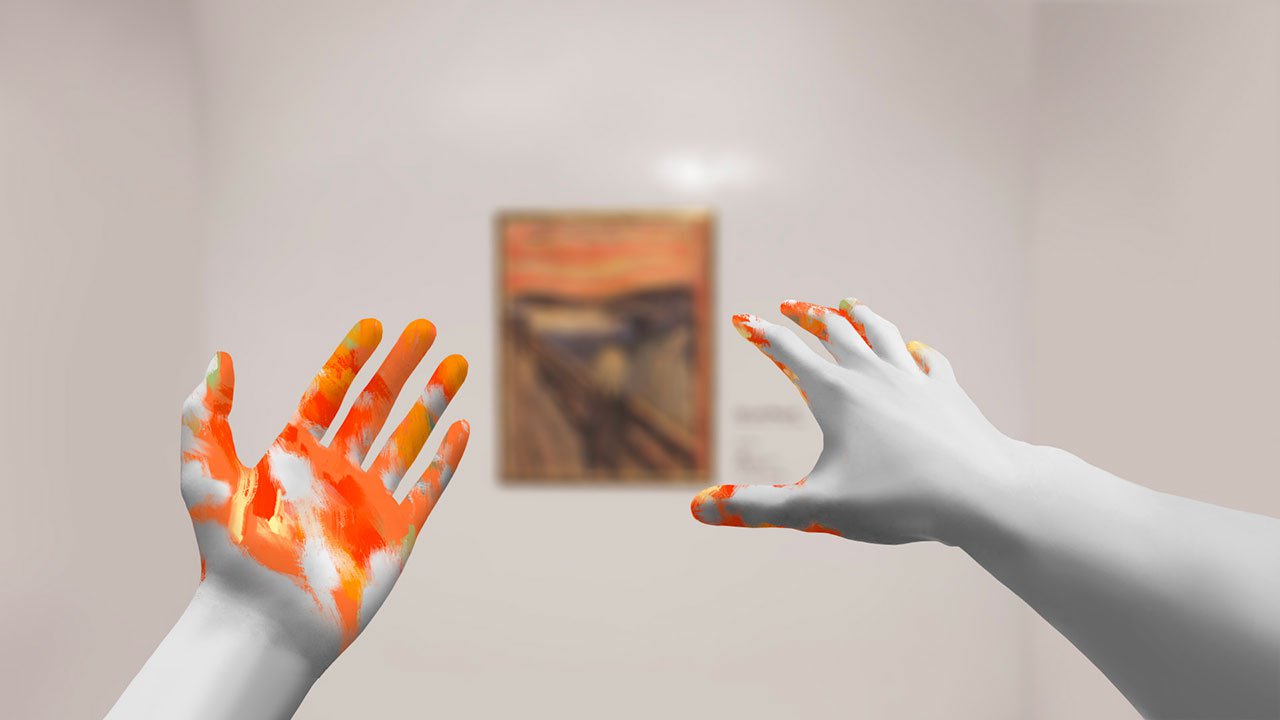
Since then, his passion for videogame and storytelling leaded to innovative and complex experiences. With THE SCREAM VR (co-created with Sandra Paugam) and 7 LIVES (co-created with Sabrina Calvo) released last year, he offered confirmation that interactive stories need more challenges.

Living the festival life

C. A. – I had the experience of SENS VR in 2016, where I really discovered which festivals and audiences could be interested in immersive contents. At this time we were like strange people travelling with our sophisticated hardware. It was always a surprise! Today the industry is much more important and structured, especially with companies like Diversion, places reflecting on scenography like Phi Center in Montreal. And of course you have to consider the work of festivals like Venice VR, where you can be invited with a prototype if you present an innovation, but where the festival does not pay for installation.

C. A. – There is now a real, positive ambition to work on immersion through scenography, the attractiveness of LBE experiences, but it is expensive to deploy. Opposite, 360 videos circulate much more easily in the same circuit of festivals and events, with the same conditions – except for a few sporadic aids. Between interactive or linear projects, the financial investment on tour is not the same. For me it can be a brake on the creation of interactive, immersive room scales (off screen).

C. A. – For 7 LIVES, we had imagined a fairly simple, transportable, inexpensive scenography. More recently on LE CRI VR we wanted room scale, with sets to explore. But we had to return to a simpler device to offer the project to the greatest number. And also target a distribution on the blinds. Interaction had to be planned for that.

C. A. – There is a lack of a technical standard for VR. At Ubisoft, they anticipated this by imagining all their experiences in 2 meters by 2 meters. But I would like to offer travel to the user to offer more freedom and involvement. This is especially the VR medium. Thinking about writing for distribution doesn’t exist anywhere else. In the cinema, we know that the work arrives on the big (or small) screen. We mainly think about the content. In VR, I was able to exchange views during VR Arles workshops where young VR creators were not aware of the medium for which they were writing. You have to think about it very early in development.

C. A. – For 7 LIVES the room scale didn’t make much sense. The project is above all dedicated to a cognitive exploration, largely passive. Anyway, we designed it like that. There was no connection to the body.

C. A. – I notice that since 2016 there has been a problem: the lack of a real press on major events, whether Venice or Tribeca. There are few specialist journalists, but in addition access is very limited. With SENS, 4 years ago, we had more spin-offs because the media could more easily see the works. On 7 LIVES, it was more complicated. We have the chance to participate in festivals with very famous cinema personalities, but VR remains on the margins … At Tribeca we had the chance to meet Hideo Kojima, but it is we who are going to get it!

XR: where to go?

C. A. – We are gradually getting closer to the video game sector. In terms of distribution it is very similar, and the bestsellers VR are video games: BEAT SABER, VADER IMMORTAL, SUPERHOT… We have a very direct approach to the LBE, the arcade, to get the public and sell tickets. There is already an existing model, to be specified. For me the multi-player is very attractive; we avoid helmet isolation, we can collaborate. It’s more attractive to the general public. VR_I by Gilles Jobin, it’s particularly attractive, unfortunately it is very expensive.

C. A. – AR is also coming, but it’s still fragile. It takes another 5 years – in my opinion – for the technology to be mature. You have to think about the light, the smartphone, the sound management: as long as there are no AR glasses, it is limited. We can imagine things with HoloLens or Magic Leap certainly, but these are primarily industrial products for the moment. Today I’m more interested in machine learning technologies to help storytelling. Or immersive theater which has a lot to offer VR / AR!

@ Dabatase

Leave a Reply

@ Magazine

“We are now thinking about the philosophy behind VR and the stories we want to tell with it” – Uri Kranot (WE ARE AT HOME)

After its success at the Tribeca Film Festival and NewImages in Paris, WE ARE AT HOME, by filmmakers Michelle and Uri Kranot, entered the Inter:Active section of CPH:DOX 2022, which recently ended. An in-depth look at this work for those

“It deals with the thrill of adventure but also the acknowledgment that our bodies are ageing” – Shehani Fernando, William Trossell (BURIED IN THE ROCK)

A pioneer of immersive creation, Shehani Fernando was for many years a producer of innovative current affairs content for the Guardian, the BBC and Al Jazeera, before moving into spatial storytelling to direct her own projects. Each time tackling societal

Review⎪Sundance New Frontier 2022: on bearing witness and taking responsibility

For the second year in a row, the 2022 Sundance Film Festival has gone all digital. Following a successful 2021 edition that saw the regular number of festival goers increase from 13,000 people to about 40,000, this second edition brought

“It may seem trivial to let the user free of his choices, but in this world it’s not” – Tim Jones (PEAKY BLINDER’S: THE KING’S RANSOM)

Discussion with Tim Jones, co-director of PEAKY BLINDER'S: THE KING'S RANSOM, one of the biggest expectations of Venice Immersive 22.

“VR TO GO allowed us to conquer new audiences” – Myriam Achard (Phi Centre)

A place of cultural excellence in Montreal, the Phi Centre had a special year (as did everyone else) but did not lose its taste for innovation and curiosity, even in times of pandemic. Participating in September as a satellite venue

Poetics and the New Opening of Greece’s Immersive Scene

In this conversation with Byron Chrysovergis, founder of Poetics, what emerges is not the portrait of a market already in place, but of a country where new openings are starting to appear for immersive exhibitions. Greece does not yet have